
Search myodfw.com
Showing 441 - 460 of 849 results
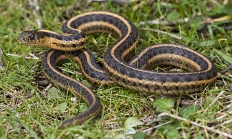
This highly aquatic snake is found in wet meadows, riparian areas, marshes, and moist forests near rivers, streams, lakes and ponds. It requires streams with thick riparian vegetation for escape and exposed boulders for basking. The Pacific coast aquatic garter snake takes aquatic prey such as small fish and fish eggs, salamanders, tadpoles, frogs, toads, earthworms, and leeches. Photo by Simon Wray, ODFW
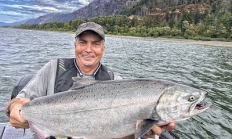
CLACKAMAS, Ore. – The two-rod validation will not be available for the Willamette River in 2026 as the forecast for hatchery-origin adult fish does not meet the minimum return threshold. The 2026 Columbia River spring-summer forecast anticipates 43,700 adult Willamette-origin spring Chinook will return to the mouth of the Columbia…
Fish counting through Willamette Falls fishway occurs at the main viewing window. Video cameras and time lapsed video recorders are used to record fish passage 24 hrs/day, 365 days/year. Our schedule for reviewing the tapes is Monday through Friday.
An Oregon native, sooty grouse occupy the coniferous forests of western Oregon, the eastern slopes of the Cascades, the Blue Mountains of northeastern Oregon, and the Klamath Basin and South Warner Mountains. Preferred habitat includes timber edges, open timbered slopes and mountain meadows, often adjacent to springs or other sources of water. They are often associated with berry producing areas such as chokecherry thickets. Hear the call of the sooty grouse Photo by ©Keith Kohl, ODFW

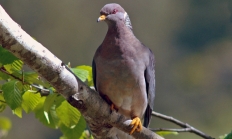
About the size of the domestic pigeon, this swift-flying species is popular among sport hunters. An arboreal bird, it is often observed perched alone on top of a tall tree or in flocks when flying about feeding areas and mineral sites. This is a common summer resident in forested areas west of the Cascade crest. It typically nests in forested mountain areas in the west Cascades. Hear the call of the Band-tailed pigeon Photo by Dave Budeau, ODFW
The bushy-tailed woodrat is a large rat-like mammal; its squirrel-like tail unique among members of the genus, is gray above and whitish below. The dorsum is buffy gray to dark brownish-black and the venter is white to buff depending on the geographic race. It occurs, statewide in a wide variety of habitats. It is active nocturnally. Sometimes, upon leaving the protection of its den, the woodrat may lie motionless on a rock or limb, watching for a long period before moving forth. Photo from ODFW


This salt-loving bird is possibly the most abundant grebe in the world. These grebes nest in the large, tule-fringed marshes of southeastern Oregon. They also use almost any open water for feeding after the breeding season. The eared grebe has been reported breeding in nearly every eastern Oregon county, but principal breeding areas are in Klamath, Lake, and Harney counties. It is local elsewhere east of the Cascades. Hear the call of the eared grebe Photo by Dave Budeau, ODFW

Along coastal shores and islands, the chatter and flight calls of Black turnstones invite an observer to look more closely at the rocky substrates to find these birds busily picking about in their search for food. They primarily use rocky shores, jetties, and offshore islands, but may also be found on shorebird flats and sandy beaches. The Black turnstone is a common transient and winter visitant on the coast. Hear the call of the Black turnstone Phogo by ©Keith Kohl, ODFW

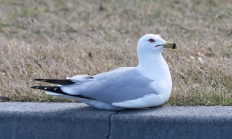
This is a colonial species that uses rocky islands or spits in large freshwater marshes, lakes, and rivers for nesting. It may fly at least five miles from the nest to forage in marshes, rivers, pastures, or other open habitats. There are colonies of Ring-billed gulls at marshes of southeastern Oregon and on islands in the Columbia and Snake rivers. There has been a colony near Baker City for over 20 years. Hear the call of the Ring-billed gull Photo by Kathy Munsel, ODFW
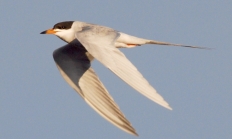
Terns are generally associated with marine environments and salt marshes, but the Forster's tern inhabits freshwater areas. During the breeding season this graceful bird is eastern Oregon's resident small white tern. Typical of terns, the Forster's employs a dramatic hunting method of plunge-diving into shallow waters to capture small fish, the bird sometimes submerging completely. This is an uncommon but highly visible colonial breeder east of the Cascades. Hear the call of the Forster's tern Photo by Dave Budeau, ODFW
World famous for its loud, persistent singing and mimic abilities, the Mockingbird is highly conspicuous. The white flashes in the wings and tail of this grayish bird identify it in flight. It is primarily a southern species that has, by taking advantage of the environmental changes brought about by the ever-increasing human population, expanded its range northward in recent years. In many parts of the country it is a familiar bird of residential neighborhoods. Hear the call of the Northern mockingbird Photo by ©Keith Kohl, ODFW

Bringing its cheerful song to streamside thickets throughout the state each breeding season, the bright and active Yellow warbler seems to be the incarnation of summer. Notable for its vivid color, it has been described as a "rich yellow flame among the opening leaves." It was once the most conspicuous breeding warbler in Oregon and was formerly common in shade trees of urban areas, including western Oregon, but has declined precipitously. Hear the song of the Yellow warbler Photo by ©Keith Kohl, ODFW

The Common yellowthroat is one of North America's most widespread warbler species and its witchity-witchity-witchity song is also among the most easily recognized. This skulker may breed in any suitably damp brushy or weedy habitat throughout the state, and can be abundant in extensive marshy habitat. They are rare in winter in western Oregon in interior valleys and along the coast. Hear the song of the Common yellowthroat Photo by Kathy Munsel, ODFW

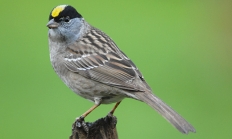
Flocks of these big, brown, plain sparrows are a common sight in winter in western Oregon. By early spring their faded head markings become a beautiful gold, black and white, and their plaintive descending songs become frequently heard from almost any large brush pile. They are an abundant migrant in western Oregon, less common farther east, and abundant in winter throughout the Willamette Valley. Hear the song of the Golden-crowned sparrow Photo by Dave Budeau, ODFW
The brush rabbit rarely ventures more than a few meters from the extremely dense brush that constitutes the requisite component of their habitat. Runways are interlaced through brushy clumps into surrounding grassy areas and are kept clear of vegetation for easy and quick access to and from foraging areas. In Oregon, the brush rabbit occurs in the Willamette Valley and other interior valleys, in coastal areas, and in valleys along coastal streams from the Columbia River south, and from the foothills of the Cascade Range west. Photo by ©Keith Kohl, ODFW

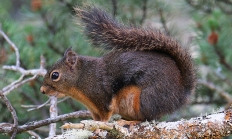
The Douglas' squirrel is one of the smaller tree squirrels in Oregon. The color and markings of this squirrel differ individually, geographically and seasonally, appearing a dusky olive to brownish gray with an indistinct band of reddish brown with a blackish band along the flanks. In Oregon, it occurs in coniferous forests from the Pacific coast to as far east as western Baker County. Douglas' squirrels are active during the daylight hours year-round, although they may remain in their nests or tree dens for a day or two during inclement weather. Photo by Kathy Munsel, ODFW
Adult Northern leopard frogs have smooth skin that is green or brown and covered with dark brown spots outlined with white rings. Females grow to just over four inches in length; males are slightly smaller at just over three inches. They live in and near various water sources with abundant vegetation such as wet meadows, marshes, riparian areas and moist, open woodlands. These frogs use the vegetation, such as grasses, sedge, weeds or brush, as cover from predators. During the winter, they need ponds or slow-running streams for hibernation. Photo from ODFW
