
Search myodfw.com
Showing 461 - 480 of 903 results
Oregon's diverse habitats and terrain offers something for every hunter. From the densely forested Coast Range to the expansive sage steppe of the Great Basin, hunting opportunities are practically unlimited. Visit e-regulations

Need to figure out controlled hunts, find a place to clam, learn how to fish or get directions to a wildlife area? We've got information on all that and more, straight from ODFW biologists and other accomplished hunters, anglers and wildlife watchers. Header image by Dave Budeau

Vireos and shrikes are predatory song birds. Their bills are strong and hooked to kill and dismember prey including insects and small birds, mammals and reptiles. These birds hunt from fences, wires and treetops and sometimes hang captured prey on thorns to eat them later.

This species breeds in upland deciduous and mixed forests with dense understory from southeastern Canada south to Georgia. It winters in the Caribbean and Middle America and casually in the United States. It migrates primarily along the east coast and regularly in small numbers along the west coast. It is rare but regular in Oregon during the fall from early September to mid-November. Hear the song of the Black-throated warbler Photo by Kenneth Schneider, Flickr

This winter visitor is a study in gray and tan, with a small dark spot on an otherwise gray breast, dull rufous stripes on the side of the head and crown, and brown wings with distinct white stripes. Tree sparrows visit Oregon only in winter, mainly in lowlands within the Blue Mountains and Owyhee upland regions with a few farther west in some years. They frequent willow clumps in grassy areas and occur occasionally at feeders. Hear the song of the American tree sparrow Photo by Eric Began, Flickr

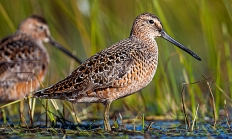
These chunky medium-small shorebirds are quite colorful in oranges and browns during most of their time in Oregon, where they are found mainly along the coast and locally in muddy areas inland. Their feeding motion has been likened to a sewing machine as flocks move slowly through shallow water and wet mud, probing with long straight bills. They are occasionally seen in marginal areas such as flooded pastures, but less likely than Long-billed to use such upland locations. They are a common to locally abundant coastal migrant, less common and more local in western interior valleys, and rare bur regular…
Look here to find out how waterfowl counts this week compare to years past.

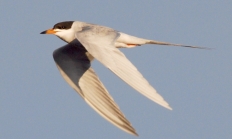
Terns are generally associated with marine environments and salt marshes, but the Forster's tern inhabits freshwater areas. During the breeding season this graceful bird is eastern Oregon's resident small white tern. Typical of terns, the Forster's employs a dramatic hunting method of plunge-diving into shallow waters to capture small fish, the bird sometimes submerging completely. This is an uncommon but highly visible colonial breeder east of the Cascades. Hear the call of the Forster's tern Photo by Dave Budeau, ODFW
The Landowner Preference Program (LOP) was established to acknowledge the contribution of private lands to support wildlife and provide a form of compensation to landowners for resources used by wildlife. Tags are available to landowners, family members, and others designated by the landowner based on the acreage owned. Pronghorn hunts are only available to landowners and family members. Recipients of LOP tags may only hunt on the property for which they are registered. step-by-step instructions Create Landowner Account
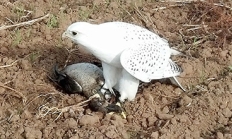
This is a large and power falcon. The majority of Gyrfalcons seen in Oregon are immatures or adults of the "gray" type, but there are several reports of "white" birds. The Gyrfalcon is a regular winter visitant to Oregon. The majority of sightings come from coastal and Willamette Valley lowlands near waterfowl concentrations. Individuals have been seen chasing and feeding on geese, ducks and gulls. Gyrfalcons forage by flying low over the ground and flushing prey, then often giving spectacular tail chases. If a bird refuses to flush the hunt is usually unsuccessful. East of the Cascades it occurs around…
The majestic trumpeter swan is the largest of our native waterfowl and one of the heaviest flying birds in the world with males sometimes exceeding 30 pounds. Historically hunted to the brink of extinction, it was recognized as an endangered species long before there was an Endangered Species Act, and its recovery is a conservation success story. The adult's snow-white plumage with contrasting black bill and feet and 8-foot wingspan define this magnificent bird. Their neck is as long as their body and is used to reach food at the marsh bottom. In spring, the trumpeter swan is a locally…

This long-distance, relatively late-arriving migrant to Oregon is associated with shrub-dominated habitats, especially riparian willow thickets. The plumage has subtle tones of olive-green and gray; the species is without a visible eye-ring but the characteristic sneezy, abrupt song reveals its presence. The Willow flycatcher breeds in western Oregon from sea level along the coast and interior to above 5,000 feet west of the Cascades summit. In eastern Oregon it breeds mostly above 1,000 feet from Klamath to Burns and also Lake County and Union County. The habitat of breeding Willow flycatchers is characterized by dense shrubs and/or tall herbaceous plants…

SALEM, Ore.—Oregon's Fish and Wildlife Commission meets April 23-24 in Lincoln City. View the agenda online. Commissioners will visit coastal coho habitat restoration and monitoring projects in the Siletz River Basin during a field tour on Thursday. To join the tour, meet at the Shearwater Inn, 120 Inlet Court at…