
Search myodfw.com
Showing 521 - 540 of 897 results
In quiet backwaters and wooded wetlands, these stunning ducks can occasionally be seen skulking near the shoreline as they search for fish. The male with a striking black head and extensible white crest, white breast, black back, and chestnut sides is truly a sight to behold. Females and immatures are quite plain by comparison: dull grayish-brown except for a reddish brown crest. Hooded mergansers are surprisingly secretive and local during the breeding season. They breed locally throughout the Willamette Valley west to the coast and south to Coos County. They are casual from April to early October in the Umpqua…

The American badger is a medium-sized, powerfully built carnivore strongly adapted for digging. The body is flattened and the legs are short but stout; the toes of the forefeet are partly webbed and equipped with long, curved claws; the hind feet are shaped like miniature shovels; and each eye is equipped with a membrane that can be extended to cover it. The ears are rounded and densely covered with fur but seem large in comparison with those of many digging mammals. The tail is short and brushlike. Dorsally, the long, shaggy pelage is mottled grayish blending on the venter to…

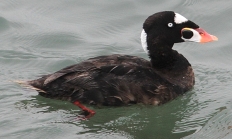
Features: Adult males' plumage is black except for white patches on the forehead and nape. The most distinguishing feature is the bill, a swollen white, red-orange, yellow, and black wedge. This highly visible standard advertises male's presence for up to a mile. Dark-billed adult females and subadults are dark brown above and paler brown below, with two indistinct light patches on the cheeks and sometimes on the nape Habitat: The surf scoter does not breed in Oregon but is abundant on salt water along the coast from fall through spring. Look for surf scoters in the Columbia River estuary and…

NW Fishing June 24, 2026 Trout season opened in the Northwest Zone streams on Friday, May 22. See the regulation booklet for limits, open areas, and bait restrictions. Cutthroat trout are present in almost all areas open to angling and sea-run cutthroat are starting to come into tidewater. Spring Chinook are in the Lower Columbia Tributaries with a few fish being caught in Big Creek, Gnat Creek, and the Klaskanine River. Fishing has been hit and miss with moderate effort, and these small tributaries are getting low. Spring Chinook fishing is going in Tillamook Bay, Nestucca Bay, the Trask River…
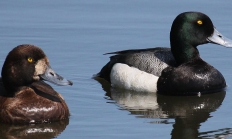
Features: Greater scaup are almost the size of redheads. In hand, they are easily distinguishable from lesser scaup by size and by the white wing stripe extending beyond the secondaries into the primaries. In the field, the two species can be difficult to separate. Drakes are black on both ends and white in the middle. Although not extremely reliable, in good light, generally the black head of drake grater scaup have a green sheen, while the head of a drake lesser scaup have a purple sheen. Hens are dark brown with a white mask around the base of the bill…


This is the largest native quail in North America and one of the least understood. Males and females have identical plumage characterized by distinctive white flank barring and prominent vertical head plumes. Their eastern Oregon range appears reduced from historical accounts. Mountain quail are considered occasional in Union and Wallowa counties. They have also been observed along many of the tributaries of the John Day River in Wheeler and Grant counties and some in Wasco, Jefferson, Deschutes and Crook counties. In western Oregon, they are found in most forested mountainous areas generally above 1,640 feet, but may move to valley…

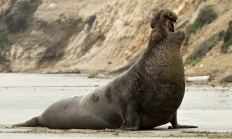
The Northern elephant seal is the largest pinniped carnivore that occurs along the North Pacific coast. The flippers are relatively small, the rear ones directed posteriorly. Its most distinctive feature is the elongated tubular proboscis with a deep transverse cleft among adult males. This proboscis can be inflated and directed into the open mouth to produce vocalizations. Also among males, the neck and chest lose most of their hair and the skin becomes rough and thickened at puberty. The adult pelage consists of course grayish or brownish hairs without any underfur. During the molt, not only is the pelage shed…
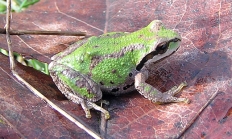
Adult treefrogs have a dark mask that extends from the tip of the nose across the eyes to the shoulders. Coloration varies between individuals, ranging from green or reddish to brown or gray. Most have dark blotches along their sides with light colored bumpy undersides. They have special skin glands that produce a waxy coating to keep their skin moist. Male treefrogs have a dark gray, inflatable throat pouch during the breeding season. As the smallest frog species in Oregon, adult Northern Pacific treefrogs only grow to two inches in length. During the non-breeding season, this treefrog is found in…
Bandon Hatchery was constructed in 1925. Various renovations have taken place since original construction and more are planned for the future. The facility is used for adult collection, egg incubation and rearing of both natural and hatchery fall Chinook, winter steelhead, and trophy-sized rainbow trout.
Alsea Hatchery was constructed in 1936 and is operated with state funds. Many improvements have been made to the hatchery since original construction. The hatchery produces both winter steelhead and rainbow trout. The facility is used for adult collection, spawning, egg incubation and rearing of winter steelhead, and egg incubation and rearing of rainbow trout.
The present facility was constructed in 1925, across the North Umpqua River from an earlier trout hatchery built in 1920. The hatchery was closed in 1975 due to low stream flows and high water temperatures, and was reopening in 1979 after extensive reconstruction. In 2012 a state of the art fish passage ladder was completed. It included a fish viewing window for Rock Creek basin fish inventory and a fish trap facility. The hatchery produces fall and spring Chinook, coho, summer and winter steelhead, and rainbow trout. The facility is used for adult collection, spawning, incubation, and rearing of Chinook…
Cole Rivers Hatchery was constructed by the US Army Corps of Engineers (USACE) in 1973 to mitigate for spawning and rearing areas blocked by the construction of Lost Creek, Applegate, and Elk Creek Dams. The hatchery was named in honor of Cole M. Rivers, a biologist on the Rogue River for 20 years. The facility is used for adult collection, spawning, egg incubation and rearing of spring Chinook, coho, summer steelhead, and winter steelhead, and egg incubation and rearing of fall Chinook and rainbow trout. Infrastructure Repair and Renovation Updates
Leaburg Hatchery was built in 1953 to mitigate for lost fishing opportunity because of the many dams on Willamette Basin rivers. These dams include Cougar, Blue River, Carmen-Smith, Lookout, Dexter, and others. The hatchery rears rainbow trout, summer steelhead and Chinook salmon, and has a staff of four employees. Come visit our show pond and see huge white sturgeon and rainbow trout. There’s a viewing platform built by the McLaren School for Boys in 1993 to allow visitors to get a close up look at spring Chinook salmon spawning in the creek below.
The Umatilla Hatchery began operation in 1991. The hatchery is used for egg incubation and rearing of spring Chinook, fall Chinook and summer steelhead.
Although the least numerous scoter on the continent, it is the most common scoter along the Pacific coast south of Alaska and winters by the thousands off Oregon. Adult males' plumage, black except for white patches on the forehead and nape, yields attention to the bill, a swollen white, red-orange, yellow, and black wedge feathered squarely along its base. The highly visible standard advertises male's presence for up to a mile. Dark-billed adult females and subadults are dark brown above and paler brown below, with two indistinct light patches on the cheeks and sometimes on the nape. A flattened head…
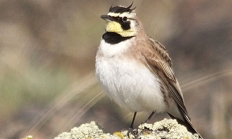
Wide open spaces generally surround these sparrow-sized, ground dwelling birds. The upperparts are mostly brownish and the underparts are generally buffy with varying amounts of yellow on the throat. There is black on the breast and side of the head, but the most unique features are small black "horns." Females and immature birds are duller. Interesting behavior includes aerial displays and "flight songs" during courtship, and the propensity to forage and loaf along dirt and gravel roads. In western Oregon, it breeds in small, scattered populations throughout the Willamette Valley, with concentrations in the central valley on and near Basket…
Features: The most distinguishing feature of white-tailed deer is the tail. Whitetails have long, wide tails that can easily be seen, especially when they are startled and raise their tails. White-tailed deer antlers differ from mule and black-tailed deer in that there is one main beam with points coming off. Mule and black-tailed deer have antlers that fork on the main beam. Habitat: White-tailed deer share the same habitat as eastern Oregon’s mule deer. Deer both graze and browse. Forbs and browse (stems and leaves of woody plants) are favored forage during the growing season. Grasses are consumed during some…

This dark colored salamander has a reddish-brown ragged edged stripe that runs along the top of the head to the tip of the tail with black or dark brown sides. It has a long body and tail and the belly is black with large white flecks. The Oregon slender salamander is a lungless salamander species, relying on its skin to breathe. Mature adults can grow to just under four inches in total length, with females about 12 percent larger than males. Oregon slender salamanders are most common in stable, moist old-growth (late successional and second-growth) forests where there are abundant…
