Search myodfw.com
Showing 561 - 580 of 1410 results
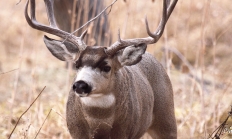
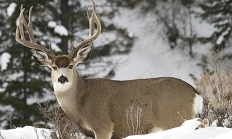
The mule deer is the larger member of the genus in Oregon. The ears are long, the metatarsal gland is surrounded by hairs similar in color but considerably longer than those on the remainder of the metatarsus, and the tail is short and constricted basally. Among adult males, the antlers are dichotomously branched with tines of approximately equal length. In winter, the basic pelage color is cinnamon buff. The chest is nearly black at the midline grading to grayish on the sides. The nose, sides of face, chin, and throat are whitish to pale buff. Spots of black occur immediately…

Coyotes, wolves and foxes are found throughout Oregon, depending on the species. The gray wolf, kit fox and Sierra Nevada red fox are Oregon Conservation Strategy Species. More about wolves in Oregon Report a wolf sighting

This colorful bird of coniferous forests and mixed woods is a common breeding species of eastern North America. It winters in the West Indies and Middle America and occasionally in California and the southern United States. It is a regular migrant in very small numbers in spring and irregular in summer and fall in the southwestern United States to California and Oregon and is occasionally found elsewhere in the West. The majority of Oregon records are from late April to late June, mostly from the east of the Cascades. Hear the song of the Northern parula Photo by Jeff Bryant…

For many, the rich, melodious song of the Black-headed grosbeak is the music of springtime in Oregon. The handsome males, with their bold pattern of cinnamon, black, and white, are among our most striking songbirds, and area familiar site in parks and gardens as well as in almost every forest type in the state. The buffy, streaked females are less conspicuous, but are also accomplished singers. The Black-headed grosbeak is a common to fairly common breeder and common migrant in forested regions throughout the state. Hear the song of the Black-headed grosbeak Photo by David Bronson

The Yellow-rumped warbler is perhaps the more familiar warbler in the state. Outside the breeding season, it can be found in almost any habitat from backyard trees in suburban areas to willow thickets in sagebrush country to the deepest coniferous forests. It maintains a presence in the state during the winter when most other warblers have retreated to warmer climates. The brightly colored male Yellow-rumped warblers regularly descend to lower branches as they dash after insects flushed from the foliage. Hear the song of the Yellow-rumped warbler Photo by David Bronson

This distinctive warbler breeds in deciduous and mixed forests from southeast Yukon, east British Columbia, across Canada and through the eastern United States. It migrates east of the Rocky Mountains to winter from northern South America north to the southern United States. It is a regular transient west of the Rocky Mountains with many more spring records than fall. Oregon spring records range from early April to mid-June. Fall records occur from mid-August to late-November. Hear the song of the Black-and-white warbler Photo by Howard Patterson, Flickr

This thrush-like ground-foraging warbler breeds from southeast Yukon and eastern British Columbia across Canada and through the eastern United States and locally elsewhere east of the Rocky Mountains. It migrates east of the Rocky Mountain to winter in Middle America. It is occasionally found in winter in its breeding range and in California. Small numbers regularly occur in western North America. Most Oregon records are from the southeast part of the state. Spring records range from early-May to mid-June. Fall records are fewer than in spring, and occur between late August and early September. Hear the song of the Ovenbird…

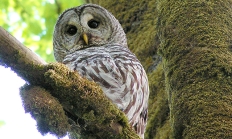
The Barred owl expanded its range from the eastern United States. It was first reported in Oregon in the early 1970s and has since spread to forested areas throughout most of the state. Sometimes confused with the closely related Northern spotted owl, the Barred owl is large with grayish-brown and white feathers and stripes on its chest and throat. It is easily distinguished from the Northern spotted owl by the pronounced horizontal barring across the throat and upper breast, and vertical brown streaks on the lower breast and abdomen. The Barred owl is now a permanent resident in forests of…
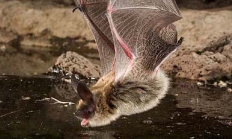
The long-eared myotis is pale brown to strawberry. It is a slow flier and hovers around trees and rocks to catch flies, moths and wasps. It is primarily a bat of coniferous forests in much of Oregon but may occur far from trees in shrub-steppe regions of the state. It forages in openings in dense forest, between the trees beneath the canopy in ponderosa pine, and over willow-bordered creeks. The species is known to enter dwellings and other buildings through open windows and doors, and to forage on moths therein. The long-eared myotis often day roosts in buildings, but may…
This medium-sized shorebird is the most common dowitcher in eastern Oregon and inland locations, where it sometimes gathers in large flocks feeding in shallow water. It is also the only dowitcher in the state that regularly winters. Although breeding plumage adults are reddish below and heavily patterned above, most birds seen in Oregon are duller postbreeding adults or browner immatures. During winter, when shorebirds are hard to find, a small flock of chattering dowitchers, even in plain gray basic plumage, often brightens a day in western Oregon. In migration, it can be found at almost any shallow water site in…

The Least flycatcher closely resembles the Hammond's flycatcher, but its distinctive voice and choice of habitat help to identify calling birds. It was formerly an unexpected vagrant west of the Rocky Mountains, but since 1981 it has become recognized as a regular migrant and local summer resident in the state. It is found in deciduous groves along streams and in wet lowlands. It desires a deciduous overstory with at least some low brushy undergrowth. It is regular migrant and local summer resident in the state of Oregon with the spring migration from May to mid-June. The majority of sightings are…

This small, dark-headed sparrow flashing white outer tail feathers is one of the state's most abundant species and one of the easiest to identify. When not nesting, the Dark-eyed junco might be seen nearly anywhere in the state. It is a regular visitor to city parks and neighborhood bird feeders. Most juncos occurring in Oregon show dark hoods, dull rusty-brown backs, and pinkish brown below the wings. Some are grayish, lacking much of the brown tones. They are most often observed in single-species flocks but individuals and small groups often join mixed wintering sparrow flocks. It is resident from the…

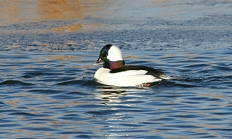
The bufflehead is North America's smallest diving duck, giving it the advantage of being able to nest in abandoned holes of northern flickers, a plentiful resource off limits to larger cavity-nesting ducks. It is a swift flyer and takes wing from water more easily and neatly than other diving ducks. Widely distributed throughout the state in winter, males attract attention with their striking white body, black back, and iridescent black head with a large notch of white; females and juveniles are dark charcoal-gray with a conspicuous white patch behind and below the eye. It is a local, uncommon breeder in…
The Turkey vulture, known locally as a "buzzard," is a common sight spring through fall throughout the state, except in the highest mountains and featureless desert expanses in summer where they are uncommon. Seeing Turkey vultures returning is a welcome sign of spring. Turkey vultures are large-winged soaring birds with overall dark plumage except for a silvery sheen on the undersides of the flight feathers. Adults have small, featherless, red heads, while juveniles have gray heads. The Turkey vulture is a common to abundant transient throughout the state and an uncommon to common summer resident except in high mountains. It…

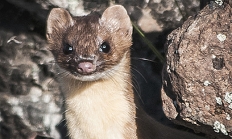
The Long-tailed weasel is the larger of the two weasels in Oregon, but smaller than the other member of the genus, the mink. Males are considerably larger than females. The head is flattened and somewhat triangular; the body and neck are elongate and almost cylindrical; the legs are short, and the tail is long. The summer pelage is brown dorsally; the venter is yellowish to orangish except for a white chin and sometimes one or more scattered brown spots. The tip of the tail is black. The pelage is molted twice annually. In the Cascade Range and eastward through the…
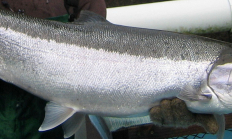
Oregon's 33 hatcheries produce about 40 million fish annually and you can visit them. They offer the chance to see fish – from eggs to brooders – and an opportunity to learn how they are raised. Oregon's hatcheries are important for anglers and the public because they directly provide fish for angling, help rebuild native fish populations, and offer educational programs. They are also vital to supporting the cultural heritage of Tribes. Hatcheries offer great wildlife viewing, interpretive displays and some provide boating and angling access. Did you know that ODFW rears 10 species of fish including steelhead/rainbow trout, brook…
The foothills of interior southwestern Oregon come alive in late April with the bold song of this bright yellow warbler. Here it seems every brushy area or mixed conifer/hardwood forest with dense undergrowth has at least one male singing just beyond the reach of binoculars. Although it can be found in many other places in the state and in a variety of habitats, nowhere else is it as common. Nashville's are one of the few warblers in the West to nest on the ground. They occupy diverse shrub communities, often including or adjacent to a relatively short or open tree…