
Search myodfw.com
Showing 621 - 640 of 1416 results
This is a large, pale bat with huge ears, large eyes and a dog-like face. Its wing beat is slower than most bats. It emerges late at night to feed primarily on the ground, eating large beetles, crickets, and even scorpions. Pallid bats can walk on the ground and are immune to a scorpion’s sting. The pallid bat is uncommon and is found mostly in arid regions in canyons in southwestern and eastern Oregon. It's an Oregon Conservation Strategy Species in the Blue Mountains, Columbia Plateau, East Cascades, Klamath Mountains, and Northern Basin and Range ecoregions. Photo by ©Michael Durham

The Northern shoveler's specialized bill earned it in the nickname "spoonbill" among waterfowl hunters. The drake is strikingly handsome with a dark head, white breast, reddish belly, blue wing coverts and an iridescent green speculum. Brown hens also have blue wing patches similar to that of the cinnamon and blue-wing teal. This duck is locally common in summer in eastern Oregon and uncommon in western Oregon. It is a common spring and fall migrant statewide. Hear the call of the Northern shoveler Photo by Kathy Munsel, ODFW

The canyon bat weighs less than one quarter of an ounce! Its fur is pale yellow to brownish gray with a dark face mask. It lives in eastern Oregon, likes rocky canyons and outcrops and flies early in the evening when it feeds on swarms of flying insects. Photo by ©Michael Durham

Piloted in 2014, the Tag Team program helps ODFW fish biologists better evaluate resident gamefish, bass, and stocked rainbow trout fisheries. It's also a chance for anglers to participate in fishery management and, perhaps, come away with up to $50.
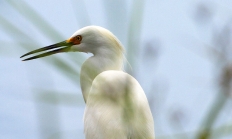
The Snowy egret is intermediate in size between Great and Cattle egrets, and much more common in Oregon than the latter. Adults have a black bill and legs and bright yellow feet; immatures show yellow on the back of their legs. In the breeding season, plumes are present on head and breast, and curve upwards on the back. The Snowy egret breeds regularly, in varying numbers, primarily in eastern Oregon. It is uncommon to fairly common spring through fall in the Klamath Basin and occasional in the northeast Malheur County. On the south coast it is rarely found in summer…
This medium-sized shorebird is the most common dowitcher in eastern Oregon and inland locations, where it sometimes gathers in large flocks feeding in shallow water. It is also the only dowitcher in the state that regularly winters. Although breeding plumage adults are reddish below and heavily patterned above, most birds seen in Oregon are duller postbreeding adults or browner immatures. During winter, when shorebirds are hard to find, a small flock of chattering dowitchers, even in plain gray basic plumage, often brightens a day in western Oregon. In migration, it can be found at almost any shallow water site in…

The Ermine is the smallest member of the genus in Oregon. It has a long, cylindrical neck and body and short legs, but the tail is relatively short. The head is flattened and somewhat triangular, the eyes are small and slightly protruding, and the ears are rounded. The summer pelage is brown dorsally, usually white or yellowish ventrally; in some individuals the throat and belly are splotched with brown or are entirely brown. In some populations east of the Cascade Range, ermines replace brown summer pelage with a white winter pelage. The tip of the tail remains black at all…

This fragile-looking bird with bold black-and-white plumage and exaggerated, long, reddish legs is often associated with American avocets at shallow inland ponds and lakes. Very noisy and aggressive in protection of its nest and young, using a variety of distraction displays, including an impressive broken-leg act to lure away interlopers. The Black-necked stilt is a locally uncommon to fairly common summer resident of Klamath, Lake, Harney and Malheur counties. The largest Oregon breeding colony is at summer Lake. It has become a regular spring and fall migrant through eastern Oregon and irregular spring and casual fall migrant through western Oregon…

This seabird, the most abundant in Oregon, has recently suffered severe declines or significant population shift in the eastern North Pacific. Similar in shape to thin, long-winged gulls, sooty shearwaters are dark sooty gray with limited amounts of white on the underwing coverts. They glide on wind currents along wave troughs on stiff wings. Gregarious, they form huge loose flocks in migration, often passing for hours within site of land-based observers. In Oregon, it is an abundant summer visitor and transient offshore on the inner shelf and is most numerous three to six miles offshore. Hear the call of the…

Cole Rivers Hatchery is the largest producer of hatchery fish on the coast of Oregon. Almost all of the fish production at Cole Rivers is done to mitigate for the fish production that was lost when miles of high quality fish habitat was blocked by Applegate Dam (Applegate Reservoir) and William Jess Dam (Lost Creek Reservoir). Visit Cole Rivers Hatchery
With its long, decurved bill, the black and cinnamon Virginia rail probes the mud for much of its food. Its narrow body is specially designed for slipping through a densely vegetated marsh, so it rarely has to move away from cover. Known for its staccato kidik, kidik call, this rail also contributes grunts, clicks, churs, squeaks, skeeuws, and quack-like noises to the marsh chorus. In Oregon, this is a rare to locally abundant breeder. In western Oregon it breeds in freshwater and brackish marshes. In eastern Oregon, large marshes in Klamath, Lake, and Harney counties host numerous breeders each year…

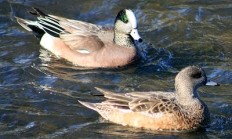
Wigeon drakes are beautifully marked with white pate, green eye stripe, purplish breast and flanks, white belly and wing covert patch, and iridescent black/green speculum. The grayish hen shows white on the wing covert patch. Drakes give a three-note whistle and get progressively noisier as spring approaches and courting flights begin. Medium sized flocks are common in fall and winter, and like geese, will be found grazing pastures, park lawns, and golf courses. It is a rare to locally common breeder in eastern Oregon and rare in summer in western Oregon. It is a common to abundant migrant and wintering…
The fog shrew is the largest of the brown shrews in Oregon. Its range extends from Taft in Lincoln County east to near the eastern boundaries of Linn and Lane counties (except it is absent in the Willamette Valley) and southward along the west slope of the Cascade Range and in the Coast Range and Siskiyou Mountains. They are found in alder/salmonberry, riparian alder, and skunk cabbage marsh habitats and less often in conifer habitats.
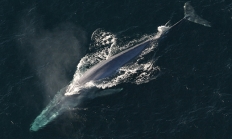
Blue whales are occasionally spotted off Oregon, but usually no closer than 10 miles offshore. These whales are part of the Eastern North Pacific population that range from Alaska to Costa Rica. They migrate between feeding areas along the west coast of the United States and Canada and breeding and calving grounds off Mexico and Central America. They are thought to be among the most endangered of the great whales. Photo by NOAA
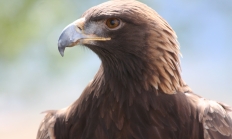
The Golden eagle is the largest soaring raptor inhabiting open country and mountainous terrain in eastern Oregon. A powerful and skillful hunter, the Golden eagle has become the National icon of the American West. A very large, dark raptor, the nape golden in all plumages, the females are slightly larger. Juvenile birds show white patches at the base of the primaries and a white tail with a broad dark terminal band. They are common residents in all Oregon counties east of the Cascade range. The Golden eagle inhabits shrub-steppe, grassland, juniper, and open ponderosa pine and mixed conifer/deciduous habitats. It…
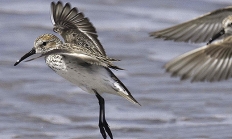
These small gray-and-white sandpipers are commonly seen on beaches from early fall through late spring running in and out along the surf's edge. Buffier, spangled juveniles can be seen in late summer but the stunning rufous breeding plumage is less often seen and can be starling and confusing. The larger size, larger bill, and different habits of the Sanderling help distinguish it in all plumages from other small sandpipers. It is common to locally abundant on open sand beaches from fall through spring. Statewide, it is a rare to locally uncommon migrant inland, most often reported along the Columbia River…
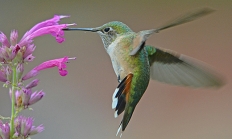
Perhaps the most enigmatic hummingbird found regularly in Oregon, the Broad-tailed hummingbird has so far eluded documentation of its breeding in the state, likely due to identification uncertainties and the remoteness of its preferred habitat. Primarily a Rocky Mountain species, its hard-to-define breeding range seems to reach its limit at Oregon's eastern edges where reports of this beautiful and rare species arise each summer. The relatively large adult male has a rose-red gorget and green plumage with no dorsal Rufous coloration. Females and immatures are nearly indistinguishable in the field from those of the more common Rufous hummingbird. Hear the…
The chat's coming in the spring is like the arrival of a brass band. Male chats are loud, continuous singers, sometimes heard through the night. Chats inhabit lowland tangles and thickets along rivers and floodplains. It is the largest of North American warblers. In western Oregon, the chat is an uncommon to common summer resident of the interior Rogue Valley. It is a locally uncommon summer resident in the interior Umpqua Valley. In the Willamette Valley it is a locally rare to uncommon summer resident, and rare east to Oakridge. In eastern Oregon, the chat is a rare spring migrant…

Bobolinks summer in Oregon's eastern grasslands and meadows, singing what has been described as a bubbling delirium of ecstatic music that flows from the throat of the bird like sparkling champagne. The yellow-brown female, juvenile or non-breeding male may at first appear to be a sparrow, but the breeding male has an astonishing and diagnostic backwards tuxedo pattern of buff on the nape and white rump and scapulars on an otherwise black body. The Bobolink is a regular, locally common breeder at the Malheur National Wildlife Refuge and a few scattered pairs occur in northeast Oregon. West of the Cascades…
