
Search myodfw.com
Showing 661 - 680 of 897 results
Although not as imposing as the Canvasback, the redhead is a large, handsome, fast-flying diver. The drake has a red head, black breast and tail coverts, and steel gray back, flanks and tail. Hens are a medium brown. During courtship, the drake utters a very un-duck-like meow. Known for nest parasitism - laying eggs in the nests of other birds, usually other diving ducks - redhead eggs have also been found in the nests of a variety of species. It is an uncommon summer resident in northeast Oregon, but commonly breeds at Batch and Bogus lakes and locally elsewhere in…

SALEM, Ore.—The Oregon Fish and Wildlife Commission will meet Thursday and Friday, Dec. 11-12 to set 2026 groundfish regulations and hear an informational briefing on the barbless hook requirement for Columbia River recreational fisheries. Both a Dec. 11 workshop and Dec. 12 meeting will be in a hybrid format, allowing for…
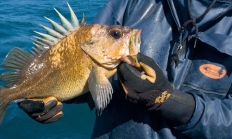
Known as "bluebill" to most hunters, this species is one of the most abundant and widespread of North American ducks. The lesser scaup is similar to the greater scaup in appearance and habits, but is smaller and lacks the white on the primaries. In the field, however, the black-and-white drakes and brown hens are very similar to greater scaups. The common vocalization is the purr call of the female; drakes are usually silent, but utter a low single-note whistle in courtship. In general, the lesser scaup is more apt to be found in interior or freshwater habitats while the greater…

Medium-sized diving ducks, Barrow's goldeneyes are the expected of the two goldeneye species in Oregon in the summer, but are typically less numerous in the winter. Drakes show graceful patterns of black and white, purple glossed head, white crescent-shaped patch between the eye and bill, steep forehead, and short bill. Females and juveniles have a chocolate-brown head, slate-gray back, wings and tail; adult females have a golden bill. They are the only waterfowl species known to defend winter territories different from breeding territories. It is uncommon from the Cascades eastward in both breeding season and winter, but it may concentrate…

Brandt's cormorants nest colonially on offshore islands and mainland cliffs and are the most common of the cormorants on the Oregon coast in summer. In the breeding season, males are easily distinguished by their intense blue gulag pouches, displayed with a skyward pointing of the bill. They also have wispy white plumes along the side of their head and on their back, which show well against the solid black of the rest of their plumage. In bright light they have a green iridescence. During all seasons they can be distinguished from the two other Oregon species by buff-colored feathers that…

The Snowy egret is intermediate in size between Great and Cattle egrets, and much more common in Oregon than the latter. Adults have a black bill and legs and bright yellow feet; immatures show yellow on the back of their legs. In the breeding season, plumes are present on head and breast, and curve upwards on the back. The Snowy egret breeds regularly, in varying numbers, primarily in eastern Oregon. It is uncommon to fairly common spring through fall in the Klamath Basin and occasional in the northeast Malheur County. On the south coast it is rarely found in summer…
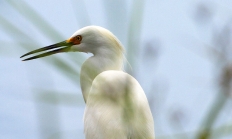
At first look, the Willet is a rather drab and nondescript medium-sized shorebird found in wetland habitats and nearby uplands. However, further observation reveals subtle patterning in its relatively uniform grayish plumage and birds in flight expose a distinct, bold white wing bar that contrasts with a black border. Sexes are similar in appearance at all times of the year. Willet are present on breeding grounds in Oregon for a short period of time during spring and summer, but displaying birds are conspicuous and emit a loud and persistent "pill-will-willet" call. These vigilant and vocal individuals often hover overhead and…

This tiny sandpiper is the rarest of the regularly occurring "peeps" in Oregon. Only a handful of individuals are reported in Oregon each year, mostly during fall migration and usually in mixed flocks with Least and Western Sandpipers. Like the Western sandpiper, the Semipalmated has black legs, but its bill is generally shorter, straighter and more blunt. Well-known as a transoceanic migrant, the Semipalmated sandpiper may be one of the fastest flying of the long-distance shorebirds. It is a rare irregular spring transient throughout Oregon, and a very uncommon coastal and rare inland fall transient. It is usually found inside…
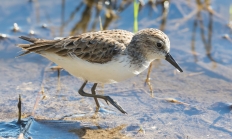
The nasal meow of the Franklin's gull can be heard as it soars above wetlands and meadows, and colonies of this species are reported to be the loudest of all the gulls. In breeding plumage, the black hood contrasts sharply with the white breast and bright red bill. This species depends much more on insects and other invertebrates than do other gulls, and is therefore considered economically beneficial and favored by farmers. The Franklin's gull occurs in the southeast portion of the state in spring and summer, especially Harney Basin. It is rare west of the Cascades. It nests locally…

The Common nighthawk is a migrant to Oregon with one of the longest migration distances of any North American bird. It is also one of the last to arrive in Oregon. Long, slender wings are marked by a white patch on the "hand" visible in flight from great distances. When perched on the ground, the cryptic brown, gray, and black mottling makes the bird almost invisible. This bird breeds and migrates at all elevations through the state. Its nesting habitat is characterized by open landscapes with little ground cover and is most abundant in sagebrush and rocky scablands and rimrock…

Shadow-colored skulkers in dense riparian growth, catbirds are among the often heard, less frequently seen denizens of northeast Oregon. They are all dark gray except for a black cap and russet undertail coverts. The sound has variable melodious warblings with occasional imitations of other birds and off-key noises. A distinct mewing call is often heard. The Gray catbird is a fairly common breeder in dense riparian zones of the northeast Blue Mountain ecoregion and is common in the Wallowa and Union counties and in east Umatilla County along the Umatilla River, Pine Creek and Meacham Creek. They breed locally in…

The male Red-winged blackbird, sentry of the marsh during the breeding season, continually announces its territory to all present with its oak-a-tee song, and tenaciously defends against flyby predators. The male is territorial, polygynous, larger than the female, and glossy black with a broad bar of red-orange, bordered with yellow, on wing writs. Females are less conspicuous in behavior, light brown, with a heavily streaked breast, and buffy supercilium. This is one of the most abundant and studied birds in North America. The Red-winged blackbird occurs west of the Cascades in Oregon from coastal and valley locations, and east of…

Formerly known as the Green-backed goldfinch, this species was either not present or overlooked during the 19th century by most Oregon ornithologists. The male's black forecrown contrasts smartly with the greenish back and bright yellow underparts. Females lack the clear contrasting colors of the males, though the tips of the secondary coverts and the base of the primaries are white in both sexes. Often the plaintive tee-yee call reveals the presence of the bird long before it is seen. In the north Willamette Valley the Lesser goldfinch is a fairly common breeder along the western fringe. Scattered and local in…
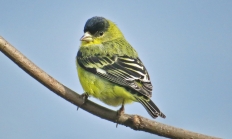
This bat, found in older forests, has a wingspan of about 10 inches. Its fur is glossy black, tipped with white. It forages over ponds, streams, meadows and roads, often flying very low and roosting behind loose tree bark. Maternity roosts of the silver-haired bat are found in trees. This bat usually bears twins. The silver-haired bat occurs statewide in Oregon except for most of the Columbia Basin and is an Oregon Conservation Strategy Species in all ecoregions except the Nearshore ecoregion. It is primarily associated with coniferous forests, including the juniper woodlands in the southeastern portion of the state…

The Ermine is the smallest member of the genus in Oregon. It has a long, cylindrical neck and body and short legs, but the tail is relatively short. The head is flattened and somewhat triangular, the eyes are small and slightly protruding, and the ears are rounded. The summer pelage is brown dorsally, usually white or yellowish ventrally; in some individuals the throat and belly are splotched with brown or are entirely brown. In some populations east of the Cascade Range, ermines replace brown summer pelage with a white winter pelage. The tip of the tail remains black at all…

The Western spotted skunk is smaller and more weasel-like than the Striped skunk. The pelage is black with a somewhat pentagonal white patch between the eyes, a round white patch on each side of the head and four or six segmented white body stripes. This skunk is endowed with a muscle-encapsulated musk gland similar to those of the Striped skunk and so similarly, can eject musk from two papillae located under the tail. The odor of the musk is considered somewhat more pungent or acrid but is less spreading than that of the Striped skunk. In Oregon, this skunk occurs…

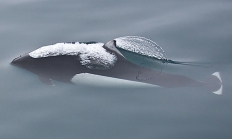
A thick body, small head and coloration similar to a killer whale make this dolphin easy to recognize. Dall’s porpoise is mostly black with a large white patch on the belly and flanks. The small dorsal fin is partly white and the trailing edges of the tail are frosted white. About seven feet long and weighing around 400 pounds, Dall’s live only in the north Pacific. Dall’s are the fastest of all small cetaceans and can swim at up to 35 miles per hour, almost as fast as a killer whale. When swimming at the surface they create a characteristic…
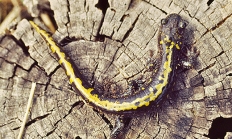
Appropriately named, adult long-toed salamanders have extremely long toes on their hind feet. Adults have black or brown skin that is smooth and moist with a yellow ragged-edged stripe running from its head to the tip of its tail. It is speckled with white or silver dots along its sides and underside. Adults may grow up to more than six inches in total length. Adult long-toed salamanders are seen infrequently, as they spend most of the year in the ground. They find cover in a variety of habitats including grasslands, dry shrub-steppe, pastures, lowland forests, high elevation lakes and ponds…
Of Oregon's breeding seabirds, Leach's storm-petrel is the smallest, most pelagic, and flies the farthest offshore of any of Oregon's breeding seabirds to feed. It spends the non-breeding season in the subtropical and equatorial Pacific. It is the second most abundant breeding seabird in Oregon, and is rarely seen from land or close to shore. It comes to its breeding islands, where it nests in burrows, only under the cover of darkness. Its plumage is black and Oregon populations have a distinct white rump. Leach's storm-petrels are long lived birds characterized by long-term pair bonds and may breed yearly for…
