Search myodfw.com
Showing 681 - 700 of 897 results
With its long, decurved bill, the black and cinnamon Virginia rail probes the mud for much of its food. Its narrow body is specially designed for slipping through a densely vegetated marsh, so it rarely has to move away from cover. Known for its staccato kidik, kidik call, this rail also contributes grunts, clicks, churs, squeaks, skeeuws, and quack-like noises to the marsh chorus. In Oregon, this is a rare to locally abundant breeder. In western Oregon it breeds in freshwater and brackish marshes. In eastern Oregon, large marshes in Klamath, Lake, and Harney counties host numerous breeders each year…

The red tree vole is a medium-sized vole. It is uniquely colored among North American voles: bright orangish-red to cinnamon on the dorsum, silvery gray (often with some light orangish hairs) on the venter, and a tail pale orangish on the venter grading to black on the dorsum. This vole is endemic to western Oregon. It occurs at moderate elevations on the west slope of the Cascade Range southward as far as the Douglas-Jackson county line and in the Coast Range to the Oregon-California border. It is largely arboreal and builds nests on suitable foundations (commonly nests of birds or…

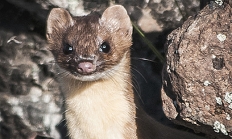
The Long-tailed weasel is the larger of the two weasels in Oregon, but smaller than the other member of the genus, the mink. Males are considerably larger than females. The head is flattened and somewhat triangular; the body and neck are elongate and almost cylindrical; the legs are short, and the tail is long. The summer pelage is brown dorsally; the venter is yellowish to orangish except for a white chin and sometimes one or more scattered brown spots. The tip of the tail is black. The pelage is molted twice annually. In the Cascade Range and eastward through the…
Features: Before spawning, sockeye salmon are silvery on their sides, white on their bellies, and dark blue on their backs. When spawning, their heads turn green with black on the snout and upper jaw, and their bodies turn red. They can be 24- to 33- inches long and weight between 5 and 15 pounds. Habitat: Many sockeye populations require a lake for part of their life cycle. Spawning may occur along lake shorelines or in stream gravels, but fry usually migrate to lake environments soon after emergence and occupy this habitat during their stay in fresh water. Technique: Sockeye salmon…

Features: Their eyed-side is greenish-brown to dark brown or black with lighter blotches. Their blind side is white to milky-white. They have a large, stout but flat body, shaped like an elongated diamond . Pacific halibut have been known to reach 500 pounds, but on average are 40 pounds. Habitat: Halibut are a large flatfish and so they spend much time near the bottom of the ocean looking above for food. They prefer chilly water and are primarily found in the Gulf of Alaska. Technique: Boat anglers use heavy rods to fish on or near gravel bottoms in water 150-500…

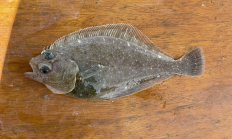
Features: The Pacific sanddab is left-eyed, meaning both eyes are on the left side of the body. The eyed-side is dull light brown, mottled with brown or black, and sometimes yellow or orange. The blind-side is off-white to tan. They have an oval shaped body with large scales. They can grow to be 16-inches long and up to 2 pounds, though most weigh less than 1/3 pound. Habitat: As you probably guessed, sanddabs like to hang out on sandy bottoms. They are most abundant at depths of 20-50 fathoms, and are common in shallow coastal waters from British Columbia to…
Features: The drake has a red head, black breast and tail coverts, and steel gray back, flanks and tail. Hens are a medium brown. During courtship, the drake utters a very unduck-like meow. Habitat: This diving duck is a locally common breeding species throughout the marshes of eastern Oregon such as Ladd Marsh, Summer Lake, the Warner Wetlands, and Malheur NWR. Known for nest parasitism, laying eggs in the nests of other birds, usually other diving ducks, redhead eggs have also been found in the nests of a variety of species. Techniques: The redhead is a very uncommon winter resident…

Features: Canada geese come in many sizes and colorations. All have the same general long, black neck and white chinstrap. Their breast color can range from light gray to a dark brown. Habitats: Canada geese have become abundant in many city parks and agricultural fields where forage grasses are available. They can be found floating in bays, estuaries, rivers, reservoirs and lakes as well. Techniques: Canada geese can be hunted like other waterfowl. From jump shooting to calling birds into a decoy spread, Canada goose hunting can be productive. Note: If you want to hunt geese in Northwest Oregon, a…

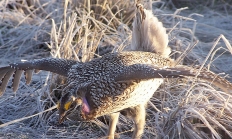
Features: Columbian sharp-tailed grouse are brown-gray with small black and white markings, a white underside, and a short tail that is white at the base. They are a medium-sized grouse. Both the males and females have a yellow-orange comb over each eye. Habitat: Columbian sharp-tailed grouse were historically found in most counties of eastern Oregon. These birds preferred the bunchgrass prairies interspersed with stream bottoms containing deciduous shrubs and trees. This habitat was particularly common in north-central Oregon and the Columbia Basin. Technique: In 1929, Oregon closed its hunting season for sharp-tailed grouse and it has never re-opened. By the…
Adult Oregon spotted frogs have moist bumpy skin that is reddish-brown on their topsides. On their heads, backs, sides and legs, they have black spots with light centers that darken with age. They also have red bellies and orange-red underlegs. Adult females grow to four inches in length and males to three inches. Oregon spotted frogs live in wet areas that provide abundant aquatic vegetation such as marshes, permanent ponds, lake edges and slow streams. When frightened, they hide in dense vegetation or under debris at the bottom of shallow wetlands. Adult frogs hibernate during the winter in freeze-free seeps…

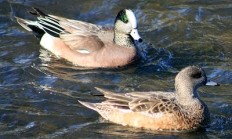
Wigeon drakes are beautifully marked with white pate, green eye stripe, purplish breast and flanks, white belly and wing covert patch, and iridescent black/green speculum. The grayish hen shows white on the wing covert patch. Drakes give a three-note whistle and get progressively noisier as spring approaches and courting flights begin. Medium sized flocks are common in fall and winter, and like geese, will be found grazing pastures, park lawns, and golf courses. It is a rare to locally common breeder in eastern Oregon and rare in summer in western Oregon. It is a common to abundant migrant and wintering…

Greater scaup are almost the size of redheads. In hand, they are easily distinguishable from lesser scaup by size and by the white wing stripe extending beyond the secondaries into the primaries. In the field the two species are sometimes difficult to separate. Drakes are black on both ends and white in the middle. Hens are dark brown with a white mask around the base of the bill. The common vocalizations are the discordant scaup and purring pbbbrr of the female. Greater scaups form large flocks, sometimes mingling with lesser scaups in fall and winter. They are an abundant migrant…

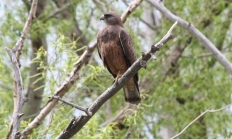
Swainson's hawks are medium-sized buteos, smaller than Red-tailed and Ferruginous hawks. Plumage beneath varies along a continuum from very pale to nearly black below. Lighter-plumaged birds have a distinct chest band. They have relatively long, pointed wings that contribute to superior flying skills. The dark flight feathers contrast with paler wing lining in all but the darkest birds. It breeds in the bunchgrass prairies east of the Cascades with the highest concentration in the foothills of the Blue and Wallowa mountains. It prefers open country and has little need for numerous trees since it forages extensively while in flight and…
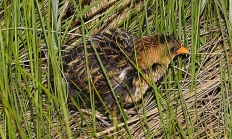
The Yellow rail is a small, secretive rail that is seen and heard far less than any other rail in Oregon. Males vocalize during the breeding season with a five-note tic-tic, tic-tic-tic repeated incessantly during hours of dark, and call infrequently during the day. The call sounds much like two small rocks being tapped together. Yellow rails are quite small and have a white patch on the trailing edge of the inner wing, more extensive than that on juvenile Soras. Males in the breeding season have a distinct yellow bill and are slightly larger but otherwise sexes are alike. Chicks…
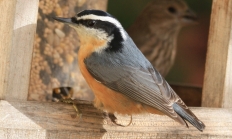
The Red-breasted nuthatch is a happy, jolly little bird, quick and agile in its motions and seemingly always in a hurry to scramble over the branches. It is distinguished from other nuthatches by white eyebrows, black eyelines and cap, reddish breast, and nasal yank yank song. Although males have a blacker cap and redder breast than females, distinguishing sexes in the field is difficult. During winter, is can be observed foraging in mixed-species flocks with Chickadees, Brown creepers, Kinglets, Townsend's carblers, and Dark-eyed junkos. The Red-breasted nuthatch breeds and winters throughout Oregon where conifer or mixed conifer-hardwood forests are present…
Bobolinks summer in Oregon's eastern grasslands and meadows, singing what has been described as a bubbling delirium of ecstatic music that flows from the throat of the bird like sparkling champagne. The yellow-brown female, juvenile or non-breeding male may at first appear to be a sparrow, but the breeding male has an astonishing and diagnostic backwards tuxedo pattern of buff on the nape and white rump and scapulars on an otherwise black body. The Bobolink is a regular, locally common breeder at the Malheur National Wildlife Refuge and a few scattered pairs occur in northeast Oregon. West of the Cascades…

One of the "winter" finches that appear unpredictably in the state, the White-winged Crossbill wanders in flocks year-round searching for food, and may actually be seen in parts of Oregon in any month of the year. Its peculiar twisted bill, specialized for prying seeds out of conifer cones, is smaller than that of the Red Crossbill, and it prefers smaller, softer cones, mainly spruce. Males are a dull pinkish red, with distinctive broad with bars on black wings. Females are dusty brown and dull yellow with blurry streaks. The White-winged crossbill is a very rare and erratic visitor in Oregon…

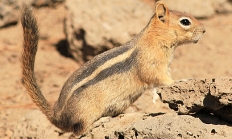
The golden-mantled ground squirrel doubtlessly is the most distinctively marked ground squirrel in Oregon; a white stripe bordered on both sides by a black stripe extends from the shoulder to the hip. From nose to nape above the eye, the head is russet. The back between the stripes is grizzled dark grayish-brown becoming less grizzled on the rump; lateral to the stripes the color grades to a light buffy-gold on the venter. The face, shoulders, front legs, and feet are a bright orangish-gold. This ground squirrel occupies the east slope of the Cascade Range and most of central Oregon, and…
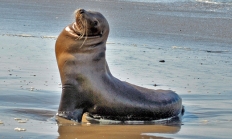
The California sea lion is the mid-sized Oregon otriid. The body is slender and tapering, the flippers are relatively small, and the rear flippers can be rotated beneath the body for moving on land. The short, course pelage lacks dense underfur; when dry, it usually is chocolate brown, but individuals with light-tan pelage are known to occur. The pelage appears black when wet. In older males, the pate is tan. The occurrence of the California sea lion along the Oregon coast is seasonal. The primary areas where it comes ashore are Cascade Head, Tillamook County; Cape Argo, Coos County; and…