Search myodfw.com
Showing 961 - 980 of 1128 results
Updated December 31, 2025 Subscribe for Sport Bottomfish Regulation Updates
Oxbow Hatchery was originally constructed in 1913 to provide additional rearing facilities for Bonneville Hatchery. It was relocated to this present site in 1937 following the construction of Bonneville Dam. Oxbow operated as a state-funded hatchery until 1952 when it was remodeled and expanded as part of the Columbia River Fisheries Development Program (Mitchell Act) – a program to enhance declining fish runs in the Columbia River Basin. The hatchery is presently used for interim egg incubation and early rearing of coho and spring Chinook salmon. No adult fish are collected or spawned at Oxbow and there are no fish…
CLACKAMAS, Ore. – Sturgeon retention in Bonneville Pool and The Dalles Pool will open for one day on Monday, Feb. 16. These retention fisheries had not opened on the traditional date of Jan. 1 as in previous years. Due to warmer-than-normal winter water temperatures, increased angling effort, and high catch…
PENDLETON, Ore. – From Oct. 18 through Nov. 30, 2025, the adult daily salmon and steelhead bag limit on the Umatilla River from the Hwy 730 bridge upstream to Threemile Dam is three fish total, but retention of Chinook will be closed. The closure of Chinook retention is necessary due…
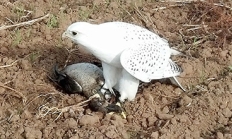
This is a large and power falcon. The majority of Gyrfalcons seen in Oregon are immatures or adults of the "gray" type, but there are several reports of "white" birds. The Gyrfalcon is a regular winter visitant to Oregon. The majority of sightings come from coastal and Willamette Valley lowlands near waterfowl concentrations. Individuals have been seen chasing and feeding on geese, ducks and gulls. Gyrfalcons forage by flying low over the ground and flushing prey, then often giving spectacular tail chases. If a bird refuses to flush the hunt is usually unsuccessful. East of the Cascades it occurs around…
The present facility was constructed in 1925, across the North Umpqua River from an earlier trout hatchery built in 1920. The hatchery was closed in 1975 due to low stream flows and high water temperatures, and was reopening in 1979 after extensive reconstruction. In 2012 a state of the art fish passage ladder was completed. It included a fish viewing window for Rock Creek basin fish inventory and a fish trap facility. The hatchery produces fall and spring Chinook, coho, summer and winter steelhead, and rainbow trout. The facility is used for adult collection, spawning, incubation, and rearing of Chinook…
ENTERPRISE, Ore. – ODFW, in coordination with co-managers, will reopen harvest of wild (adipose-intact) fall Chinook salmon in the Snake River effective Saturday, Oct. 4. The reopening follows a temporary closure implemented in September to ensure fisheries remained within agreed harvest limits. During the closure, managers continued to monitor run…
ROSEBURG, Ore. – The Oregon Department of Fish and Wildlife is looking for a volunteer site host at its Canyonville winter steelhead acclimation site on lower Canyon Creek. This opportunity to work with hatchery steelhead and help improve Oregon's fisheries is from Jan. 1 – Apr. 30, 2026. The acclimation…
Oregon hosted the first successful introduction of the ring-necked pheasant in North America. This exotic game bird, released for sport hunting from China is now widely introduced and distributed throughout North America. Although more likely to run than fly, the ring-necked pheasant will explode into the air if startled, producing a distinctive sound from rapid wing-beats. It inhabits open areas such as grasslands, agricultural fields, and brushy areas, and avoids forested habitats. Hear the call of the ring-necked pheasant Photo by Charlotte Ganskopp

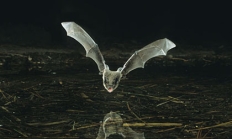
The long-legged myotis lives in forests and comes out early in the evening to hunt. It is a fast flier and will chase insects for a long distance. One baby is born in the summer, and the species hibernates in winter. In general, the long-legged myotis is a species associated with montane coniferous forests, but it also occurs in some desert and riparian habitats. The long-legged myotis is an Oregon Conservation Strategy Species in these ecoregions: Blue Mountains, Coast Range, East and West Cascades, Klamath Mountains, and Northern Basin and Range. Photo by ©Michael Durham
Updated April 29, 2026 Sign up for Halibut Regulation Updates
Subscribe for updates Find catch estimates Ocean sport salmon regulations map
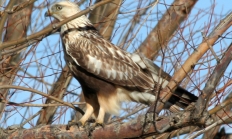
Characteristic of open country and cold weather, the Rough-legged hawk can be found soaring over exposed terrain or perched on utility poles across much of the state in winter. The rough appearance of its legs comes from the feathers covering their length, an adaptation that provides extra warmth in frigid weather. In flight, dark wrist patches and belly help identify this large buteo, though like other hawks it is subject to much variation in plumage. From a distance it frequently appears to have a frosty upper half. It often hovers over fields while hunting, a behavior that is rare among…
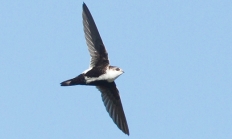
High overhead at the top of the rimrock in Oregon's desert country, the White-throated swift swoops, soars, and darts about erratically, hunting and catching insects. At great speed, it disappears into a crevice on a cliff without appearing to slow down. Its long, strong claws enable it to crawl deep inside these crevices to roosting and nesting areas, which often cannot be seen from the entrance. This bird is a locally common to abundant breeder, primarily on eastern Oregon cliffs. It is an occasional spring and sporadic fall migrant in western Oregon along the coast, in the Willamette Valley, and…
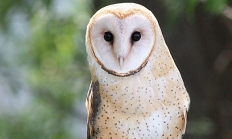
One of the most startling sounds in the black of night is the loud, harsh call of the Barn owl as it flies over field or marsh in search of small rodents. They are white to tan beneath with fine spotting ranging from almost none to fairly extensive. The face has a well-defined facial disc that acts as a parabolic dish collecting the faint sounds of its prey, allowing it to hunt successfully in total darkness. Male and female Barn owls are similar in appearance though the female is somewhat larger. The Barn owl is a fairly common permanent resident…
Willamette Trout Hatchery and the adjacent Oakridge Salmon Hatchery were combined in 1983 and operate today as Willamette Hatchery. The trout hatchery was constructed in 1922 and the salmon hatchery in 1911. The U.S. Army Corps of Engineers (USACE) rebuilt the salmon hatchery in 1952 to mitigate for fishery losses caused by Hills Creek, Lookout Point and the Dexter hydroelectric/flood control projects. The trout side was rebuilt between 1950 and ‘56. Today, Willamette Hatchery is used for adult holding/spawning, egg incubation and rearing of spring Chinook and rainbow trout. In addition, both summer and winter steelhead are reared at this…
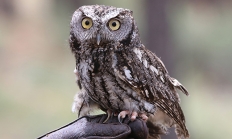
Almost strictly nocturnal, the Western screech-owl hunts discreetly at night and roosts during the day in dense woodlands, its perfectly streaked plumage allows it to pass as tree bark. These habits make it difficult to see, and it is more common than many are aware. It is a small owl with yellow eyes and feathered ear tufts. It exhibits geographic variation in plumage color and pattern: both gray morphs and brown morphs occur in the Pacific Northwest. Sexes are alike. The Western screech-owl is a fairly common year-round resident in lower-elevation woodlands throughout Oregon. It is usually found below 3,000…