
Search myodfw.com
Showing 101 - 120 of 220 results
Ensatina salamanders are a lungless species with a short body and yellow or orange legs. There are two sub-species in Oregon: the Oregon ensatina ( E. e. oregonensis) is solid red, orange, brown or tan, while the painted ensatina ( E. e. picta) has small yellow, black or white spots on the back and tail. Ensatinas grow to just over four inches in total length. Ensatinas live in humid forests, woodlands and other areas with woody debris. They hide under logs, bark piles at the base of snags (standing dead trees), stumps and even woodpiles in residential areas for cover…

Though less conspicuous than Great blue herons, Green herons are well-established residents of western Oregon. They are distinguished by small size, glossy greenish-black cap and back, yellow legs, blackish-green wings, gray underparts, and dark red neck. One of the few tool-using birds, Green herons are experts at making and using baits and lures, such as bread crusts, mayflies, earthworms, sticks, and feathers to catch fish. The Green heron is an uncommon but regular migrant and summer resident throughout west and south central Oregon. Detection of nests is difficult and breeding status uncertain in some areas due to its secretive habits…

During the breeding season Pigeon guillemots are easily seen flying low over the water along rocky coastlines or in estuaries. They have striking red feet, legs, and mouth linings and their large white wing patches contrast markedly with the rest of their black plumage. When standing on land they have a distinctive upright posture and often emit a high-pitched squeal. In the non breeding season they move offshore and look entirely different when their black plumage becomes mottled with white. The Pigeon guillemot occurs during the breeding season all along the Oregon coast wherever offshore islands or rocky cliffs are…

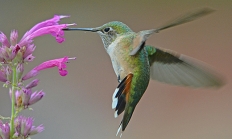
Perhaps the most enigmatic hummingbird found regularly in Oregon, the Broad-tailed hummingbird has so far eluded documentation of its breeding in the state, likely due to identification uncertainties and the remoteness of its preferred habitat. Primarily a Rocky Mountain species, its hard-to-define breeding range seems to reach its limit at Oregon's eastern edges where reports of this beautiful and rare species arise each summer. The relatively large adult male has a rose-red gorget and green plumage with no dorsal Rufous coloration. Females and immatures are nearly indistinguishable in the field from those of the more common Rufous hummingbird. Hear the…
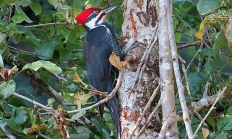
The Pileated woodpecker was the model for the cartoon character, Woody Woodpecker. It is a large black-and-white bird with a bold red feathered crest and distinctive call. You may hear its powerful drumming before you see it. In Oregon, its habitat includes older forests in the Blue Mountains, East and West Cascades, Klamath Mountains, Willamette Valley and Coast Range ecoregions. They prefer mature forests and younger forests with large snags and logs, requiring large diameter snags for nesting and foraging. Pileated woodpeckers are an Oregon Conservation Strategy Species in the Blue Mountains ecoregion. Hear the call and the drumming of…
Arguably the most widely recognized of Oregon's birds, the American robin is the largest, most abundant, and most widespread thrush in the state. Ranging from sea level to treeline, the robin's loud, musical voice and conspicuous brick-red chest make it unmistakable to even the most casual of observers. The robin thrives in both human-dominated and natural landscapes and is considered to be a habitat generalist throughout its range. Considering the robin's natural history, we know most about its diet, which comprises primarily of soft invertebrates in the spring and summer and fruit in the fall and winter. It is most…

Features: This species is relatively thin compared to other rockfish. It is easily recognized by its three to four horizontal green stripes that extend onto the caudal fin membranes. The body color ranges from white to reddish; red or orange areas can be observed on the body after capture. Habitat: Though found between 40 and 1,632 foot depths, these rockfish tend to stay between 300 and 825 feet with older/larger individuals found deeper. They live on muddy, sandy and rocky bottoms. Technique: Rubber tail jigs or shrimp flies are good choices when targeting greenstriped rockfish. Be wary of sharp dorsal…
Although not as imposing as the Canvasback, the redhead is a large, handsome, fast-flying diver. The drake has a red head, black breast and tail coverts, and steel gray back, flanks and tail. Hens are a medium brown. During courtship, the drake utters a very un-duck-like meow. Known for nest parasitism - laying eggs in the nests of other birds, usually other diving ducks - redhead eggs have also been found in the nests of a variety of species. It is an uncommon summer resident in northeast Oregon, but commonly breeds at Batch and Bogus lakes and locally elsewhere in…

The largest of Oregon's grebes, these have a long white neck, black cap, bright red iris, long strait bill, dark back, bright white breast, and they appear tailless. While excellent divers, they are unable to walk on land because their body weight is forward of their legs. Differences in appearance between western and Clark's grebes are subtle. In the western grebe, the black cap typically extends down to the eye whereas white facial plumage extends slightly above the eye on the Clark's grebe, but this is not always diagnostic in winter. The western grebe is a common breeder in eastern…

The nasal meow of the Franklin's gull can be heard as it soars above wetlands and meadows, and colonies of this species are reported to be the loudest of all the gulls. In breeding plumage, the black hood contrasts sharply with the white breast and bright red bill. This species depends much more on insects and other invertebrates than do other gulls, and is therefore considered economically beneficial and favored by farmers. The Franklin's gull occurs in the southeast portion of the state in spring and summer, especially Harney Basin. It is rare west of the Cascades. It nests locally…

This drab, greenish, diminutive species is similar in appearance to the Hutton's vireo, and sometimes confused with that species in western Oregon. Slighter-billed and smaller than the vireo, this little bundle of energy seems always to be moving as it flicks its wings and hops from twig to twig. The male Ruby-crowned kinglet sports a bright red crown spot, typically visible only when the bird is agitated, and in spring pours fourth a delightful melody, surprising for such a small, drab bird. This species breeds in high elevation forests, primarily east of the Cascade crest, where it is common in…

The Turkey vulture, known locally as a "buzzard," is a common sight spring through fall throughout the state, except in the highest mountains and featureless desert expanses in summer where they are uncommon. Seeing Turkey vultures returning is a welcome sign of spring. Turkey vultures are large-winged soaring birds with overall dark plumage except for a silvery sheen on the undersides of the flight feathers. Adults have small, featherless, red heads, while juveniles have gray heads. The Turkey vulture is a common to abundant transient throughout the state and an uncommon to common summer resident except in high mountains. It…

The bubbly warble of this finch is common in western Oregon conifer forests in summer, while its Crossbill-like - but more delicate - pik call is heard in lowland valleys in the winter. Adult males have a distinctly reddish-colored head, face, rump, throat, and breast, broadly but very faintly streaked brownish-pink sides, and a diffused brownish-red nape, back, and wings. Females and immature males have brownish-olive upperparts, wings, and tail, with contrasting streaking. Underparts are buffy-white to off-white with fuzzy, brownish streaking; a dingy pale gray stripe is present above the eye. In Oregon, the Purple finch breeds west of…
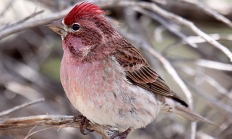
The bubbly warble of this finch is common in western Oregon conifer forests in summer, while its Crossbill-like - but more delicate - pik call is heard in lowland valleys in the winter. Adult males have a distinctly reddish-colored head, face, rump, throat, and breast, broadly but very faintly streaked brownish-pink sides, and a diffused brownish-red nape, back, and wings. Females and immature males have brownish-olive upperparts, wings, and tail, with contrasting streaking. Underparts are buffy-white to off-white with fuzzy, brownish streaking; a dingy pale gray stripe is present above the eye. In Oregon, the Purple finch breeds west of…

Features: Before spawning, sockeye salmon are silvery on their sides, white on their bellies, and dark blue on their backs. When spawning, their heads turn green with black on the snout and upper jaw, and their bodies turn red. They can be 24- to 33- inches long and weight between 5 and 15 pounds. Habitat: Many sockeye populations require a lake for part of their life cycle. Spawning may occur along lake shorelines or in stream gravels, but fry usually migrate to lake environments soon after emergence and occupy this habitat during their stay in fresh water. Technique: Sockeye salmon…

Features: The drake has a red head, black breast and tail coverts, and steel gray back, flanks and tail. Hens are a medium brown. During courtship, the drake utters a very unduck-like meow. Habitat: This diving duck is a locally common breeding species throughout the marshes of eastern Oregon such as Ladd Marsh, Summer Lake, the Warner Wetlands, and Malheur NWR. Known for nest parasitism, laying eggs in the nests of other birds, usually other diving ducks, redhead eggs have also been found in the nests of a variety of species. Techniques: The redhead is a very uncommon winter resident…

SE WILDLIFE VIEWING July 30, 2026 Harney County With warmer temperatures now occurring throughout the district, remember to bring extra water and any preventative tools with you while in the field. Note that parking on tall dry grasses is a serious fire danger concern and try avoiding doing so. The county experienced a mild winter this season making for low snowpack accumulation even at higher elevations, access for observation opportunities should be good this summer. Although, those looking to explore rural areas of the county should keep recovery items in their vehicle. Early summer rains occurring periodically may cause muddy…
Swainson's hawks are medium-sized buteos, smaller than Red-tailed and Ferruginous hawks. Plumage beneath varies along a continuum from very pale to nearly black below. Lighter-plumaged birds have a distinct chest band. They have relatively long, pointed wings that contribute to superior flying skills. The dark flight feathers contrast with paler wing lining in all but the darkest birds. It breeds in the bunchgrass prairies east of the Cascades with the highest concentration in the foothills of the Blue and Wallowa mountains. It prefers open country and has little need for numerous trees since it forages extensively while in flight and…
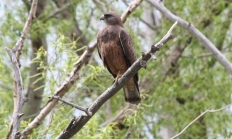
This small, rich-brown wren is only slightly larger than a quarter, and has a tail quite short for a wren. A quiet observer in the forest will see these birds hop in and out and all over logs, snags, shrubs, twigs, and limbs on the forest floor. It has been said that the song of this bird is larger than the bird itself. The Winter wren breed from Coos County southward and in eastern Oregon in the Blue and Steens mountains. It retreats from high altitudes in winter where snow pack is heavy. Migration probably occurs throughout the state, but…

Features: While their coloration can be variable, bull trout are generally gray infused with green. The body is covered with small white or pale yellow spots. Some spots along the side may be deep orange to red. The leading edges of the fins along their bellies are white. Bull trout, despite the common name, is not actually a trout but a member of the closely related char group. Habitat: Bull trout require cold, clean water to survive and are typically found in the headwaters of Oregon rivers. Spawning occurs in the fall when water temperatures drop below 50F. Techniques: Anglers…
