Search myodfw.com
Showing 1061 - 1080 of 1204 results
The Western harvest mouse is the smallest sigmodontine rodent in Oregon. It occurs east of the Cascade Range, except it is absent from the Blue and Wallowa mountains; it also occurs in the southern parts of Josephine and Jackson counties west of the Cascades. The Western harvest mouse commonly uses runways. It is active nocturnally with its greatest activity between sunset and sunrise. They spend periods of inactivity in ball-shaped nests constructed on the surface of the ground; nests are sometimes placed beneath shrubs or debris. Photo by J. N. Stuart, Flickr
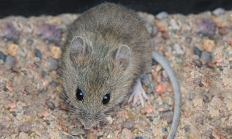
The canyon mouse is a moderate to small-sized mouse-like rodent with a long tail, nearly naked ears and a long, lax, and silky dusty gray pelage. In Oregon, most locations where the canyon mouse has been found are in Harney and Malheur counties, but the distribution includes a group of localities in Crook, Jefferson, Wasco, and Wheeler counties and another group in Lake County. There are also records of the species in extreme southeastern Baker County. Rock, primarily rimrock and talus slopes, seems to be the key component of habitats occupied by the canyon mouse. They are usually active nocturnally…
The deer mouse is a moderately small mouse-like rodent that exhibits considerable variation in color, tail length and markings. In general, the pelage of adult deer mice is buff to dark brown on the dorsum and white on the venter. The ears are moderately long, essentially naked and usually held erect and directed forward. The eyes are black and beady. The deer mouse has the broadest distribution of any species within the genus and occurs throughout Oregon. Below the treeline, it occurs as part of essentially all communities. It is active nocturnally, the time of onset of activity is cued…

The piñon mouse is the largest member of the genus in Oregon. It is characterized by its enormous ears. Hair color varies geographically; overall, in central and eastern Oregon it is a pale-buff color with a wash of black on the dorsum, whereas mice from southwestern Oregon are bright ocherous on the shoulders and flanks and a dirty brown on the dorsum. In Oregon, the piñon mouse has been found in Josephine, Jackson, Klamath, Lake, Deschutes, Jefferson, Grant, Crook, and Harney counties. East of the Cascade Range it is almost always associated with western juniper in rimrocks. In southwestern Oregon…
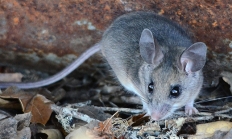
The Northern grasshopper mouse is a stockily built mouse with a thick tail. The dorsal pelage is dark sepia long the midline grading moderately sharply to a light tannish along the sides. The ventral pelage is white. A dark sepia line extends across the face between the eyes. The ears are thinly furred, sepia on the external surface and light grayish-tan on the internal surface. The feet and tip of the tail are white. In Oregon, Northern grasshopper mice have been found in grassland and desert areas in Crook, Deschutes, Gilliam, Harney, Jefferson, Klamath, Lake , Malheur, Morrow, Sherman, Umatilla…
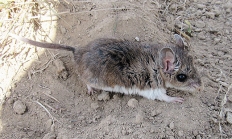
The bushy-tailed woodrat is a large rat-like mammal; its squirrel-like tail unique among members of the genus, is gray above and whitish below. The dorsum is buffy gray to dark brownish-black and the venter is white to buff depending on the geographic race. It occurs, statewide in a wide variety of habitats. It is active nocturnally. Sometimes, upon leaving the protection of its den, the woodrat may lie motionless on a rock or limb, watching for a long period before moving forth. Photo from ODFW

The dusky-footed woodrat is a medium-sized rat-like form with large, nearly naked ears, protruding eyes, and a long tail. The dorsal pelage consists of hairs with steel gray bases, a band of ocherous buff, and a tip of black. Hairs on the throat and belly are white. Although variably in extent, a dusky splotch occurs on the dorsal surface of the white feet. In Oregon, this woodrat occurs from the California border northward along the coast to near Bandon, northward inland through the Willamette Valley and other interior valleys to near Mollala and Monmouth, and northward to Brownsboro, Jackson County…
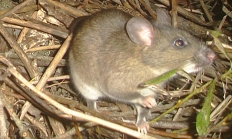
The desert woodrat is the smallest member of the genus that occurs in Oregon. The tail is round, short and bicolored and the ears are long and lightly furred. The pelage is long and soft, a mixture of buff and black dorsally and whitish or light buff ventrally; except for he chest, all body hairs have lead-colored bases. The feet and underside of the tail are white. It occurs in Malheur, Harney, and southern Lake Counties. Throughout its range, it tends to be a habitat generalist, but in Oregon it usually occurs in sagebrush habitats, especially those associated with rimrocks…
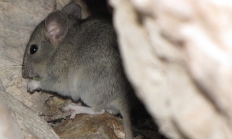
The black rat is slightly smaller than the Norway rat, but much larger than the house mouse, the only other members of the subfamily in Oregon. The black rat is similar to other members of the subfamily in that it possesses a scaly, scantily haired tail; membranous, nearly naked ears, and a soft pelage. It differs from the Norway rat in having a tail much longer than the length of its head and body and commonly having a darker-colored pelage. The pelage ranges from black to sandy brown dorsally and from lead colored to nearly white ventrally. The black rat…

The house mouse is the smallest member of the subfamily in Oregon and smaller that most other members of the family. The ears are large and membranous; the tail is long, tapering, and scaly; and the soles of the feet are naked. The pelage is short, harsh, and usually grayish brown to nearly black dorsally, lighter brown or buffy ventrally. Albino, spotted, and other colormorphs are known to occur. House mice occur throughout the world in association with humans. In Oregon, this mouse is found in 30 of the 36 counties. House mice are usually more active at night, but…
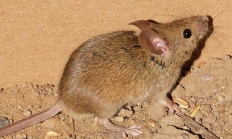
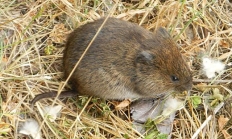
The Western red-backed vole is among the smaller of the voles in Oregon. The pelage consists of a vaguely demarked reddish-brown or chestnut-brown stripe on the dorsum grading to buffy gray to dark gray on the sides and venter; the tail is indistinctly bi-colored, light grayish-brown above and whitish below. This vole occurs from the Columbia River south through the Coast Range. It does not occur in the Willamette Valley or other interior valleys west of the Cascade Mountains. It is a denizen of forest habitats, but tends to be most abundant in closed canopy old-growth forests containing an abundance…

The Southern red-backed vole is among the smaller voles in Oregon. The pelage is silvery on the venter and grayish with ocherous on the sides, and with a rusty or reddish stripe on the dorsum; the tail is dark brown or black above and whitish or grayish below. In Oregon it occurs in the Ochoco, Blue, and Wallowa Mountains southwestward to central Crook County and northern Harney County. Photo by D. Gordon Robertson, Wikipedia
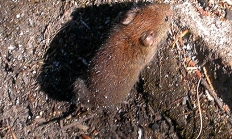
The white-footed vole is among the smaller voles. The pelage consists of dark bluish-gray hairs tipped with a rich brown or black on the dorsum grading lighter on the sides, thence to light gray to pinkish buff on the venter. The tail is distinctly bi-colored: white or buff on the vental surface, brownish black on the dorsal surface. The dark dorsal stripe is much wider than the lighter ventral stripe. The feet are light grayish. This vole occurs from Old Fort Clatsop, Clatsop county, and near Rainier, Columbia County, south through the coast range. Various Oregon specimens have been found…
The heather vole is among the smaller voles in Oregon. In appearance, it strongly resembles the montane vole. It is gray to brownish on the dorsum, whitish to grayish on the venter. Two of nine nominal subspecies are purported to occur in Oregon: the lighter colored P. I. intermedius in the Blue and Wallowa mountains of northeastern Oregon and the darker P. I. oramontis in the Cascade Range. Heather voles are rather docile creatures; they usually make little attempt to flee or to defend themselves when captured. It is active during daylight hours more frequently than the Southern red-backed vole…
The red tree vole is a medium-sized vole. It is uniquely colored among North American voles: bright orangish-red to cinnamon on the dorsum, silvery gray (often with some light orangish hairs) on the venter, and a tail pale orangish on the venter grading to black on the dorsum. This vole is endemic to western Oregon. It occurs at moderate elevations on the west slope of the Cascade Range southward as far as the Douglas-Jackson county line and in the Coast Range to the Oregon-California border. It is largely arboreal and builds nests on suitable foundations (commonly nests of birds or…

The California vole is a medium-sized vole with a cinnamon-brown to tawny-olive dorsum overlain by dark brown or black hairs. The underparts are medium gray, sometimes washed with buff; the tail is bi-colored, black above and gray below. The feet are grayish. It occurs from near Eugene south through the interior valleys of Oregon and most of California. It has been found in the drainages of the upper Willamette, Umpqua, and Rogue rivers in Lane, Douglas, Jackson, and Josephine counties. This vole spend most of the time underground in its burrows or in those of other species; it makes only…
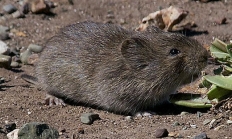
The gray-tailed vole is a medium-sized vole with yellowish-brown or yellowish-gray dorsal pelage and a short tail, blackish or brownish above and light gray below. It is endemic to the Willamette Valley and occurs from near Scapoose and Gresham south through the Willamette Valley to near Eugene. It is associated largely with agricultural lands, particularly small grains, grasses grown for seed, permanent pastures and hay fields, and waste places vegetated with grasses. These voles occasionally become so abundant that control measures are necessary.
The long-tailed vole usually is considered to be a medium-sized vole, although the size of an exceptionally large male may rival that of the largest Townsend's vole. The color of the dorsal pelage ranges from dull grayish through brownish gray to dark sepia brow. Those west of the Cascade Range have the darkest and richest-colored pelages. The sides are lighter and more grayish and the venter is grayish white to dull buff. The eyes and ears are large. In Oregon, the long-tailed vole occurs in 30 of the 36 counties. It is absent from the Willamette Valley and other interior…
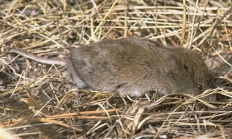
The montane vole is a medium-sized vole. The pelage is ashy gray mixed with brown and black on the dorsum shading to light gray or whitish on the venter. The feet are lead colored and the tail is bi-colored black or dark gray above and light gray to whitish below. Splotches of different shades of yellow on the nose, venter, and dorsal surfaces of the feet and tail occur on some adult Montane voles. This vole is distributed throughout most montane and intermontane areas of the west occurring throughout that portion of Oregon east of the crest of the Cascade…
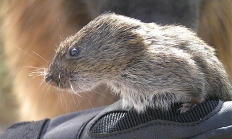
The creeping vole is the smallest vole in Oregon. It has an exceedingly short tail and tiny eyes. The short, dense fur on the dorsum ranges from sooty gray to dark brown or black, with scattered yellowish hairs. Hair on the venter is dusky washed with buff or white; the tail is blackish, slightly darker above that below; and the fur on the ears is black. In Oregon, it ranges from Brooks Meadows and Crater Lake west to the Pacific Ocean. The species has been seen at some localities in the Willamette Valley. However, hiatuses in the distribution occur in…