Search myodfw.com
Showing 1081 - 1100 of 1204 results
Other than the muskrat, the water vole is the largest arvicoline in Oregon. It occurs in the Cascade Range from Mt. Hoot to Mt. Mazama and in the Wallowa and Blue mountains east and north of a line connecting Langdon Lake, Umatilla County; the North Fork Malheur River, Grant County and Cornucopia, Baker County. It is considered an inhabitant of alpine and subalpine streamsides. The water vole is active throughout the diel cycle; however, activity is least from dawn to midday, rises during the afternoon, and peaks at night, probably after midnight. It is a good swimmer and can swim…
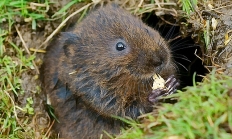
The Townsend's vole is a large vole with large ears that extend above the fur, a long brownish or blackish tail and brownish or blackish feet equipped with brown claws. In Oregon, it has been found along the Pacific Coast south to southern Coos County, throughout the Willamette Valley with eastward extensions along the Columbia River to near Hood River; the McKenzie River to Douglas County; and the Rogue River to Prospect, Jackson County. With few exceptions, Townsend's vole is associated with moist habitats: meadows, lowland pastures, riparian zones, boggy lands, marshes, and irrigated fields densely vegetated with grasses and…
The sagebrush vole is among the smaller voles in the state. The tail does not exceed the length of the hind feet. The long, soft, and dense dorsal pelage is grayish tan; the bases of the hairs are lead colored and the tips are black. The ventral pelage is pale buff, the feet light gray, and the tail slightly bicolored. In Oregon, it occurs mostly east of a line connecting The Dalles, Bend, and Klamath Falls, except it is absent from the Columbia Basin and most of the Blue and Wallowa mountains. Clustering of burrows tends to indicate that the…
The common muskrat is the largest arvicoline rodent on Oregon. The body is heavy and rounded, and except for the tail and feet, heavily furred. The eyes are beady; the ears are rounded and almost covered with fur; the tail is flattened laterally, scaly, keeled, and naked except for a few hairs on the keel. The forefeet are relatively small, but the hind feet are large and partly webbed. The pelage consists of an exceedingly dense underfur usually overlain by glossy dark-brown guard hairs; the underfur is waterproof. Reddish, blackish, silvery, and white individuals have been recorded. In Oregon, muskrats…

The Western jumping mouse is a long tailed, sleek-bodied mouse. The pelage is course. They yellowish-gray to ocherous sides are separated sharply from the pale-brown to grayish-brown dorsum; the venter is white, often washed with ochre. The tail is bicolored, but not markedly so. In Oregon, the species occurs throughout most of the area east of the Cascade range except for the Columbia Basin-Deschutes Plateau region. It also occurs in southern Jackson County. Throughout its range, it is a denizen of mountain meadows, particularly those with small streams. Without doubt, the most unique feature of the life cycle of the…
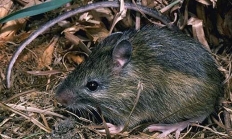
The Pacific jumping mouse is a long tailed, sleek-bodied mouse. The pelage is course. The ocherous sides are separated sharply from the tawny dorsum; the venter is white, often washed with ochre. The tail is bicolored, but not markedly so. In Oregon, the species occurs in the Cascade Range and westward to the Pacific Ocean except for southern Jackson County. These mice are largely marsh and meadow dwellers but are often found along creek banks or under ferns and weeds in the woods. In September and October, these jumping mice become exceedingly fat; in captivity, they become progressively less active…
Large, slow-moving rodents, porcupines are found on every continent except Antarctica. There are 12 "New World" species in North, Central and South America. In Oregon, there is only one, the common porcupine.
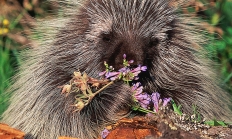
The common porcupine is a large, short-legged rodent with up to 30,000 bare-tipped quills (modified hairs) covering the upper parts of the body and the dorsal and lateral surfaces of the tail. The quills are scattered among much longer, course guard hairs; the underfur is woolly. The quills are arranged in rows across the body, the longest quills are on the rump, the shortest on the face. Quills used in defense are replaced commencing about 10-42 days after loss. The overall color of the porcupine is dark brown or blackish. The front feet have four toes, the rear feet five…

Coyotes, wolves and foxes are found throughout Oregon, depending on the species. The gray wolf, kit fox and Sierra Nevada red fox are Oregon Conservation Strategy Species. More about wolves in Oregon Report a wolf sighting

Canis lupus is the largest canid, not only in Oregon, but in the rest of the world as well. The wolf has relatively long legs, a narrow and deep chest, elbows that turn inward and foot pads that turn outward. These, combined with the digitigrade feet possessed by all canids, make the wolf highly adapted for running. The pelage of gray wolves is long over the body and tail, but relatively short on the legs and face. The predominant color is gray, but the legs, flanks, and venter sometimes are yellowish or light brownish. These colors are overlain by long…

The gray fox is among the smaller canids in Oregon. The basic color of the gray fox is grizzled gray, but the stiff middorsal hairs have long black tips that extend onto the tail as a black mane. Guard hairs are banded white, gray, and black. The throat, venter, and inside of the legs are white; a cinnamon-rufous border to the white throat extends on the flanks and underside of the tail A blackish patch on the side of the face extends onto the lower jaw and a grayish black "exclamation point" extends upward from the interior margin of each…
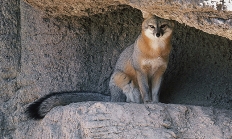
The kit fox is the smallest canid that occurs in Oregon. It has the typical canid conformation: the body is slim, the legs are long and thin, and the ears are large and erect. The tail is about 40 percent of the total length and is tipped with black, but has no dark mane on the dorsal surface. The feet and legs are whitish interiorly, light rusty-brown posteriorly. The dorsum is grizzled brownish-gray medially blending to grizzled gray then to light buff laterally and finally to white on the chest and venter. The head and posterior surface of the ears…

The red fox has a beautiful orange-red coat, black feet, and black-tipped ears. The belly is usually white or light grey, the muzzle is narrow and pointed, and the ears are pointed. It is an opportunistic carnivore, eating what is available including small mammals, birds and their eggs, reptiles, amphibians, fruit and some insects. The red fox is territorial and mates for life Red foxes occur throughout much of Oregon.

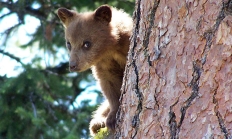
Black bears are the largest extant carnivores in Oregon. They are, however, smaller than grizzly bears, and they lack the grizzly's distinctive shoulder hump. A black bear is heavily built with stout legs and large feet. The eyes and ears are relatively small and the tail is extremely short. The claws are recurved but relatively short with those on the forefeet equal to or only slightly longer than those on the hind feet. The characteristic humped shoulders and dished face of the grizzly bear are absent. During spring-autumn seasons, black bears tend to be more active during daylight and crepuscular…
Oregon has two sea lion species and three seals. The Steller sea lion, Northern elephant seal and Pacific harbor seal are Oregon Conservation Strategy Species.

The Northern fur seal is the smallest member of the family in Oregon. The flippers are nearly twice as large as those of a comparably-sized individual of any other species of otariid. The ears are cylindrical and the auditory meatus is covered with wax to prevent entry of water. The pelage consists of coarse guard hairs and an exceedingly thick underfur that serves as waterproof insulation. Adult males are dark gray or brown dorsally and reddish brown ventrally; a grayish cape covers the neck and shoulders. Adult females are grayish brown dorsally and reddish brown ventrally. The Northern fur seal…
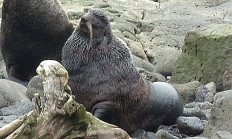
The Steller (or Northern) sea lion is the largest member of the family Otariidae. Among adult females and subadult males, the upper body is slim, whereas in adult males it is heavy and muscular. The head is bearlike with a moderate step between muzzle and forehead. The rear flippers are relatively small and can be turned beneath the body for travel on land. The pelage is light buff to reddish brown, slightly darker in the chest and abdomen. Overall the pelage appears darker when wet. However, beneath the water it appears white, whereas the California sea lion appears black. In…

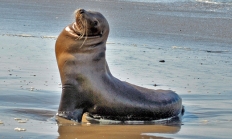
The California sea lion is the mid-sized Oregon otriid. The body is slender and tapering, the flippers are relatively small, and the rear flippers can be rotated beneath the body for moving on land. The short, course pelage lacks dense underfur; when dry, it usually is chocolate brown, but individuals with light-tan pelage are known to occur. The pelage appears black when wet. In older males, the pate is tan. The occurrence of the California sea lion along the Oregon coast is seasonal. The primary areas where it comes ashore are Cascade Head, Tillamook County; Cape Argo, Coos County; and…
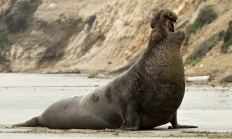
The Northern elephant seal is the largest pinniped carnivore that occurs along the North Pacific coast. The flippers are relatively small, the rear ones directed posteriorly. Its most distinctive feature is the elongated tubular proboscis with a deep transverse cleft among adult males. This proboscis can be inflated and directed into the open mouth to produce vocalizations. Also among males, the neck and chest lose most of their hair and the skin becomes rough and thickened at puberty. The adult pelage consists of course grayish or brownish hairs without any underfur. During the molt, not only is the pelage shed…
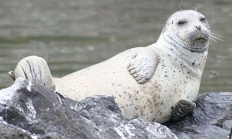
The body of the Pacific harbor seal is plump but tapers to small rear flippers permanently extended posteriorly. The head is large and rounded, the eyes are large, the limbs are short, and the nostrils sit dorsally on the muzzle. The nostrils can be closed when this seal dives. The tongue is notched at the tip. The pelage consists of long overhairs that overlay short underhairs. Markings are extremely variable, but in general the pelage is gray or brownish gray with numerous small spots of black that may coalesce to form splotches. Pacific harbor seals have been observed ashore at…