
Search myodfw.com
Showing 121 - 140 of 220 results
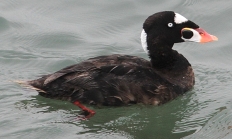
Features: Adult males' plumage is black except for white patches on the forehead and nape. The most distinguishing feature is the bill, a swollen white, red-orange, yellow, and black wedge. This highly visible standard advertises male's presence for up to a mile. Dark-billed adult females and subadults are dark brown above and paler brown below, with two indistinct light patches on the cheeks and sometimes on the nape Habitat: The surf scoter does not breed in Oregon but is abundant on salt water along the coast from fall through spring. Look for surf scoters in the Columbia River estuary and…

The FRWA was created by a licensing agreement signed in 1957 and modified in 1982 and 2008, between the US Army Corps of Engineers and the Oregon Game Commission. This agreement authorized the state to develop, conserve, and manage all wildlife resources on 5,261 acres of land and water within the Fern Ridge Project. ODFW also acquired the 309 acre Coyote Creek South and 224 acre Coyote Creek Northeast units in 2013 and 2015, respectively. The wildlife area now totals 5,794 acres.
The development of the WWA began in 1953 with the acquisition of five parcels of land consisting of 4,400 acres. The Department continued to purchase additional lands, acquiring 1,670 acres in 1954 and another 760 acres in 1955. From 1961 to the present the department has purchased or received another 4,219 acres. The wildlife area currently consists of 12,419 acres owned by the department. In addition, the department, through agreements with the Bureau of Land Management (BLM), manage 1,329 acres within or adjacent to the wildlife area. The WWA was established in response to continuing complaints from landowners concerned with…

Features: Brook trout are easily identified by the worm-like pale yellow markings on their backs and red dots with blue halos and white borders on their lower fins. In small streams brook trout are often 5- to 7-inches long but can reach 25 inches or more in large rivers or lakes. Habitat: Brook trout are an introduced species, first stocked in the early 1900s. They are widely distributed from high mountain lakes to headwater tributaries, and thrive in cold, mountainous streams and lakes where other species are unable to do well. Many barren lakes have been stocked with brook trout…

Features: Like all cutthroat trout, this species boasts bright red streaks on either side of its “throat.” You can tell it’s a westslope cutthroat by its spot pattern – the majority of the black spots are found on the back end of the fish with rather few ahead of the dorsal fin. Habitat: While westslope cutthroat trout was once the most widely distributed cutthroat in North America, its home in Oregon has always been limited to the John Day Basin. During the cooler months of summer you can find them in places like Strawberry Creek and upper Canyon Creek. As…

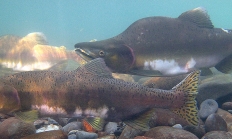
Features: These fish are silver when young, but darken and develop black spots on their tails and backs as they age. In fresh water, the males are red on their sides and develop a hump on their backs earning this species the common name humpback salmon. Females in fresh water are green on the sides with dark bars. Pink salmon are an average of 20- to 25-inches long and rarely weigh over 5 pounds. Habitat: Pink salmon spawn on odd numbered years and do so very close to saltwater, never going very far upriver. In fact, some pink salmon will…
Features: Spruce grouse are gray with white spots on the belly. The back feathers often have dark bars. Females tend to be paler in color than the males. The eyes are outlined by red combs over and white arcs underneath. Habitat: The spruce grouse is native to Oregon and found in coniferous forests across northern North America. However, Oregon is on the periphery of this species' range and they likely were never abundant in the state. Currently, spruce grouse can only be found in the Wallowa Mountains and Snake River divide of northeastern Oregon. Technique: Spruce grouse have been protected…

Although the least numerous scoter on the continent, it is the most common scoter along the Pacific coast south of Alaska and winters by the thousands off Oregon. Adult males' plumage, black except for white patches on the forehead and nape, yields attention to the bill, a swollen white, red-orange, yellow, and black wedge feathered squarely along its base. The highly visible standard advertises male's presence for up to a mile. Dark-billed adult females and subadults are dark brown above and paler brown below, with two indistinct light patches on the cheeks and sometimes on the nape. A flattened head…
The bright yellow, red, and black plumage of the male Western Tanager, so conspicuous in open situations is very obscure in forested areas where it tends to blend into the shaded foliage. The species perhaps is best known in migration when it visits city parks, orchards, and other open urban and suburban areas. It is attracted to birdbaths but seldom to bird feeders. It breeds in open coniferous forests and mixed coniferous and deciduous woodlands, primarily in mountains. They usually nest in conifers - rarely deciduous trees - at varying heights, usually well out on a branch, often at the…

The gregarious Tricolored blackbird is one of North America's most intensely colonial breeders, forming dense, non-territorial, noisy colonies. A highly synchronized nesting system exploits secure nesting locations and rich food supplies that change from year to year. In Oregon, breeding colonies are scattered and intermittent at specific locations, though sites used during consecutive years may be in the same general area. The Tricolored blackbird breeds most consistently in Klamath and Jackson Counties. Small colonies and summering residents have been found in the Willamette Valley; during fall and winter they are rare. Most retreat south to California in winter, while some…

Features: The coloration tends to be golden-brownish with dark brown or black spots on the body, and on the dorsal and adipose fins. Usually few or no spots appear on the tail fin. Many body spots, especially those below the lateral line, are edged with pink, red, or orange, forming rings or halos. Breeding males develop strong teeth and a hooked snout. Size can range from 11-inches long in small streams to over 30-inches in large rivers or lakes. Habitat: Although brown trout can adapt themselves to sluggish streams and warmer temperatures than other trout, cold, spring-fed tributary streams with…

Features: As the name suggests, these fish have rosy red strip along their sides. Other identification clues include large, profuse black spots on the body and orange and yellow tints along the belly. Habitat: Redband trout are a subspecies of native rainbow trout that have adapted to the arid, desert conditions of eastern Oregon. During drought years distribution constricts as streams dry and become uninhabitable. Trout re-colonize these streams during wet cycles, expanding the distribution. Prime trout waters are clear, clean and cold. Good trout stream habitat is complex, consisting of an array of riffles and pools, submerged wood, boulders…
Features: When in the ocean chum salmon are bluish green on their backs. Their tails lack spots but tend to have silver streaks like the coho. Their lower jaw will be dark at the gum line and white or pink both inside and outside of the gum line. Once in freshwater, chums become dark green to brown with red to purple marks going vertically down their sides. Habitat: Like other salmon species, chum spend most of their lives at sea and return to their natal streams to spawn. Most spawning runs are over a short distance. Adults are strong swimmers…

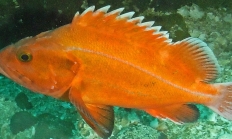
Features: They are orange red to orange yellow with a bright yellow eyes. Their fin tips may be black. On the top of their head they have a pair of rough ridges. Yelloweye, canary and vermilion rockfish can look similar. See this rockfish identification article for distinguishing features of each species Take the "Yelloweye Rockfish or Not?" quiz Habitat: Juveniles and subadults prefer shallower water than adults, and are associated with rocky reefs,and kelp canopies. Adults move into deeper water as they grow, and prefer rocky bottoms. Technique: Yelloweye rockfish are currently prohibited in the catch. Anglers are required to…
Del Norte salamanders are solid brown or black in color. Some individuals, especially younger salamanders, have a reddish-orange to red stripe along their backs, but it generally fades as they mature. As the species’ scientific name suggests, individuals have long bodies in relation to their short limbs. The Del Norte salamander is one of the lungless salamander species that breathes through it’s skin. They can grow to six inches in total length. Del Norte salamanders live in older redwood or Douglas-fir forests and commonly use rocky substrates rubble, talus (rock fragment piles) and rock outcroppings for cover. During hot and…

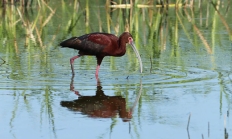
Sporting the form of a curlew, this medium-sized marsh wader is almost always found in flocks, flying in formation and quacking like ducks. Their long, down-curved bill complements their long neck and legs. Although their feathers appear black, a closer look will reveal an iridescence of bronze, purple, maroon, and green. They are named for their "white face" which appears in alternate plumage as a narrow border of white feathers along the edge of their reddish-purple facial skin, delineating a mask around the red eye. The White-faced ibis has extended its breeding grounds in Oregon to wetlands in Harney, Lake…
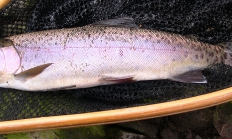
Features: Steelhead are rainbow or redband trout ( O. mykiss) that migrate to the ocean during their first or second year, returning one to three years later to spawn. While in the ocean, steelhead are silvery in color and typically grow significantly larger than their siblings who never leave fresh water. Once back in fresh water, they usually turn dark-olive in color, with silvery-white undersides, heavily speckled bodies and a pink to red stripe running along their sides. Habitat: Summer-run steelhead return to freshwater between May and October and require several months to mature and spawn. Winter-run steelhead return to…

Features: Chukars are brown-gray with a black stripe running across the head, through the eye, and down onto the chest. Their bills and feet are red, and their sides have white and black barring. Habitat: Extensive areas in eastern Oregon provide ideal habitat for chukars. Cheatgrass, an introduced plant species, was already well established through much of eastern Oregon prior to the 1950s, and provides one of the most important year-around food resources for the chukar. Their habitat is generally steep, rocky, dry, and largely unsuitable for development, agriculture or other commercial uses except grazing. Important chukar areas in Oregon…

CENTRAL WILDLIFE VIEWING July 30, 2026 Crook County Spring ungulate migration will soon be upon us. You can find mule deer transitioning from low elevation winter feeding areas to the higher elevation sagebrush and agricultural areas. There are red-tailed, rough-legged and ferruginous hawks, northern harriers, American kestrels, prairie falcons and golden eagles throughout Crook County and they're usually associated more closely with open/agricultural areas. Bald eagles and ospreys, on the other hand, are more closely associated with water bodies. Look for northern goshawks throughout the Ochoco National Forest, and for ducks and geese in rivers and lakes. Prineville Reservoir Wildlife Area The Prineville Reservoir Wildlife…