
Search myodfw.com
Showing 1321 - 1340 of 1415 results
The Striped skunk is about the size of a house cat with a pointed head; slightly upturned, nearly spherical nose pad; and beady black eyes. The pelage is entirely black except for a narrow white stripe on the forehead and nose, a white pate leading to two diverging white stripes on the back that extend partly or completely to the rump. Entirely white skunks, or skunks with the black replaced by seal brown or the white replaced by yellow are also know to occur. Without doubt, the most widely recognized characteristic of the Striped skunk is the pungent odor of…

Features: Coastal cutthroat trout are typically are blue/green on top, red along the lateral line, and white on the belly. They are lightly or heavily spotted and adults have a red slash mark on the throat. Habitat: The most common variety of trout in Oregon is the coastal cutthroat, found in the streams and beaver ponds in coastal drainages. They also are stocked in high mountain hike-in lakes where the water stays cool throughout the summer. Techniques: Cutthroats that are year-round residents of small streams may not get any bigger than 8- or 9-inches, but can reward the angler with…
Siskiyou Mountains salamanders are similar to Del Norte salamanders, except they are a little shorter, growing to about five-and-a-half inches in total length. An adult salamander is brown with a light brown stripe along the back and a grayish-purple belly. It has light scattered flecks along the body. The Siskiyou Mountains salamander is a lungless salamander and breathes through its skin. Siskiyou Mountains salamanders require talus (rock fragment piles) or rock outcrops in older forests. This salamander retreats deep within rocky crevices that remain cool and moist during the dry summer. Even during the rainy season, Siskiyou Mountains salamanders typically…

California slender salamanders are a lungless species that has an especially long and slender worm-like body. They have reddish-brown stripes along their backs from head to tail. This stripe fades as the animal ages. Mature adults can grow to five-and-a-half inches in total length. In Oregon, this salamander usually lives in humid coastal conifer forests. In redwood forests, this salamander easily blends in with bark and other debris. During warm wet weather, California slender salamanders take cover just beneath the surface; if conditions are especially dry, salamanders may retreat deep into crevices, logs, stumps, or insect and worm burrows underground…

These large toads are well camouflaged in earth tones with dry bumpy skin that aids in protection from predators. Their color can be highly variable among individuals ranging from gray or reddish-brown to yellow or green. They have a light colored stripe that runs along the center of the back. Adult female toads are larger than males, growing to five inches in length. They live mainly on land in a range of habitats from forests to mountain meadows to desert flats. During the non-breeding season, they are nocturnal. They dig their own burrows in loose soil, use existing burrows or…

Swainson's hawks are medium-sized buteos, smaller than Red-tailed and Ferruginous hawks. Plumage beneath varies along a continuum from very pale to nearly black below. Lighter-plumaged birds have a distinct chest band. They have relatively long, pointed wings that contribute to superior flying skills. The dark flight feathers contrast with paler wing lining in all but the darkest birds. It breeds in the bunchgrass prairies east of the Cascades with the highest concentration in the foothills of the Blue and Wallowa mountains. It prefers open country and has little need for numerous trees since it forages extensively while in flight and…
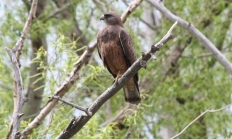
One of the most familiar sights along the roads of Oregon is a Red-tailed hawk soaring high on the sky over a field, or perched on a utility pole, waiting patiently for prey. Red-tailed hawks are large-bodied raptors with relatively broad wings. The back is mottled brown, and the tail of mature birds is orangish red with a thin, dark subterminal band. Perched birds can be identified from behind even when the tail is concealed by the white mottling on the scapulars forming a faint 'V'. Most individuals can be assigned to one of two color morphs, light or dark…

These small, fast flying seabirds are unique among alcids in North America in their use of coastal coniferous forests, primarily old-growth trees, as nesting habitat. Their solitary nests are usually concealed within the forest canopy, and breeding birds are cryptic and primarily crepuscular at nest sites. Because of their secretive behavior and elusive nests, Marbled murrelets were considered the "enigma of the Pacific" and were one of the last ornithological mysteries in North America, as the first nest was not discovered until 1974. Distribution at inland nesting sites is fragmented, as birds occur only in areas where suitable habitat remains…

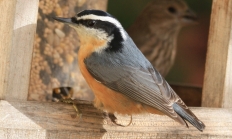
The Red-breasted nuthatch is a happy, jolly little bird, quick and agile in its motions and seemingly always in a hurry to scramble over the branches. It is distinguished from other nuthatches by white eyebrows, black eyelines and cap, reddish breast, and nasal yank yank song. Although males have a blacker cap and redder breast than females, distinguishing sexes in the field is difficult. During winter, is can be observed foraging in mixed-species flocks with Chickadees, Brown creepers, Kinglets, Townsend's carblers, and Dark-eyed junkos. The Red-breasted nuthatch breeds and winters throughout Oregon where conifer or mixed conifer-hardwood forests are present…
The European starling is considered an invasive species in Oregon. It was introduced from Europe. They most closely resemble blackbirds, with which they often flock in fall and winter. While both have iridescent plumage, starlings can be told from blackbirds by their two-toned wing pattern - dark upperwing, pale underwing - and during the breeding season by the bright yellow bill. Starlings adapt readily and quickly to human habitation and are highly efficient and successful breeders. However, the abundance of the bird, the rapidity with which it has spread across North America, and its propensity to cause damage to crops…

All of Oregon's blue-colored birds are appreciated for their dazzling appearance, but the striking plumage of this summer visitor is accompanied by a song described as vivacious, varied, well-articulated and sweet. Males are unmistakable when singing from a prominent perch, flashing deep azure upper parts with rich orange-brown breast and flanks, a white belly, and white wing bars. Females are warm brown and relatively plain, though they share with males the habit of twitching the tail to one side when excited. The Lazuli bunting is fairly common in low-elevation dry valleys in Curry County but are becoming uncommon north through…

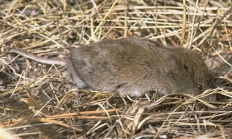
The long-tailed vole usually is considered to be a medium-sized vole, although the size of an exceptionally large male may rival that of the largest Townsend's vole. The color of the dorsal pelage ranges from dull grayish through brownish gray to dark sepia brow. Those west of the Cascade Range have the darkest and richest-colored pelages. The sides are lighter and more grayish and the venter is grayish white to dull buff. The eyes and ears are large. In Oregon, the long-tailed vole occurs in 30 of the 36 counties. It is absent from the Willamette Valley and other interior…
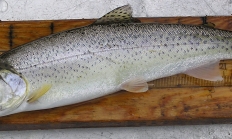
Features: While their coloration can be variable, bull trout are generally gray infused with green. The body is covered with small white or pale yellow spots. Some spots along the side may be deep orange to red. The leading edges of the fins along their bellies are white. Bull trout, despite the common name, is not actually a trout but a member of the closely related char group. Habitat: Bull trout require cold, clean water to survive and are typically found in the headwaters of Oregon rivers. Spawning occurs in the fall when water temperatures drop below 50F. Techniques: Anglers…

The Cascade torrent salamander generally has numerous medium-sized black spots and white-gray flecking along its tan back and sides and a bright yellow belly that has fewer spots. Adults can grow to just over four inches in total length. Cascade torrent salamanders spend their lives in and near permanent, cold, fast-flowing and clear water including headwater streams, waterfall splash zones and seeps in older coniferous forests. Adults need gravel streambeds or other gravel areas with constant and shallow water flow for foraging and cover. The Cascade torrent salamander is an Oregon Conservation Strategy Species in the West Cascades and Willamette…

Adult frogs have moist bumpy skin that is tan or olive-green colored on their topsides. On their heads, backs, sides and legs, they have dark spots with light centers that darken with age. They also have red bellies and orange-red underlegs. Adult females grow to four inches in length and males to three inches in length. Columbia spotted frogs live in wet areas that provide abundant aquatic vegetation such as marshes, permanent ponds, lake edges and slow streams. When frightened, they hide in dense vegetation or under debris at the bottom of shallow wetlands. Adult frogs overwinter in springs, spring-fed…

The ring-necked duck, which would have been better named "ring-billed duck" and is called "blackjack" in the southeastern United States, frequents different habits than the scaups with which is is often confused. The black back, white crescent on the side just in front of the wing, and white-ringed bill separate the drake ring-neck from the scaups. The brownish neck ring of the male in alternate plumage is not prominent. The hen is a small dark brown duck with a buff face. Drakes in courtship give a head-throw accompanied by a wow note while hens utter a growling purr. Ring-necks are…

This restless diver of cold oceans and bays is one of the prize waterfowl to see on a coastal winter day. Although the loud, musical call of males is seldom heard in Oregon, we can still be cheered on a chilly day by this energetic visitor from the north. The winter males' body is mostly white except for a black breast and central back; the wings are dark, scapulars long and gray, and the dark central tail feathers elongate. Winter females are darker above with a light head; scapulars and tail feathers are short and dark. Dark areas mark females'…

The Long-billed curlew is the largest North American shorebird. Its most striking morphological characteristic, the long decurved bill, is an adaptation for foraging on earthworms or burrow-dwelling organisms like shrimp and crab. Body plumage is a rich buff with a tinge of cinnamon or pink. Sexes have similar plumage, but females are larger with a longer bill. It can be distinguished from other curlews in flight by its bright cinnamon underwings. When observed on the ground, the Long-billed curlew's head lacks the strongly streaked pattern of other cerlews or Whimbrel. It is a locally common breeder in open grassland areas…

At certain estuaries and interior alkali lakes, flocks of many thousands of these migrants can be observed swirling around over shallow water, landing to frantically feed, before resuming migration. Falcons often attack Westerns, and their acrobatic, tightly coordinated escape flights are breathtaking to observe. In winter, these small sandpipers are gray above with white underparts. In breeding plumage they have a rich rufous-chestnut back, cheeks and cap, dark-centered scapulars with rufous-chestnut edges, grayish throats streaked with dark chevrons through the flank, and whitish underparts. Longer-billed females generally are larger than males but are otherwise similar in appearance. Along the coast…

So familiar is the American crow that it has been said if a person knows only three species of birds, one of them will be the crow. Recognized by its coal-black plumage, fan-shaped tail, and nasal caw call, it is found throughout most of North America, and its seemingly mischievous character has been immortalized in folk tales and fables. These shrewd birds possess a superior intelligence and an ability to learn and make decisions. They are also sociable, joining together in large roosts, especially in fall and winter. Able to thrive in a wide variety of environments, crows are expanding…
