Search myodfw.com
Showing 1 - 20 of 220 results
The Sierra Nevada red fox is a montane red fox subspecies. Its presence in Oregon was confirmed in 2015, specifically in the Mt. Jefferson, Mt. Washington, and Three Sisters Wilderness Areas. The Sierra Nevada red fox is smaller than the red fox and averages about eight pounds. This fox has three color phases: silver (black), "cross" color phase and the more familiar red. The Sierra Nevada red fox is an Oregon Conservation Strategy Species in the East Cascades, Klamath Mountains and West Cascades ecoregions. Research continues on this species in the Oregon Cascades. Biologists captured and radio-collared several Sierra Nevada…

A research study that began in 2012 confirmed Sierra Nevada red fox presence in the Oregon Cascades, specifically in the Mt. Jefferson, Mt. Washington, and Three Sisters Wilderness Areas. Confirmation was through genetic testing of hair and scat samples. Sierra Nevada red fox is a subspecies of Red fox that live in high elevations. They are slightly darker than Red fox and are highly specialized to montane (mountain) ecosystems. In the red color phase, the upper body is reddish-brown with white chin, cheeks, throat and belly. This fox ranges from silver to black in the black/silver color phase with silver…
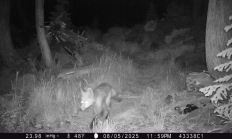
The red fox has a beautiful orange-red coat, black feet, and black-tipped ears. The belly is usually white or light grey, the muzzle is narrow and pointed, and the ears are pointed. It is an opportunistic carnivore, eating what is available including small mammals, birds and their eggs, reptiles, amphibians, fruit and some insects. The red fox is territorial and mates for life Red foxes occur throughout much of Oregon.

Coyotes, wolves and foxes are found throughout Oregon, depending on the species. The gray wolf, kit fox and Sierra Nevada red fox are Oregon Conservation Strategy Species. More about wolves in Oregon Report a wolf sighting

Find maps, boundary descriptions and hunts available in the new Fox Hunt Area. Download printable PDF map
Find maps, boundary descriptions and hunts available in the new Fox Hunt Area. Download printable PDF map
Find maps, boundary descriptions and hunts available in the new Fox Hunt Area FX-02. Download printable PDF map
The kit fox is the smallest canid that occurs in Oregon. It has the typical canid conformation: the body is slim, the legs are long and thin, and the ears are large and erect. The tail is about 40 percent of the total length and is tipped with black, but has no dark mane on the dorsal surface. The feet and legs are whitish interiorly, light rusty-brown posteriorly. The dorsum is grizzled brownish-gray medially blending to grizzled gray then to light buff laterally and finally to white on the chest and venter. The head and posterior surface of the ears…

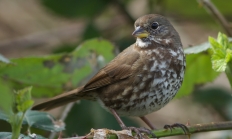
These big, medium-brown sparrows with variable grayish faces and heavily streaked or blotch undersides can be found in summer at higher elevations across much of the state except the Coast Range. Darker brown birds from more northerly breeding populations are common in western Oregon in winter, often coming to feeders, where they scratch like towhees for seed on the ground. Hear the song of the Fox sparrow Photo by Robin Horn, Flickr
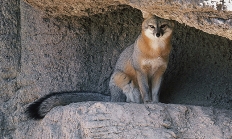
The gray fox is among the smaller canids in Oregon. The basic color of the gray fox is grizzled gray, but the stiff middorsal hairs have long black tips that extend onto the tail as a black mane. Guard hairs are banded white, gray, and black. The throat, venter, and inside of the legs are white; a cinnamon-rufous border to the white throat extends on the flanks and underside of the tail A blackish patch on the side of the face extends onto the lower jaw and a grayish black "exclamation point" extends upward from the interior margin of each…
The Eastern fox squirrel is among the larger of the tree squirrels in Oregon. Its body is the typical squirrel shape. The ears are short, rounded, and without tufts. The tail is flattened and somewhat fluffy. In Oregon, it has been found in Multnomah, Washington, Marion, Lane, Union, Clackamas, Yamhill and Baker counties, all occurring in urban areas or in association with nut orchards. The Eastern fox squirrel is active throughout the year during daylight with its greatest activity in the early morning and late afternoon. During autumn, they are exceptionally active on the ground, scatter-hoarding nuts and acorns as…

The Red crossbill is aptly named for its unusual bill configuration of crossed upper and lower tips of the mandibles which it uses to pry seeds primarily from native conifer cones. Degree of bill crossing is variable depending on wear, and it can have a right or left cross. Adaption to varied conifer cone structures and sizes has resulted in a diversity in body size, bill size and shape, and palate configurations in Red crossbills. Juveniles are brown with heavy streaked undersides and faint buff wing bars. Mature males are red with dark brown flight feathers and tail; first-year males…

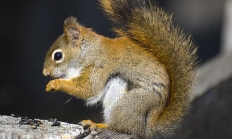
The red squirrel is also a small tree squirrel, only slightly larger than the Douglas' squirrel. They occur in the montane forested portions of Wallowa, Union, Umatilla, Morrow, Malheur and Baker counties. It is a largely arboreal, forest-dwelling species and although often occupying areas vegetated by other conifers, it is associated most frequently with lodgepole pine. Activity patterns of red squirrels are similar to those of Douglas' squirrels. Much activity is directed toward foraging, gathering and catching cones, feeding, and resting. Photo by Shawn Nystrand, Flickr
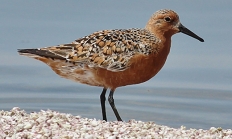
These stocky shorebirds stand out among their fellow migrants in spring, resplendent with rich rufous breasts shading into white on the lower belly. Red knots have short, black bills tapering to a fairly fine tip; short legs give them a low-slung appearance. They are highly gregarious and tend to form tight foraging and roosting flocks. Found primarily on the coast, they are regular transients in spring and fall. Knots forage on open estuarine tide flats, less commonly on margins of sand ocean beaches. Inland, they are found on margins of sewage ponds and at large brackish lakes such as Malheur…
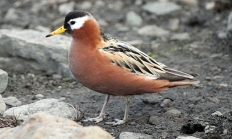
Flying over the water in small flocks or riding the ocean swells like puffs of down, a more incongruous picture can hardly be imagined than these dainty mites riding the waves during rough weather, apparently entirely indifferent to the tumult of waters. Pelagic shorebirds, they come to shore only to breed. Adapted to life on the sea, they have glands that allow them to expel salt from the seawater they drink, and lobed, coot-like toes to swim. Brick red in their breeding plumage, they are mostly gray and white in winter. They are uncommon to common spring and fall transients…
The male Red-winged blackbird, sentry of the marsh during the breeding season, continually announces its territory to all present with its oak-a-tee song, and tenaciously defends against flyby predators. The male is territorial, polygynous, larger than the female, and glossy black with a broad bar of red-orange, bordered with yellow, on wing writs. Females are less conspicuous in behavior, light brown, with a heavily streaked breast, and buffy supercilium. This is one of the most abundant and studied birds in North America. The Red-winged blackbird occurs west of the Cascades in Oregon from coastal and valley locations, and east of…

This medium-sized, shy grebe has bright white cheeks that contrast sharply against a dark crown and rust red neck during the breeding season. An aquatic bird, it breeds in lakes and ponds, usually in forested areas. In Oregon, it is found in waters with hardstem bulrush intermixed with open water over five feet deep. Five to 20 birds at Rocky Point in the Upper Klamath Lake National Wildlife Reserve form the only consistent breeding population in Oregon. The red-necked grebe reaches its greatest numbers during winter along the coast. The red-necked grebe is an Oregon Conservation Strategy Species in the…

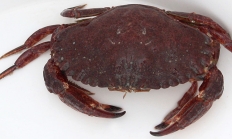
Features: These crab can be identified by their black-tipped claws, wide fan-shaped carapace (body cover) and deep, brick-red color. Habitat: As the name implies, red rock crab prefer the harder substrate habitats such as rocks, pilings, and other structure. Red rock crab prefer higher salinities than Dungeness crab and therefore are usually found in larger estuaries, close to the ocean. They are most common in Coos, Yaquina, and Tillamook bays where there are plentiful rocky substrates. Red rock crabs are native to Oregon. Techniques: Usually caught in combination with Dungeness crab, using the same techniques.
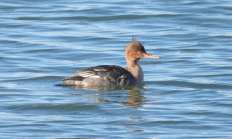
Swimming and diving with grace and energy, red-breasted mergansers arrive in fall but save their complex, contorting courtship display for early spring. A ragged-crested dark green head and reddish brown breast mark the male, along with a dark back and gray sides. Females share the ragged crest; their rufous heads and gray bodies may make separation from common merganser females difficult. Their bills, however, are noticeably slimmer. Red-breasted mergansers are common from fall through spring, mostly in coastal bays and estuaries but occasionally on the open ocean. Hear the call of the red-breasted merganser Photo by Jason Badger, ODFW