
Search myodfw.com
Showing 361 - 380 of 699 results
The House sparrow is an invasive species introduced from Europe. No other North American wild bird is so associated with human settlement as this introduced House sparrow. Its foods are nearly all imports, and its nesting and cover requirements are also human-derived. The House sparrow and European starling are the only introduced passerine birds that are thriving in Oregon. These birds can dominate bird feeders and utilize nest boxes that were intended for native species. The House sparrow can be found statewide around buildings at human developments of adequate size ranging from scattered farmsteads in remote and rural areas to…

CLACKAMAS, Ore.— Anglers will be able to use their two-rod validation in the Willamette River for hatchery spring Chinook and all other fish except sturgeon from June 3-July 31. Two rods were not originally authorized on the Willamette River this year because the forecasted return of hatchery-origin adult spring Chinook…
SALEM, Ore.—Oregon's Fish and Wildlife Commission meets April 23-24 in Lincoln City. View the agenda online. Commissioners will visit coastal coho habitat restoration and monitoring projects in the Siletz River Basin during a field tour on Thursday. To join the tour, meet at the Shearwater Inn, 120 Inlet Court at…
Vireos and shrikes are predatory song birds. Their bills are strong and hooked to kill and dismember prey including insects and small birds, mammals and reptiles. These birds hunt from fences, wires and treetops and sometimes hang captured prey on thorns to eat them later.

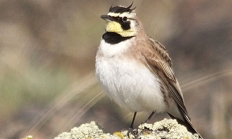
Wide open spaces generally surround these sparrow-sized, ground dwelling birds. The upperparts are mostly brownish and the underparts are generally buffy with varying amounts of yellow on the throat. There is black on the breast and side of the head, but the most unique features are small black "horns." Females and immature birds are duller. Interesting behavior includes aerial displays and "flight songs" during courtship, and the propensity to forage and loaf along dirt and gravel roads. In western Oregon, it breeds in small, scattered populations throughout the Willamette Valley, with concentrations in the central valley on and near Basket…
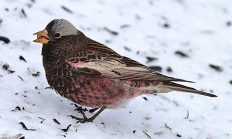
This dark, medium-sized finch with gray and pink highlights is the darkest of the rosy-finches and one of Oregon's rarest breeding birds. It is found in summer in montane areas above timberline, where loose swarms of these birds seem to blow like leaves among isolated cirques, cliffs, and hanging snowfields. In Oregon it breeds on Steens Mountain and may breed occasionally in the Wallowa Mountains. Winter distribution is poorly known, but birds have been found on the lower east side of Steens Mountain and in the Alvord Desert in winter and rarely in central Wallowa County. Hear the song of…
A group of twittering, tiny gray birds streaming through bushes and trees and across openings surely are Bushtits. Females' eyes are pale, males' dark. They are highly gregarious except when nesting. The intricately made sock-like nest is unusually large for the size of the bird. Bushtits show a distinct indifference to humans and regularly nest within residential neighborhoods and establish foraging routs throughout many cities. They regularly take suet at bird feeding stations and visit backyard birdbaths. The Bushtit is a fairly common resident throughout Oregon except in Umatilla, Union, and Wallowa counties and at higher elevations of mountain ranges…

Few birds are as astonishing as the American dipper. This nondescript, dark brown to gray bird is seldom seen more than a few feet from the water's edge. Its elaborate song, which can come forth even on cold winter days, is readily heard above the noise of rushing streams. This bird's ability to dive into a rushing stream to forage on aquatic invertebrates and reappear in the same location has elicited wonder and excitement from ornithologists, naturalists, and birders as well as envy and adoration from fly-fishers. It is an uncommon year-round resident in montane streams and rivers throughout Oregon…

The Common nighthawk is a migrant to Oregon with one of the longest migration distances of any North American bird. It is also one of the last to arrive in Oregon. Long, slender wings are marked by a white patch on the "hand" visible in flight from great distances. When perched on the ground, the cryptic brown, gray, and black mottling makes the bird almost invisible. This bird breeds and migrates at all elevations through the state. Its nesting habitat is characterized by open landscapes with little ground cover and is most abundant in sagebrush and rocky scablands and rimrock…

SALEM, Ore. – Last week in a Corvallis neighborhood, residents worked together to ensure a newborn fawn spotted on a grass strip between a sidewalk and road was left alone. By early evening, its mother returned for her fawn. ODFW biologists praised the residents for recognizing that does often leave…

One of the most familiar sights along the roads of Oregon is a Red-tailed hawk soaring high on the sky over a field, or perched on a utility pole, waiting patiently for prey. Red-tailed hawks are large-bodied raptors with relatively broad wings. The back is mottled brown, and the tail of mature birds is orangish red with a thin, dark subterminal band. Perched birds can be identified from behind even when the tail is concealed by the white mottling on the scapulars forming a faint 'V'. Most individuals can be assigned to one of two color morphs, light or dark…

This small, rich-brown wren is only slightly larger than a quarter, and has a tail quite short for a wren. A quiet observer in the forest will see these birds hop in and out and all over logs, snags, shrubs, twigs, and limbs on the forest floor. It has been said that the song of this bird is larger than the bird itself. The Winter wren breed from Coos County southward and in eastern Oregon in the Blue and Steens mountains. It retreats from high altitudes in winter where snow pack is heavy. Migration probably occurs throughout the state, but…

In grass or sagebrush-dominated habitats throughout the state, the song and striking appearance of the Western meadowlark create one of the most familiar and endearing avian images in Oregon. It's one of Oregon's most recognizable birds with its bold yellow breast and belly with a distinct black V across the chest and its habit of perching on fences along roadsides. Fittingly, it was chosen as Oregon's state bird by a vote of Oregon schoolchildren ratified by the Legislature in 1927. It is one of the most widely distributed open-country species in the arid desert country of eastern Oregon. It can…

The majestic trumpeter swan is the largest of our native waterfowl and one of the heaviest flying birds in the world with males sometimes exceeding 30 pounds. Historically hunted to the brink of extinction, it was recognized as an endangered species long before there was an Endangered Species Act, and its recovery is a conservation success story. The adult's snow-white plumage with contrasting black bill and feet and 8-foot wingspan define this magnificent bird. Their neck is as long as their body and is used to reach food at the marsh bottom. In spring, the trumpeter swan is a locally…

WALDPORT, Ore. — The Oregon Department of Fish and Wildlife and First Baptist Church of Waldport will host the 27th annual family fishing event at Eckman Lake on Saturday, May 16. The event will take place from 9 a.m. to 2 p.m. for youth ages 17 and younger. Each participant…
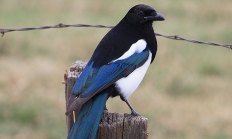
These birds are intelligent, curious, social and have good memories. Members of this group are commonly called the crow family, and are the among the most intelligent birds studied so far.


Oak Springs Hatchery was constructed in several phases beginning in 1922 with the last major construction in 1996. The facility is currently used for egg production, incubation and rearing of rainbow trout, incubation and rearing of summer and winter steelhead, and maintains one resident rainbow trout and one resident cutthroat broodstock.