
Search myodfw.com
Showing 441 - 460 of 665 results
Find maps, boundary descriptions and hunts available in the new Northeast Hunt Area. Download printable PDF map
SALEM, Ore. – ODFW's Oregon Conservation and Recreation Fund (OCRF) is now accepting letters of interest for its summer 2025 Wildlife Crossing Infrastructure Grant Opportunity, supporting capital construction projects that reduce wildlife-vehicle collisions and restore critical movement and migration pathways across Oregon. Letters of Interest must be submitted before 11:59…
ORDER Replacement Hunter Safety Card
Year Round
Online
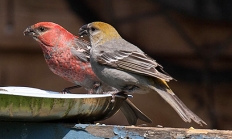
While in Oregon, the Pine grosbeak is tame and not suspicious, usually allowing a close approach as it feeds on buds or dried fruits. The soft-gray females and young males, the latter more or less washed with yellow on the head, far outnumber the rosy males, and observers should look carefully for these duller-colored birds. The song of the Pine grosbeak is often described as similar to the Purple finch, but fuller and with lower pitch. The flight is typically finch-like, but with broad, bounding undulations. The Pine grosbeak breeds in the Wallowas and is suspected to breed in the…
Find maps, boundary descriptions and hunts available in the new Northeast Hunt Area. Download printable PDF map
CLACKAMAS, Ore.— Anglers with the two-rod validation will be able to use two rods in areas of the upper Willamette River open to coho retention through the end of the year, under a temporary rule adopted by ODFW. Effective Aug. 1 through Dec. 31 for anglers with the validation, two…
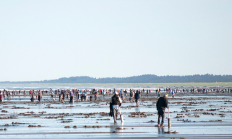
ASTORIA, Ore. – Clatsop beaches reopen for razor clam harvesting Oct. 1 following the annual conservation closure that began July 15. Before harvesting razor clams or any shellfish, always call the Shellfish Safety Hotline at 1-800-448-2474 or visit the ODA Recreational Shellfish Biotoxin Webpage. During the closure, Oregon Department of…
Salem, Or. — The Oregon Department of Fish and Wildlife's Salmon and Trout Enhancement Program (STEP) Advisory Committee will meet in person Tuesday, Oct. 14 in the Evergreen conference room in Cartwright's Taprock Grill & Restaurant at 971 SE 6 th St. in Grants Pass. The meeting runs from 8…

Brandt's cormorants nest colonially on offshore islands and mainland cliffs and are the most common of the cormorants on the Oregon coast in summer. In the breeding season, males are easily distinguished by their intense blue gulag pouches, displayed with a skyward pointing of the bill. They also have wispy white plumes along the side of their head and on their back, which show well against the solid black of the rest of their plumage. In bright light they have a green iridescence. During all seasons they can be distinguished from the two other Oregon species by buff-colored feathers that…

Skulking through wetlands, the American bittern is rarely seen - it has an extremely slow and stealthy walk, and when a threat approaches it freezes and mimics marshland plants with upright posture and beak pointed skyward. These behaviors combined with its cryptic plumage effectively camouflage the bird. However, it is occasionally seen in flight, and its low, gurgling song can be heard over long distances. An uncommon to fairly common breeder east of the Cascades and a rare migrant in Malheur county it has also been noted at mountain lakes east of the Cascades in Lake County. In western Oregon…

Find maps, boundary descriptions and hunts available in the new South Wallowa Hunt Area. Download printable PDF map
SALEM, Ore.—Head to a participating Jamba location for a new limited edition Wildlife Conservation tumbler that benefits wildlife. The colorful tumbler features five species: Sierra Nevada red fox, Northern red-legged frog, Western snowy plover, Northwestern pond turtle and Pygmy rabbit. All are native species facing population declines due to challenges…

With short pointed wings and long narrow tails, these small falcons are well built for fast pursuit and mid-air attacks. Sexes differ in color and size, with adult males about 25 percent smaller by weight than females. Males range from blackish gray to pale blue-gray on the back with a reddish wash along sides of the breast and a banded tail; females have brownish backs. In winter, it can be found throughout the state in open or semi-open habitats, but it is most regular near major estuaries, lakes, reservoirs, and occasionally in cities where food supplies are reliable. For nesting…

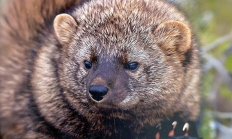
The Fisher is considerably larger than the marten and males are considerably larger than females. It is more stockily built than the weasels, but is similar in that the head is somewhat pointed, the body elongate, and the legs short. The pelage is long except on the face. The fur is dark brown grading to black on the rump and legs; the tail is black. Fishers once occurred throughout the coniferous and mixed forests of Oregon's Coast Range and Cascade Mountains. Currently, there is a native population in the Siskiyou Mountains and an introduced populations in the southern Cascades that…
The Striped skunk is about the size of a house cat with a pointed head; slightly upturned, nearly spherical nose pad; and beady black eyes. The pelage is entirely black except for a narrow white stripe on the forehead and nose, a white pate leading to two diverging white stripes on the back that extend partly or completely to the rump. Entirely white skunks, or skunks with the black replaced by seal brown or the white replaced by yellow are also know to occur. Without doubt, the most widely recognized characteristic of the Striped skunk is the pungent odor of…

This medium-sized, shy grebe has bright white cheeks that contrast sharply against a dark crown and rust red neck during the breeding season. An aquatic bird, it breeds in lakes and ponds, usually in forested areas. In Oregon, it is found in waters with hardstem bulrush intermixed with open water over five feet deep. Five to 20 birds at Rocky Point in the Upper Klamath Lake National Wildlife Reserve form the only consistent breeding population in Oregon. The red-necked grebe reaches its greatest numbers during winter along the coast. The red-necked grebe is an Oregon Conservation Strategy Species in the…
