
Search myodfw.com
Showing 461 - 480 of 699 results
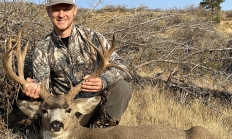

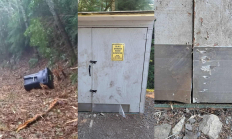
A black bear tried its best to get into a Neskowin homeowner's bear resistant trash can. The homeowner then built a small shed to enclose the trash can. The persistent bear left its prints and claw marks on the shed but did not succeed in breaking into it. This resident…
Secretive little birds, wrens creep through vegetation and take flight in erratic patterns. Kinglets are insectivores.

The major portion of Elk River Hatchery construction was completed in 1968. In 1971 the hatchery completed final construction on an intake and ten new ponds. The purpose of the facility is to supplement natural production of fall Chinook in the Elk and Chetco Rivers and winter steelhead in the Chetco River. The facility is used to collect Elk River fall Chinook, to incubate eggs and rear both natural and hatchery fall Chinook and winter steelhead.
The North Nehalem Fish Hatchery was originally constructed in 1966. The hatchery replaced the Foley Creek Hatchery which was constructed in 1926. The facility is used for adult collection, spawning, egg incubation and rearing of fall Chinook, coho, winter steelhead and rainbow trout.
Oxbow Hatchery was originally constructed in 1913 to provide additional rearing facilities for Bonneville Hatchery. It was relocated to this present site in 1937 following the construction of Bonneville Dam. Oxbow operated as a state-funded hatchery until 1952 when it was remodeled and expanded as part of the Columbia River Fisheries Development Program (Mitchell Act) – a program to enhance declining fish runs in the Columbia River Basin. The hatchery is presently used for interim egg incubation and early rearing of coho and spring Chinook salmon. No adult fish are collected or spawned at Oxbow and there are no fish…
ODFW's legislatively adopted 2025-27 budget did not include funding to continue the operation of Salmon River Hatchery. The hatchery is shifting fish production to other facilities but will remain open for public/fishing access with a volunteer host and occasional staff on site. Learn more.
Although called warblers, many of these perching birds may not necessarily be closely related to one another. They are usually easier to hear than see.

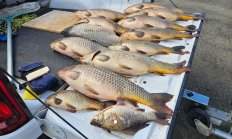
ROSEBURG, Ore. – Illegally introduced common carp were found in Cooper Creek Reservoir near Sutherlin. ODFW verified an angler's report of carp in Cooper Creek last week by electrofishing, removing 14 adult carp, most of which were pregnant females ranging in age from approximately two to eight years old. This…
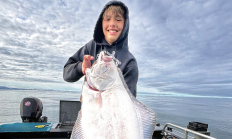
NEWPORT, Ore – Pacific halibut angling opens Aug. 17, Sundays through Friday through Sept. 30 or until quota is reached in the Columbia River subarea (Leadbetter Pt., WA to Cape Falcon, OR) all-depth fishery. The daily bag limit is one Pacific halibut. The Columbia River subarea received a 5,000-pound allocation…
Bitterns, herons, and egrets are all long-legged wading birds with long necks and pointed bills for spearing fish or other prey.

Fun little birds to watch, chickadees and nuthatches are common in Oregon. With short, strong bills, they feed on insects and seeds and are often seen in groups.

Towhees, sparrows, grosbeaks and buntings are ground-dwelling birds that are typically drab looking. They feed on insects in summer and seeds in winter.

These diving birds are built for living on the water, floating low on the surface with legs farther to the rear to help propel them underwater. Loons have webbed feet, grebes have lobed toes.

Murres, auklets and puffins are all sea birds that only come ashore to nest. The most unique is the Marbled murrelet which flies inland - sometimes great distances - to nest in coastal coniferous forests.

Alsea Hatchery was constructed in 1936 and is operated with state funds. Many improvements have been made to the hatchery since original construction. The hatchery produces both winter steelhead and rainbow trout. The facility is used for adult collection, spawning, egg incubation and rearing of winter steelhead, and egg incubation and rearing of rainbow trout.
The present facility was constructed in 1925, across the North Umpqua River from an earlier trout hatchery built in 1920. The hatchery was closed in 1975 due to low stream flows and high water temperatures, and was reopening in 1979 after extensive reconstruction. In 2012 a state of the art fish passage ladder was completed. It included a fish viewing window for Rock Creek basin fish inventory and a fish trap facility. The hatchery produces fall and spring Chinook, coho, summer and winter steelhead, and rainbow trout. The facility is used for adult collection, spawning, incubation, and rearing of Chinook…