
Search myodfw.com
Showing 481 - 500 of 699 results
Cole Rivers Hatchery was constructed by the US Army Corps of Engineers (USACE) in 1973 to mitigate for spawning and rearing areas blocked by the construction of Lost Creek, Applegate, and Elk Creek Dams. The hatchery was named in honor of Cole M. Rivers, a biologist on the Rogue River for 20 years. The facility is used for adult collection, spawning, egg incubation and rearing of spring Chinook, coho, summer steelhead, and winter steelhead, and egg incubation and rearing of fall Chinook and rainbow trout. Infrastructure Repair and Renovation Updates
Construction of this facility began in 1924 and production started in 1925 by the state of Oregon. Various renovations have taken place with the most recent being the addition of 4 new fish rearing raceways and improvements to the pollution abatement system which was completed in 2016. Other renovations made throughout the hatchery have utilized the Restoration and Enhancement Program.. The purpose of this facility is to enhance spring Chinook, winter steelhead, summer steelhead, and coho populations for various coastal streams. The facility is used for adult collection, egg incubation and rearing of spring Chinook, fall Chinook, winter steelhead, summer…
Leaburg Hatchery was built in 1953 to mitigate for lost fishing opportunity because of the many dams on Willamette Basin rivers. These dams include Cougar, Blue River, Carmen-Smith, Lookout, Dexter, and others. The hatchery rears rainbow trout, summer steelhead and Chinook salmon, and has a staff of four employees. Come visit our show pond and see huge white sturgeon and rainbow trout. There’s a viewing platform built by the McLaren School for Boys in 1993 to allow visitors to get a close up look at spring Chinook salmon spawning in the creek below.
Oregon has two species of pelicans, American white and the Brown pelican, and three species of cormorants. All are fish-eating water birds with four toes joined by webbing. Depending on the species, pelicans and cormorants inhabit the Oregon coast, rivers or interior waterbodies.

Oregon has a variety of raptors, from the diminutive Sharp-shinned hawk to our nation's symbol, the Bald eagle. Some of these birds of prey are migratory, while many live here year-round and can be seen hunting along rivers, roadside posts and fields.

Hummingbirds are a popular backyard bird watching species, especially at hummingbird feeders. Avoid commercial mixes that contain red dye. Hummingbirds swoop and dive with most performing a low back-and-forth movement called a shuttle display. Feeding on flower nectar, hummingbirds often are stained with pollen and are an important pollinator.

The mottled petrel breeds in New Zealand and nearby islands, and ranges throughout much of the Pacific Ocean, mostly far from land. It is a common May to October visitant in the northern and eastern North Pacific, with non-breeding birds occurring during the winter months. Photo by Dominique, Flickr

FOR IMMEDIATE RELEASE Oregon Department of Fish and Wildlife (ODFW) Confederated Tribes of the Umatilla Indian Reservation (CTUIR) Statement on Qapqápa Wildlife Area Acquisition Oregon Department of Fish and Wildlife (ODFW) and the Confederated Tribes of the Umatilla Indian Reservation (CTUIR) regret to announce that the Qapqápa (pronounced cop-COP-a) Wildlife…
SALEM, Ore. – Effective June 1 through Sep. 30, minimum and maximum size limits as well as the daily and possession bag limits for rainbow trout and bass are suspended for Thief Valley Reservoir, Pilcher Creek Reservoir, and Wolf Creek Reservoir which are all located within the Southeast Zone in…
Trask River Hatchery was constructed in 1916 to replace an earlier hatchery that was located three miles upstream from the present site. Many improvements have been made to the hatchery since original construction including a new alarm system, early rearing building, and a 40’ x 60’ pole building. Trask Pond was constructed in 1970 and Tuffy Creek was constructed in 1988. The hatchery is used for adult collection, incubation, and rearing of fall and spring Chinook, coho, wild winter steelhead and hatchery winter steelhead.
Willamette Trout Hatchery and the adjacent Oakridge Salmon Hatchery were combined in 1983 and operate today as Willamette Hatchery. The trout hatchery was constructed in 1922 and the salmon hatchery in 1911. The U.S. Army Corps of Engineers (USACE) rebuilt the salmon hatchery in 1952 to mitigate for fishery losses caused by Hills Creek, Lookout Point and the Dexter hydroelectric/flood control projects. The trout side was rebuilt between 1950 and ‘56. Today, Willamette Hatchery is used for adult holding/spawning, egg incubation and rearing of spring Chinook and rainbow trout. In addition, both summer and winter steelhead are reared at this…
The gopher snake occurs in a wide variety of habitats, from deserts and grasslands to woodlands and open forests. It frequents agricultural regions, especially where there is brushy cover such as fence rows. Diet varies according to size, with young eating insects, lizards, rodents, and birds and their eggs. Adults can take larger prey, occasionally as large as rabbits. Photo by Simon Wray, ODFW
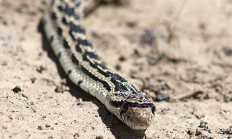
The red fox has a beautiful orange-red coat, black feet, and black-tipped ears. The belly is usually white or light grey, the muzzle is narrow and pointed, and the ears are pointed. It is an opportunistic carnivore, eating what is available including small mammals, birds and their eggs, reptiles, amphibians, fruit and some insects. The red fox is territorial and mates for life Red foxes occur throughout much of Oregon.

This lizard prefers humid areas, such as the edges of meadows in coniferous forests, and is also found in riparian zones. This is the only lizard found in the cool coastal forests of northern Oregon. The Northern alligator lizard eats small invertebrates (termites, beetles, ticks, spiders, millipedes, and snails), and occasionally takes small birds, mammals, and other lizards. Photo by Simon Wray

This snake is most common in thick vegetation along water bodies, but ranges into farmland, chaparral, and deciduous and mixed coniferous woodlands in the Rogue and Umpqua river valleys of southwestern Oregon. Common kingsnakes usually feed on other snakes, but have been known to take small turtles, birds and their eggs, frogs, lizards, reptile eggs, and some small mammals. Photo by Alan Schmierer, Flickr
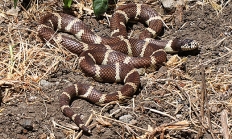
In the Northwest, this snake is found in grasslands, sagebrush flats, rocky stream courses, and canyon bottoms. Elsewhere it also frequents juniper and pine-oak woodlands. In southwestern Oregon, it is found in dry bushy areas close to rocks. Young striped whipsnakes feed primarily on lizards and insects. Adults also take snakes, small mammals, young birds, and insects. Photo by Bryn Hamilton, Flickr

The Rufous hummingbird is the most common and widespread of Oregon hummingbirds. This rusty-red and fearless nectar feeder is a popular yard bird, inspiring even the most modest of nature lovers to set up a feeder. It is a common transient and breeder throughout most of western Oregon, especially in forested regions. Hear the call of the Rufous hummingbird Photo by Charlotte Ganskopp

The racer is found in a variety of open habitats, including sagebrush flats, juniper woodlands, chaparral, and meadows. It avoids dense forests, high mountains, and very dry areas, and seeks cover under rocks, logs, or dense shrubs This species feeds on lizards, smaller snakes, frogs, toads, small mammals, birds and their eggs, and some insects. Young racers eat crickets, grasshoppers, and other insects. Photo by Simon Wray, ODFW
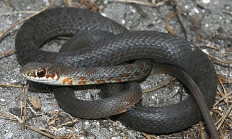
These delicate and truly golden plovers that pass through Oregon in fall are always a delight to find on an open beach or grassy coastal plain. The Pacific golden-plover feeds mainly in the open. A rare to uncommon migrant; most birds occur in fall on the outer coast. They are very rare to rare in winter on the coast and in the Willamette Valley. Hear the call of the Pacific golden-plover Photo by Dave Budeau, ODFW

With long, pointed wings, nighthawks can sometimes be seen during the day catching insects while in flight although most are active at night. Nighthawks roost by scraping the ground or roost on low branches. Nestlings can fly at 10 days old. Swifts nest on vertical walls, such as chimneys or old smoke stacks, hollow trees or rock crevices. It's fun to watch them at dusk in summer, circling their nesting site. These birds are never seen perched, but only in flight.
