
Search myodfw.com
Showing 481 - 500 of 677 results
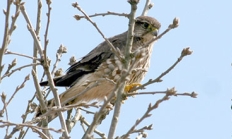
One of the most impressive sights in the unforested regions east of the Cascades is a Prairie falcon strafing a Belding's ground squirrel colony repeatedly at full speed in hopes of catching one emerging from its burrow at just the wrong moment. Prairie falcons are most common in rimrock country where they nest, but may travel great distances in search of prey. Prairie falcons are large, sandy brown above and off-white with variable amounts of streaking below. The face has a vertical stripe below the eye, as do many falcons. In flight, the long, pointed wings and long tail identify…
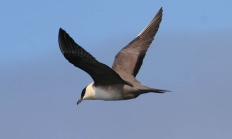
Graceful and buoyant fliers, adults are light gray-brown above with black caps, have dark flight feathers contrasting with grayer mantles and light underparts. Breeding adults have a central pair of tail feathers extremely long and pointed, extending up to eight inches past the rest of the tail. They are not usually as aggressive as other jaegers and rely as much on food they pick from the ocean's surface as they do from food they steal from other small seabirds. The Long-tailed jaeger is a rare to fairly common fall transient offshore. They are usually detected when Arctic terns and Sabine's…
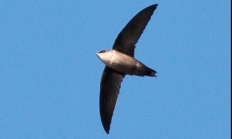
This small swift is best known for its quick flight and dazzling aerial agility, perching only when nesting or roosting. It is aerodynamically designed for fast speeds with long, pointed wings, short stout legs, and a compact body. The Vaux's swift is a transient and summer resident nesting in older forests and brick chimneys statewide except the southeast part of Oregon. Hear the call of the Vaux's swift Photo by Julio Mulero, Flickr
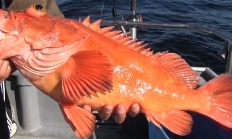
Features: Blue sharks are named for their brilliant blue color. They are slender with a long, pointed nose. They can grow to be 12-feet long, though they rarely get over 10-feet. Habitat: Blue sharks are found in all the world’s temperate and tropical oceans. They have been spotted as far north as Norway and as far south as Chile. They roam both open and coastal waters in search of octopuses, squid, cuttlefish, and fish. Technique: Typically chumming the water will attract blue sharks. You will need a wire leader to protect your line from the blue shark's saber-shaped teeth. Fins…

Features: Female pheasants are brown on top and paler underneath. They have black spots on their sides and black bars throughout their tails. The males are much more conspicuous with bright red on their head, a white band around their necks, and an iridescent copper color on their sides and backs. Their tails are long and pointed with barring. Habitat: The ringneck is a farmland species, heavily dependent on cereal grains and other seeds. They also like taller vegetation for cover. Technique: Because pheasants are tied so closely to agriculture, the majority of hunting opportunity occurs on private lands. State…

Find maps, boundary descriptions and hunts available in the new Northeast Hunt Area. Download printable PDF map
CLACKAMAS, Ore.— Anglers with the two-rod validation will be able to use two rods in areas of the upper Willamette River open to coho retention through the end of the year, under a temporary rule adopted by ODFW. Effective Aug. 1 through Dec. 31 for anglers with the validation, two…
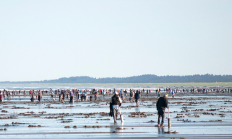
ASTORIA, Ore. – Clatsop beaches reopen for razor clam harvesting Oct. 1 following the annual conservation closure that began July 15. Before harvesting razor clams or any shellfish, always call the Shellfish Safety Hotline at 1-800-448-2474 or visit the ODA Recreational Shellfish Biotoxin Webpage. During the closure, Oregon Department of…
Salem, Or. — The Oregon Department of Fish and Wildlife's Salmon and Trout Enhancement Program (STEP) Advisory Committee will meet in person Tuesday, Oct. 14 in the Evergreen conference room in Cartwright's Taprock Grill & Restaurant at 971 SE 6 th St. in Grants Pass. The meeting runs from 8…
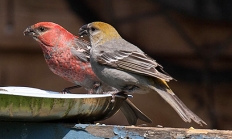
While in Oregon, the Pine grosbeak is tame and not suspicious, usually allowing a close approach as it feeds on buds or dried fruits. The soft-gray females and young males, the latter more or less washed with yellow on the head, far outnumber the rosy males, and observers should look carefully for these duller-colored birds. The song of the Pine grosbeak is often described as similar to the Purple finch, but fuller and with lower pitch. The flight is typically finch-like, but with broad, bounding undulations. The Pine grosbeak breeds in the Wallowas and is suspected to breed in the…
Find maps, boundary descriptions and hunts available in the new Northeast Hunt Area. Download printable PDF map

Brandt's cormorants nest colonially on offshore islands and mainland cliffs and are the most common of the cormorants on the Oregon coast in summer. In the breeding season, males are easily distinguished by their intense blue gulag pouches, displayed with a skyward pointing of the bill. They also have wispy white plumes along the side of their head and on their back, which show well against the solid black of the rest of their plumage. In bright light they have a green iridescence. During all seasons they can be distinguished from the two other Oregon species by buff-colored feathers that…

Skulking through wetlands, the American bittern is rarely seen - it has an extremely slow and stealthy walk, and when a threat approaches it freezes and mimics marshland plants with upright posture and beak pointed skyward. These behaviors combined with its cryptic plumage effectively camouflage the bird. However, it is occasionally seen in flight, and its low, gurgling song can be heard over long distances. An uncommon to fairly common breeder east of the Cascades and a rare migrant in Malheur county it has also been noted at mountain lakes east of the Cascades in Lake County. In western Oregon…

Find maps, boundary descriptions and hunts available in the new South Wallowa Hunt Area. Download printable PDF map
Marion Forks Hatchery began operation in 1951. The U.S. Army Corps of Engineers (COE) funds the majority of operational costs as mitigation for the development of Detroit and Big Cliff dams. The hatchery is used for egg incubation and rearing of spring Chinook.
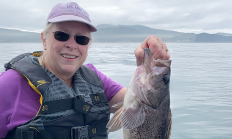
Cara Rupp with her 5 lb. 11 oz. Black rockfish near Beverly Beach State Park. Photo provided by Dennis J Rupp. NEWPORT, Ore. – The General Marine Species daily bag limit is reduced to three fish beginning Sept. 18 to lower the risk of an early season closure. The one-fish…
CLACKAMAS, Ore. – Fishery managers from Oregon and Washington added more recreational salmon fishing days in the mainstem Columbia River during a joint-state hearing today. The decision came after fishery managers assessed Chinook harvest in the fall season fisheries and considered the current in-season abundance expectations for upriver salmon stocks…