
Search myodfw.com
Showing 501 - 520 of 1410 results
The Eastern gray squirrel is the smallest member of the genus in Oregon. This squirrel was introduced into Oregon and can now be found in Salem, Portland, Milwaukie, and Vale. All populations in Oregon have been found in urban areas. This squirrel is active throughout the year, activity restricted to daylight hours. Photo from Washington Fish and Wildlife

Searching for frogs and salamanders is a great way to introduce kids to the wonders of Oregon's wildlife and the great outdoors. Learn more about their various habitat needs and you'll increase your chances of seeing one of these unique species. Remember to leave no trace to preserve their habitat. Check out our fun facts on Oregon's frogs.
The American bullfrog is a non-native invasive frog that survives and reproduces very successfully in Oregon. Bullfrogs aggressively compete for food and living space with our native frogs. They eat many types of native wildlife including other frogs, young pond turtles, and ducklings. Bullfrogs can lay almost 10 times more eggs than native frogs and can quickly out number them. Photo by Kathy Munsel

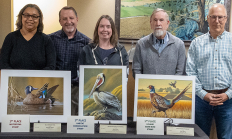
SALEM, Ore. – The winning artwork has been selected for the 2026 Oregon Waterfowl, Upland Game Bird, and Habitat Conservation Stamp Art Contests. In the Waterfowl Stamp category, first place went to Richard Clifton of Milford, Del., for his artwork featuring a blue-winged teal. For the Upland Game Bird category…

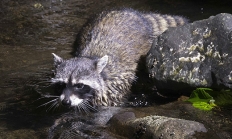
Few, if any, behavior patterns of wild mammals are more widely recognized than the so-called "food-washing" behavior of the racoon. Wild raccoons, in foraging along streams, commonly sit on their hind legs (sometimes in the water), stare vacantly into space, and search for food by "dabbling" with splayed-fingered forepaws. View more information about Living with Wildlife, Raccoons for tips on preventing conflicts at home and in the wild.


The major portion of Elk River Hatchery construction was completed in 1968. In 1971 the hatchery completed final construction on an intake and ten new ponds. The purpose of the facility is to supplement natural production of fall Chinook in the Elk and Chetco Rivers and winter steelhead in the Chetco River. The facility is used to collect Elk River fall Chinook, to incubate eggs and rear both natural and hatchery fall Chinook and winter steelhead.
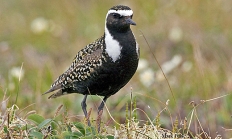
These elegant shorebirds are found as often in dry or damp upland areas as they are on mudflats or beaches. The plain brown immature birds of autumn become spangled with black and gold as breeding approaches. It is an occasional to uncommon migrant in western Oregon (mainly coastal) and locally rare, irregular migrant in eastern Oregon, with most reports at Malheur National Wildlife Refuge, in the Klamath Basin (summer) and in Umatilla County. Hear the call of the American golden-plover Photo by Mark Peck, Flickr
This is a bird of riparian thickets, farmlands, and towns. Since 1980, it has been observed almost annually in Harney County, usually in numbers less than five. A pair successfully fledged young near the Malheur National Wildlife Refuge headquarters in 1994. Most Harney County records occur from early April to late October. Away from Harney county individuals have also been seen in the various eastern and southeastern counties of Oregon. Hear the song of the Great-tailed grackle Photo by Kathy Munsel, ODFW

The Townsend's pocket gopher is a large pocket gopher. The pelage is dark buffy-gray to sooty gray on the dorsum and a rich buff on the venter; the face, nose and auricular patch are black; the feet are dirty gray; and the chin is white. This gopher occurs along the Malheur and Owyhee river valleys in Malheur County and in southern Harney County. Townsend's pocket gophers have been found in alkaline soils along the south shore of Harney Lake and in deep fertile soils near Sod House School near the headquarters of the Malheur National Wildlife Refuge and in Stergen…
The pelage of this mouse is grayish or brownish dorsally, the venter hairs are white with lead-colored bases, and the tail is light colored. In Oregon, it occurs within the area circumscribed by a line connecting Denio Nevada; Fort Rock, Lake County; Powell Butte, Crook County; Malheur National Wildlife headquarters, Harney County; and Burns Junction, Malheur County. On a daily basis, activity begins with an intense burst during the first light to hours after sunset, and declines to almost nil six hours after sunset, then, especially in summer, increases again before sunrise. The Dark Kangaroo Mouse constructs elaborate nests with…

SALEM, Ore.—Oregon's Fish Screens Task Force and Fish Passage Task Force will meet jointly Friday, Dec. 5 from 8 a.m. to 12:30 p.m. online. The meeting will be open to the public. Members of the public who are interested in the meeting are encouraged to attend in person or participate…
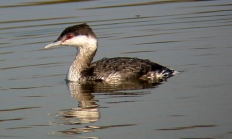
In alternate plumage this striking bird's lower neck, chest, and sides are bright chestnut. Three groups of yellow plumes adorn the sides of the head. Its head and throat are black. This grebe favors areas with much open water surrounded with emergent vegetation. The horned grebe is a rare breeder east of the Cascades. Malheur National Wildlife Reserve averages four to five pairs per summer. It is also rare along the coast in summer and is an uncommon spring and fall transient on lakes, reservoirs, and large rivers west of the Cascades and uncommon to common east of the Cascades…
Western Oregon observers enjoy these large, elegant plovers almost year-round, and as a consequence they are one of the most familiar larger shorebirds. Almost all migrants and winterers visiting Oregon inhabit mudflats and open wet dirt fields. A few can be found on sand beaches and even occasionally on rocks, but the great majority are found feeding and resting on open mud. In Oregon, it is a fairly common to common transient in western interior valleys. East of the Cascades, the Black-bellied plover is an uncommon transient in the Klamath Basin and at Malheur National Wildlife Refuge. In winter it…

A large, long-legged wader distinguished from similar species in a flight by flashing rufous underwings and dark brown primaries. Its feet extend beyond tail tip in flight. Flocks generally consist of fewer than 50 birds on the coast. Juveniles migrate south several weeks later than most adults. After mid-November, a few stragglers are seen until late December. The Marbled godwit is a regular spring and fall migrant on the Oregon coast. Spring migration commences in early April and extends through early June on the coast. Its average arrival at the Malheur National Wildlife Reserve is April 27. Hear the call…

