Search myodfw.com
Showing 581 - 600 of 903 results
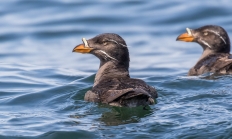
Rhinoceros auklet are one of the rarer breeding alcids in Oregon. Adults are easily recognized during the breeding season by the vertical "horn" at the base of the upper mandible. Birds in breeding plumage have brownish gray backs, a gray-brown chest, and a dirty white belly. Two distinct plumes are present on the head, one above and one below the eye. The bill is orange. In non-breeding plumage the horn is greatly reduced, the plumes absent or reduced, and the bill duller. It nests in small numbers in Oregon with Goat and Hunter Islands having the largest concentrations of breeding…
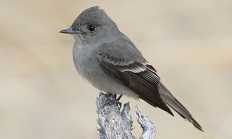
The down-slurred pee-eer call of this flycatcher is one of Oregon's most characteristic summertime bird sounds. Wherever there is a canopy of mature deciduous trees, one is likely to hear the call during warm afternoons when most other birds are silent. Because the call can easily be heard, it can usually be found perched near the tip of a dead branch from which it frequently flies a short distance to capture a flying insect, or to chase an intruder from its territory. The Western wood-pewee is a common migrant and fairly common breeder statewide in open groves of trees or…
A colorful harbinger of spring, the hardy Tree swallow arrives from the south during February each year. It is a highly social species that is usually observed in large flocks often with Violet-green and other swallow species. It is not colonial but several pairs may nest together if available cavities are clustered. The Tree swallow is a bird of open places near water and is seldom seen in residential neighborhoods or built-up urban areas. It is the only swallow that eats berries and small seeds as well as insects. In Oregon, it is a locally abundant summer resident and breeding…

Brown creepers are the only North American birds that rely on both the trunk and bark of trees for both nesting and foraging. They are small birds, about five inches in length, and have a long, slender, down-curved bill used to probe for insects hidden in the furrows of tree bark. Their brown back, streaked with white, makes creepers on of the best-camouflaged girds of the forest. They most often forage upward from the base of a tree, using their long, stiff tail for support. The Brown creeper breeds and winters throughout forested areas of Oregon, from the coast to…

Skulking through wetlands, the American bittern is rarely seen - it has an extremely slow and stealthy walk, and when a threat approaches it freezes and mimics marshland plants with upright posture and beak pointed skyward. These behaviors combined with its cryptic plumage effectively camouflage the bird. However, it is occasionally seen in flight, and its low, gurgling song can be heard over long distances. An uncommon to fairly common breeder east of the Cascades and a rare migrant in Malheur county it has also been noted at mountain lakes east of the Cascades in Lake County. In western Oregon…

This medium-sized shorebird is the most common dowitcher in eastern Oregon and inland locations, where it sometimes gathers in large flocks feeding in shallow water. It is also the only dowitcher in the state that regularly winters. Although breeding plumage adults are reddish below and heavily patterned above, most birds seen in Oregon are duller postbreeding adults or browner immatures. During winter, when shorebirds are hard to find, a small flock of chattering dowitchers, even in plain gray basic plumage, often brightens a day in western Oregon. In migration, it can be found at almost any shallow water site in…

This drab, greenish, diminutive species is similar in appearance to the Hutton's vireo, and sometimes confused with that species in western Oregon. Slighter-billed and smaller than the vireo, this little bundle of energy seems always to be moving as it flicks its wings and hops from twig to twig. The male Ruby-crowned kinglet sports a bright red crown spot, typically visible only when the bird is agitated, and in spring pours fourth a delightful melody, surprising for such a small, drab bird. This species breeds in high elevation forests, primarily east of the Cascade crest, where it is common in…

One of the most numerous breeding birds in Douglas-fir and true fir forests of western Oregon is the Hermit warbler, yet it is often overlooked. This may be surprising, given the male's bold colors; however, it seldom descends from the higher reaches of the forest canopy. If you are familiar with its song, you can often hear three to five males singing on a spring morning from many places in appropriate habitat. The male Hermit warbler has a bright yellow head, set off by a black throat and nape. The gray back is marked with black stripes that vary in…

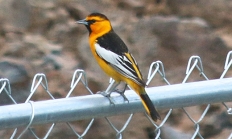
A boldly colored medium-sized bird, the Bullock's oriole builds its characteristic hanging nest in broadleafed trees and tall shrubs, especially when the trees or shrubs are spaced widely and situated along the edges of streams and fields. In Oregon, the Bullock's oriole is a rare to fairly common breeder, especially along major rivers and around farmsteads. It is most widespread in southwest and northeast Oregon. In particular, on the Derby Road in Jackson County. It nests primarily in open spaced cottonwoods, maples, and other tall, forking broadleaf trees. The nest is constructed of plant fibers, hairs, fine grass, and moss…
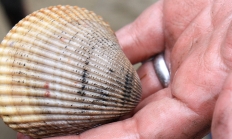
Features: Identified by its prominent radiating ridges. Habitat: Cockles are "hard shelled" clams. Their protective, stout shells and short siphons mean that they do not have to bury as deeply as other common bay clams. Good cockle beds will often have cockles right on top of the sand on a good tide. They prefer sandy areas with high salinity, but can be found at many types of tideflats. Technique: The best clamming is during low/minus tides. Because these clams are so near the surface, you rake, rather than dig, for them. A four prong gardening rake is perfect for raking…
Features: Dungeness crab can sometimes be confused with rock or other crab species. However, it is easily identified by its white-tipped claws and reddish-brown to purple color. Habitat: Adult Dungeness crab forage on a number of fish and invertebrate species. They can be found throughout the sandy and muddy areas in the shallowest parts of lower estuaries all the way to depths of almost 1,500 feet. Techniques: There are many kinds of crab catchers – from crab pots and rings, to traps you can cast with a fishing rod. You can easily crab from a dock in many coastal bays…

This medium-sized, shy grebe has bright white cheeks that contrast sharply against a dark crown and rust red neck during the breeding season. An aquatic bird, it breeds in lakes and ponds, usually in forested areas. In Oregon, it is found in waters with hardstem bulrush intermixed with open water over five feet deep. Five to 20 birds at Rocky Point in the Upper Klamath Lake National Wildlife Reserve form the only consistent breeding population in Oregon. The red-necked grebe reaches its greatest numbers during winter along the coast. The red-necked grebe is an Oregon Conservation Strategy Species in the…

This is the world's smallest "peep" and can usually be picked out by its brownish coloration, dull yellowish legs, and hunched, creeping foraging style. Least can be found in small flocks in Oregon almost year-round. The Least sandpiper feeds on open mud with Western sandpipers but often feeds where some grass, salicornia or other cover is present, avoiding walking in the water as Western often do. It is uncommon to locally abundant statewide in migration, with most birds along the coast and at larger lakes and marshes inland. It is locally common on the coast in winter; smaller numbers winter…

Cryptically colored, usually solitary and somewhat secretive, the Wilson snipe is often flushed before being seen, sometimes exploding from practically underfoot and rocketing off in a corkscrew flight. This plump-bodied, long-billed bird of open marshland is primarily crepuscular, peaking in feeding activity at dusk and dawn, and often sleeping during the day. In breeding season they become more flamboyant, appearing atop fence posts and displaying their unique winnowing flights from high in the air, their outer tail feathers vibrating with an eerie whistling sound. They are uncommon and local west of the Cascades in the summer and uncommon and local…

The Juniper titmouse presents the demeanor of a miniature jay with its crest jutted proudly upright. It is a pale gray bird above and underneath, with little or no brown coloration. Songs and calls are useful in locating hidden titmice. The Juniper titmouse occurs in pinyon pine-juniper woodlands in the bulk of its range. This bird is a cavity nester. The nest is often placed in a crevice of a twisted trunk of large, older junipers. It primarily forages in junipers and juniper seed are important in the winter diet. An Oregon Conservation Strategy Species in the Northern Basin and…

SALEM, Ore.—Everyone can fish, clam and crab for free in Oregon on Saturday and Sunday, June 7-8, 2025. No fishing/shellfish licenses or tags (including a Combined Angling Tag or Columbia River Basin Endorsement or Two-Rod Validation) are required on these days. Both Oregon residents and nonresidents can fish for free. Oregon…
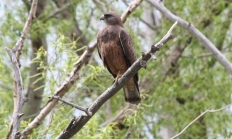
Swainson's hawks are medium-sized buteos, smaller than Red-tailed and Ferruginous hawks. Plumage beneath varies along a continuum from very pale to nearly black below. Lighter-plumaged birds have a distinct chest band. They have relatively long, pointed wings that contribute to superior flying skills. The dark flight feathers contrast with paler wing lining in all but the darkest birds. It breeds in the bunchgrass prairies east of the Cascades with the highest concentration in the foothills of the Blue and Wallowa mountains. It prefers open country and has little need for numerous trees since it forages extensively while in flight and…
These small, fast flying seabirds are unique among alcids in North America in their use of coastal coniferous forests, primarily old-growth trees, as nesting habitat. Their solitary nests are usually concealed within the forest canopy, and breeding birds are cryptic and primarily crepuscular at nest sites. Because of their secretive behavior and elusive nests, Marbled murrelets were considered the "enigma of the Pacific" and were one of the last ornithological mysteries in North America, as the first nest was not discovered until 1974. Distribution at inland nesting sites is fragmented, as birds occur only in areas where suitable habitat remains…

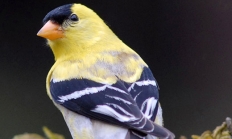
The exuberant bounding flight, musical calls, and flashy yellow and black plumage of the American goldfinch in breeding-season make them one of the most recognized and welcome of Oregon birds. Found in flocks nearly year-round, these goldfinches are a familiar site in riparian woodlands, orchards, weedy fields, and agricultural land. They are among the last of Oregon's songbirds to nest and are highly nomadic in the nonbreeding season. They may form mixed flocks with Lesser goldfinches and Pine siskins at bird feeders and weed patches throughout Oregon, as well as with Common redpolls some years in northeast Oregon. Their diet…