Search myodfw.com
Showing 601 - 620 of 825 results
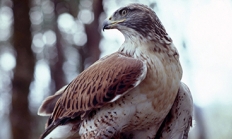
This largest of Oregon's hawks inhabits the most open country of the state's buteos, and watches over its home range on long, motionless wings for extended periods in search of prey. Ferruginous hawks are sensitive to human disturbance and tend to reside in remote areas. They occur in two color morphs, but dark-morph birds are rare in Oregon. Light-morph birds are white below with few markings except for the ruddy-colored leg feathers. The back and wing coverts are rust colored and the tips of the primaries and end of the tail tend toward dark smoky gray. It is an uncommon…
The Long-billed curlew is the largest North American shorebird. Its most striking morphological characteristic, the long decurved bill, is an adaptation for foraging on earthworms or burrow-dwelling organisms like shrimp and crab. Body plumage is a rich buff with a tinge of cinnamon or pink. Sexes have similar plumage, but females are larger with a longer bill. It can be distinguished from other curlews in flight by its bright cinnamon underwings. When observed on the ground, the Long-billed curlew's head lacks the strongly streaked pattern of other cerlews or Whimbrel. It is a locally common breeder in open grassland areas…

At certain estuaries and interior alkali lakes, flocks of many thousands of these migrants can be observed swirling around over shallow water, landing to frantically feed, before resuming migration. Falcons often attack Westerns, and their acrobatic, tightly coordinated escape flights are breathtaking to observe. In winter, these small sandpipers are gray above with white underparts. In breeding plumage they have a rich rufous-chestnut back, cheeks and cap, dark-centered scapulars with rufous-chestnut edges, grayish throats streaked with dark chevrons through the flank, and whitish underparts. Longer-billed females generally are larger than males but are otherwise similar in appearance. Along the coast…

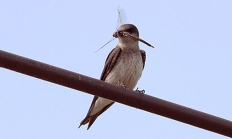
All have cause to marvel at the sight of a gorgeous male Purple martin. Adult males are entirely glossy bluish-purple, although they may look black in poor light. Females and yearling males are grayish below and darker above with a paler forehead and nape. The world's largest swallow, martins are uncommon in Oregon. They nest both solitarily and colonially in nest boxes specially put up for them, in crevices in human-made structures, and in cavities in snags and pilings. They are an uncommon local summer resident, principally inhabiting the Coast Range and Willamette Valley. They are also locally common at…
The song of the Yellow-headed blackbird, if it can be called a song as it lacks any musical quality, is a familiar sound in the marshes particularly of central and southeastern Oregon. The male, with its yellow head, neck, and breast, black body and wings, and white wig patches, is unmistakable. The female is more subtle with its dusky or sooty brown body plumage and yellow cheeks, chin, throat and chest, but is also distinctive. It is an abundant spring and summer resident in marshes of large alkaline lakes and wetlands in southeast Oregon, most notably the Klamath, Summer, Malheur…

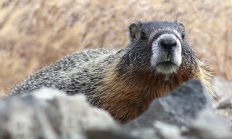
The yellow-bellied marmot is the largest squirrel in Oregon. It has short legs, a short and bushy tail, and ears short and covered with fur. The pelage consists of a dense, wooly underfur covered by long, course guard hairs and is distinctively colored and marked. In Oregon, it occurs in suitable habitats east of a line connecting Mt. Hood, Hood River County, and Mt. Mazama, Klamath County, except for the Columbia Basin. The primary requisites of suitable habitats for the yellow-bellied marmot are boulders or piles of rocks and an abundance of succulent vegetation in close proximity thereto. Occasionally, an…
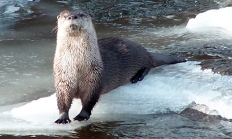
The River otter is adapted for both terrestrial and aquatic environments. The heavily muscled, somewhat cylindrical body is thickest at the thorax and tapers posteriorly to a thick, flattened tail. The body tapers to a blunt and slightly flattened head. The legs are short and powerful; and the toes are webbed. The eyes are small, forwardly directed and set high on the head. The underfur is grayish, short, and dense, and overlain by longer, stiff and shiny guard hairs. The dorsum is brown and the venter a lighter brown or tan; the lower jaw and throat are whitish. In Oregon…
Eastern Oregon mule deer are managed by Deer Hunt Areas, while all other big game, including Western Oregon deer hunts are managed by wildlife management units. Plan ahead by checking the boundaries of where you want to hunt. Hunters in Oregon can access millions of acres of public land open to hunting ( national forests, BLM land, state forests, wildlife areas) plus many private lands open through Oregon’s Access and Habitat program. See www.oregonhuntingmap.com to find a place to hunt.

The Rocky Mountain tailed frog’s coloring often matches the color of local rocks ranging from brown or reddish-brown to gray. They have grainy textured skin that further enhances their camouflage. Males have a short tail, the signature for tailed frogs. Adult males are slightly smaller than adult females that grow to two inches in length. Rocky Mountain tailed frogs are found in the water or close by it. They live in very shallow and heavily shaded water of fast-flowing, small, permanent streams in older mountain forests with cold and clear water, rocky substrates and little silt. These streams are often…

Adult frogs are gray or brown with yellow underbellies and thighs. Their color and grainy textured rough-looking skin helps camouflage them, making them hard to see among rocks. Adults can grow to three inches in length; males are slightly smaller than females. Foothill yellow-legged frogs live in or along edges of permanent streams and rivers with exposed rocky streambeds and off-channel waters that are slow flowing and quiet. In summer, they are likely to hide under rocks in streams or among clumps of vegetation along pools. They use rocks or debris at the bottom of the streams as refuge from…

This small, boldly-patterned duck can be found in Oregon throughout the year, either around rocky headlands on the coast or inland on mountain streams. No other breeding duck in Oregon feeds almost exclusively on benthic invertebrates, often swimming underwater and upstream against swift current in search of prey. Though males are striking in appearance, these and the drab brown females can be difficult to see when at rest on a mid-stream rock or dodging behind rocks as they evade observers. Broods have been observed or nests located on tributaries in the river basins of the west Cascades. They are found…

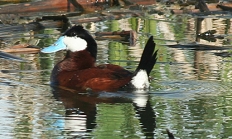
Small in size and displaying a showy, almost comical alternate plumage, the male ruddy duck is an unforgettable sight. Breeding males are unmistakable with their rich chestnut back, black crown, white cheek, sky-blue bill, and proportionately long stiff tail. Female plumage is drab in comparison, being dusky dark brown with a dark facial strip across the mostly white cheek, quite similar to the male's basic plumage. Known for their peculiar courtship display in which the male draws his head down and slaps his bill against his breast repeatedly in increasing tempo, creating a bubbling in the water and a hollow…
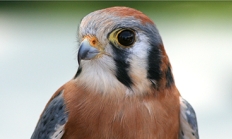
Formerly known in American literature as the Sparrow hawk, this is the smallest (dove-sized) and most familiar and abundant member of the family Falconidae in North America and one of the easiest raptors to observe. It has two considerably different plumages: adult male and female and juvenile males differ somewhat from adult males until post-juvenile mold in fall. Adult males have rufous backs and tails with blue-grey upper wing coverts. The tail has a wide black subterminal band. Juvenile males are similar to adult males but have heavily streaked breasts. Females are slightly larger than males and have reddish-brown backs…
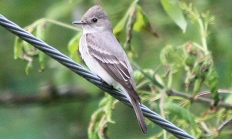
The Olive-sided flycatcher is one of the most recognizable breeding birds of Oregon's conifer forests with its resounding, three-syllable whistle song quick, three beers. It is a relatively large, somewhat bulky, large headed, short-necked flycatcher that perches erect and motionless at the top of a tall tree or snag except when singing or darting out to capture flying insects. The overall olive-gray plumage is generally nondescript except for a whitish stripe down the breast and belly which gives the impression of an unbuttoned vest, and white patches between the wings and lower back. This flycatcher breeds in low densities throughout…
This medium-sized flycatcher has expanded its breeding range from northern California to southwestern Oregon and continues to expand its range in Oregon. First experiences with the species may bring to mind a Slate-colored Junco behaving like a flycatcher. The Black phoebe is dull, sooty black overall, somewhat paler on the back, with a white belly contrasting with the black breast and sides. Bill, legs, and feet are black. The phoebe dips its tail repeatedly. Black phoebes are associated with water. Slow-flowing, idle, or slack water of large rivers, streams, and creeks, ephemeral and permanent ponds, lake shorelines, irrigation ditches, and…

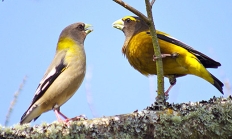
This sturdy-looking bird has a large head, short tail, and massive conical bill adapted for seed eating. The male plumage features bold patches of lemon yellow shading into olive, then brown and black, with white secondaries creating a flashy wing-patch easily seen in flight. The male's bill is chalky white in winter, but changes in early spring to a pale green that matches the new growth at the tips of spruce boughs, where they often nest. Many encounters with this species are of individuals heard flying high overhead, leaving the observer with little else to note. The Evening grosbeak is…
ODFW's Living with bears page has tips on living, working, and recreating in bear country and more. Oregon is Black Bear Country Brochure (pdf) Be Wildlife Smart When Working in the Woods (pdf) Electric Fences Keep Bears Out - BearWise Bulletin (pdf) Follow these "bear" essentials on working or recreating in bear country, print this homeowner checklist to keep bears at bay, and more. Essentials for Living with bears (pdf)

The Steller (or Northern) sea lion is the largest member of the family Otariidae. Among adult females and subadult males, the upper body is slim, whereas in adult males it is heavy and muscular. The head is bearlike with a moderate step between muzzle and forehead. The rear flippers are relatively small and can be turned beneath the body for travel on land. The pelage is light buff to reddish brown, slightly darker in the chest and abdomen. Overall the pelage appears darker when wet. However, beneath the water it appears white, whereas the California sea lion appears black. In…

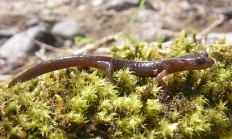
Adult clouded salamanders are generally brown with brassy patches on their backs and gray bellies. As salamanders age, the brassy color fades. The clouded salamander is one of the lungless salamander species; they breathe through their moist skin. Mature adults can grow to just over five inches in total length. Clouded salamanders prefer forest habitats or burned areas that provide large decaying logs or stumps. They are often found in Douglas fir trees where they can find burrows in the wood, or spaces just under the bark to hide. They may also hide deep in rock crevices during dry and…