
Search myodfw.com
Showing 761 - 780 of 903 results
This moderately small wren maintains the frenetic energy that is so obviously typical of this family of birds. It is a summer inhabitant in many parts of Oregon, generally in open woodlands, thickets, and occasionally in residential gardens. The House wren occurs over the widest latitudinal range of any New World passerine. The House wren nests in a wide variety of native and human-influenced habitats. Nest sites are primarily located within preformed cavities in snags. It is a very uncommon to common transient and summer resident in semi-open woodland habitats throughout the state. In southwest Oregon, it is most common…

The graceful short-distance flight of a bright male bluebird is a memorable sight. The Mountain bluebird haunts open country, providing an irreplaceable color note in the gray sagebrush landscape; particularly when in migration their brilliant blues flash in the desert sun in startling contrast to the prevailing dull colors of most other birds. Like other bluebirds, it readily accepts nest boxes. This accessibility, along with its sky-blue color, have always endeared it to nature lovers and made it a favorite of many. In Oregon, it is a common breeder and transient east of the Cascade summit except in treeless expanses…

Shadow-colored skulkers in dense riparian growth, catbirds are among the often heard, less frequently seen denizens of northeast Oregon. They are all dark gray except for a black cap and russet undertail coverts. The sound has variable melodious warblings with occasional imitations of other birds and off-key noises. A distinct mewing call is often heard. The Gray catbird is a fairly common breeder in dense riparian zones of the northeast Blue Mountain ecoregion and is common in the Wallowa and Union counties and in east Umatilla County along the Umatilla River, Pine Creek and Meacham Creek. They breed locally in…

This olive-green warbler is one of the drabbest of Oregon's Warblers., often showing obscure streaking on the underparts and indistinct dark eyeline. The species is named for its telltale orange crown spot but this feature is often hidden, reduced or absent in immature and female birds, and therefore rarely observed in the field. Orange-crowned warblers are one of the earliest and most abundant migrants in Oregon. They glean insects from the undersides of leaves and are often seen probing into dead leaf clusters and flower heads. Perhaps this is why they are able to winter farther north than most other…

This small, dark-headed sparrow flashing white outer tail feathers is one of the state's most abundant species and one of the easiest to identify. When not nesting, the Dark-eyed junco might be seen nearly anywhere in the state. It is a regular visitor to city parks and neighborhood bird feeders. Most juncos occurring in Oregon show dark hoods, dull rusty-brown backs, and pinkish brown below the wings. Some are grayish, lacking much of the brown tones. They are most often observed in single-species flocks but individuals and small groups often join mixed wintering sparrow flocks. It is resident from the…

The male Red-winged blackbird, sentry of the marsh during the breeding season, continually announces its territory to all present with its oak-a-tee song, and tenaciously defends against flyby predators. The male is territorial, polygynous, larger than the female, and glossy black with a broad bar of red-orange, bordered with yellow, on wing writs. Females are less conspicuous in behavior, light brown, with a heavily streaked breast, and buffy supercilium. This is one of the most abundant and studied birds in North America. The Red-winged blackbird occurs west of the Cascades in Oregon from coastal and valley locations, and east of…

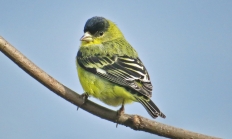
Formerly known as the Green-backed goldfinch, this species was either not present or overlooked during the 19th century by most Oregon ornithologists. The male's black forecrown contrasts smartly with the greenish back and bright yellow underparts. Females lack the clear contrasting colors of the males, though the tips of the secondary coverts and the base of the primaries are white in both sexes. Often the plaintive tee-yee call reveals the presence of the bird long before it is seen. In the north Willamette Valley the Lesser goldfinch is a fairly common breeder along the western fringe. Scattered and local in…
Of Oregon's breeding seabirds, Leach's storm-petrel is the smallest, most pelagic, and flies the farthest offshore of any of Oregon's breeding seabirds to feed. It spends the non-breeding season in the subtropical and equatorial Pacific. It is the second most abundant breeding seabird in Oregon, and is rarely seen from land or close to shore. It comes to its breeding islands, where it nests in burrows, only under the cover of darkness. Its plumage is black and Oregon populations have a distinct white rump. Leach's storm-petrels are long lived birds characterized by long-term pair bonds and may breed yearly for…

The Turkey vulture, known locally as a "buzzard," is a common sight spring through fall throughout the state, except in the highest mountains and featureless desert expanses in summer where they are uncommon. Seeing Turkey vultures returning is a welcome sign of spring. Turkey vultures are large-winged soaring birds with overall dark plumage except for a silvery sheen on the undersides of the flight feathers. Adults have small, featherless, red heads, while juveniles have gray heads. The Turkey vulture is a common to abundant transient throughout the state and an uncommon to common summer resident except in high mountains. It…

With a widespread distribution and affinity for open habitats, the Killdeer is one of the most common and recognized birds through much of North America. Killdeer are large for a plover and easily distinguished from other North American plovers by their characteristic two black or brownish-black breast bands. Killdeer are well known for their loud and persistent call of "kill-dee, kill-dee," heard at all times of day or night on both the breeding and wintering grounds. Killdeer often nest close to human activities. Adults perform an elaborate and exaggerated broken-wing display to lure humans and potential predators away from their…

The red tree vole is a medium-sized vole. It is uniquely colored among North American voles: bright orangish-red to cinnamon on the dorsum, silvery gray (often with some light orangish hairs) on the venter, and a tail pale orangish on the venter grading to black on the dorsum. This vole is endemic to western Oregon. It occurs at moderate elevations on the west slope of the Cascade Range southward as far as the Douglas-Jackson county line and in the Coast Range to the Oregon-California border. It is largely arboreal and builds nests on suitable foundations (commonly nests of birds or…

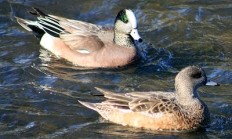
Wigeon drakes are beautifully marked with white pate, green eye stripe, purplish breast and flanks, white belly and wing covert patch, and iridescent black/green speculum. The grayish hen shows white on the wing covert patch. Drakes give a three-note whistle and get progressively noisier as spring approaches and courting flights begin. Medium sized flocks are common in fall and winter, and like geese, will be found grazing pastures, park lawns, and golf courses. It is a rare to locally common breeder in eastern Oregon and rare in summer in western Oregon. It is a common to abundant migrant and wintering…
NEWPORT, Ore. – The General Marine Species bag limit returns to a four-fish bag limit beginning Monday, Aug. 18. The one-fish sub-bag limit for cabezon and the one-fish sub-bag limit for canary rockfish remain in place, and retention of quillback rockfish and yelloweye rockfish is prohibited. Great weather in mid-July…
NEWPORT, Ore. – The Oregon Department of Fish and Wildlife is hosting a public meeting on July 29 from 6 p.m. – 7:30 p.m. to get input on the 2026 recreational Pacific halibut season. The meeting is being held in the conference room of the ODFW office, 2040 SE Marine…
SALEM, Ore. – The Oregon Conservation and Recreation Fund (OCRF) is now accepting letters of interest for its summer 2025 Wildlife Crossing Infrastructure Grant Opportunity, supporting capital construction projects that reduce wildlife-vehicle collisions and restore critical movement and migration pathways across Oregon. Letters of Interest must be submitted before 11:59…
Accessibility Statement for Oregon Department of Fish & Wildlife The Oregon Department of Fish & Wildlife is committed to providing a website experience that functions for all users regardless of ability, network speed, or device. We are continually improving the user experience for everyone, and applying the relevant accessibility standards. We invite feedback if you have issues accessing any part of https://myodfw.com/ Site features Each page on the site has a “Skip to Main Content” that’s visible on focus, giving visitors the option of jumping past navigation and into main content. A link to our Accessibility Statement and feedback form…

SALEM, Ore. – Bowhunters can warm up for the archery season at a free 3D shoot in La Pine on Saturday, Aug. 2 at Three Rivers Archers Park located at the intersection of Coach Rd. and Memorial Lane. This unique course offers hunting scenarios and learning opportunities to help you…
Canada geese, with their distinctive black neck and head and white cheek patches, need little description because they are one of Oregon's most familiar and conspicuous birds. There are 11 subspecies of the Canada goose. As a whole, the species is widely distributed throughout Oregon, with the exception of mountainous and desert areas lacking reservoirs, lakes, or large rivers. Concentrations of wintering and breeding Canada geese occur wherever agriculture and other human developments provide green forage or small grains and water bodies provide sanctuary. Hear the call of the Canada goose Photo by Leise Wease

In Oregon, fork-tailed storm-petrels breed in numbers that are only a tiny fraction of those of Leach's storm petrels. This is the larger of the two storm-petrels breeding in Oregon and is gray in color. These birds leave and return to breeding colonies only at night, when they are best detected by their distinct raspy call. At sea, they are distinguished by quick, buoyant flight with short glides interspersed with wing fluttering to maintain their position at a food source. Fewer than 20 nests have been found in Oregon, all located in the same habitat as colonies of Leach's storm…
