
Search myodfw.com
Showing 821 - 840 of 903 results
Cascade Hatchery was authorized under the Mitchell Act and began operating in 1959 as part of the Columbia River Fisheries Development Program – a program to enhance declining fish runs in the Columbia River Basin. The facility is used for egg incubation and rearing of coho.
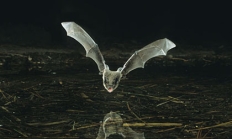
The long-legged myotis lives in forests and comes out early in the evening to hunt. It is a fast flier and will chase insects for a long distance. One baby is born in the summer, and the species hibernates in winter. In general, the long-legged myotis is a species associated with montane coniferous forests, but it also occurs in some desert and riparian habitats. The long-legged myotis is an Oregon Conservation Strategy Species in these ecoregions: Blue Mountains, Coast Range, East and West Cascades, Klamath Mountains, and Northern Basin and Range. Photo by ©Michael Durham
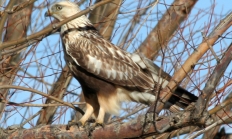
Characteristic of open country and cold weather, the Rough-legged hawk can be found soaring over exposed terrain or perched on utility poles across much of the state in winter. The rough appearance of its legs comes from the feathers covering their length, an adaptation that provides extra warmth in frigid weather. In flight, dark wrist patches and belly help identify this large buteo, though like other hawks it is subject to much variation in plumage. From a distance it frequently appears to have a frosty upper half. It often hovers over fields while hunting, a behavior that is rare among…

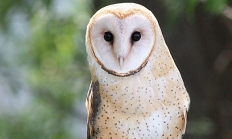
One of the most startling sounds in the black of night is the loud, harsh call of the Barn owl as it flies over field or marsh in search of small rodents. They are white to tan beneath with fine spotting ranging from almost none to fairly extensive. The face has a well-defined facial disc that acts as a parabolic dish collecting the faint sounds of its prey, allowing it to hunt successfully in total darkness. Male and female Barn owls are similar in appearance though the female is somewhat larger. The Barn owl is a fairly common permanent resident…
Sandy Hatchery began operation in 1951 as a state-funded facility. In 1959, the hatchery became part of the Columbia River Fisheries Development Program (Mitchell Act) – a program to enhance declining fish runs in the Columbia River Basin. The facility is currently used for the adult collection of spring Chinook, winter and summer steelhead, and coho salmon. Coho and winter steelhead eggs are taken, hatched, ponded and reared to release on station.
Irrigon Hatchery began operation in 1984 as part of the Lower Snake River Compensation Program (LSRCP)—a program to mitigate for spring Chinook and summer steelhead losses caused by the four federal dams constructed on the lower Snake River. This facility serves as an egg incubation and rearing facility for summer steelhead destined for the Grande Ronde and Imnaha river systems and egg incubation for 575,000 Umatilla coho eggs for transfer to Cascade Hatchery. Irrigon Hatchery also rears 1.4 million fall Chinook for the Grande Ronde and Snake Rivers and is used as a rearing site for legal-sized and trophy rainbow…
Klaskanine Hatchery was first operated in 1911 by the state of Oregon. In 1959 the hatchery was enlarged and renovated under the Columbia River Fisheries Development Program (Mitchell Act)—a program to enhance declining fish runs in the Columbia River Basin. The hatchery is now closely tied to the Select Area Fisheries Enhancement (SAFE) program and works closely with Clatsop County Fisheries (CCF). The facility is currently used primarily for rearing coho for SAFE commercial fisheries, as well as for adult collection and spawning of fall Chinook and as a rearing facility for fall Chinook and winter steelhead.
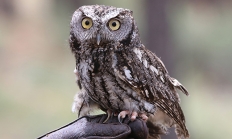
Almost strictly nocturnal, the Western screech-owl hunts discreetly at night and roosts during the day in dense woodlands, its perfectly streaked plumage allows it to pass as tree bark. These habits make it difficult to see, and it is more common than many are aware. It is a small owl with yellow eyes and feathered ear tufts. It exhibits geographic variation in plumage color and pattern: both gray morphs and brown morphs occur in the Pacific Northwest. Sexes are alike. The Western screech-owl is a fairly common year-round resident in lower-elevation woodlands throughout Oregon. It is usually found below 3,000…
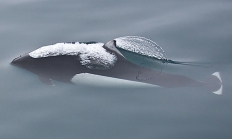
A thick body, small head and coloration similar to a killer whale make this dolphin easy to recognize. Dall’s porpoise is mostly black with a large white patch on the belly and flanks. The small dorsal fin is partly white and the trailing edges of the tail are frosted white. About seven feet long and weighing around 400 pounds, Dall’s live only in the north Pacific. Dall’s are the fastest of all small cetaceans and can swim at up to 35 miles per hour, almost as fast as a killer whale. When swimming at the surface they create a characteristic…
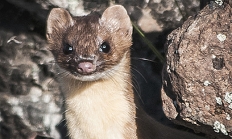
The Long-tailed weasel is the larger of the two weasels in Oregon, but smaller than the other member of the genus, the mink. Males are considerably larger than females. The head is flattened and somewhat triangular; the body and neck are elongate and almost cylindrical; the legs are short, and the tail is long. The summer pelage is brown dorsally; the venter is yellowish to orangish except for a white chin and sometimes one or more scattered brown spots. The tip of the tail is black. The pelage is molted twice annually. In the Cascade Range and eastward through the…
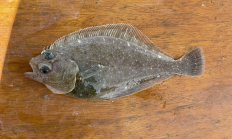
Features: The Pacific sanddab is left-eyed, meaning both eyes are on the left side of the body. The eyed-side is dull light brown, mottled with brown or black, and sometimes yellow or orange. The blind-side is off-white to tan. They have an oval shaped body with large scales. They can grow to be 16-inches long and up to 2 pounds, though most weigh less than 1/3 pound. Habitat: As you probably guessed, sanddabs like to hang out on sandy bottoms. They are most abundant at depths of 20-50 fathoms, and are common in shallow coastal waters from British Columbia to…

Bandon Hatchery was constructed in 1925. Various renovations have taken place since original construction and more are planned for the future. The facility is used for adult collection, egg incubation and rearing of both natural and hatchery fall Chinook, winter steelhead, and trophy-sized rainbow trout.
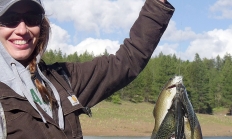
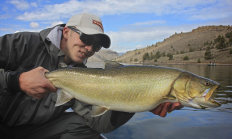
Piloted in 2014, the Tag Team program helps ODFW fish biologists better evaluate resident gamefish, bass, and stocked rainbow trout fisheries. It's also a chance for anglers to participate in fishery management and, perhaps, come away with up to $50.