Search myodfw.com
Showing 921 - 940 of 1128 results
In grass or sagebrush-dominated habitats throughout the state, the song and striking appearance of the Western meadowlark create one of the most familiar and endearing avian images in Oregon. It's one of Oregon's most recognizable birds with its bold yellow breast and belly with a distinct black V across the chest and its habit of perching on fences along roadsides. Fittingly, it was chosen as Oregon's state bird by a vote of Oregon schoolchildren ratified by the Legislature in 1927. It is one of the most widely distributed open-country species in the arid desert country of eastern Oregon. It can…

The black rat is slightly smaller than the Norway rat, but much larger than the house mouse, the only other members of the subfamily in Oregon. The black rat is similar to other members of the subfamily in that it possesses a scaly, scantily haired tail; membranous, nearly naked ears, and a soft pelage. It differs from the Norway rat in having a tail much longer than the length of its head and body and commonly having a darker-colored pelage. The pelage ranges from black to sandy brown dorsally and from lead colored to nearly white ventrally. The black rat…

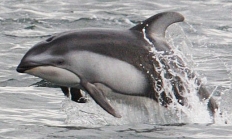
The Pacific white-sided dolphin is most abundant in the Southern California Bight in winter, but move further north, off Oregon and Washington in summer. These animals can be found from the tip of Baja to the Aleutians and the western Pacific from the Kuril Islands to Japan. They prefer deep, off-shore waters, so sightings are usually limited to recreational and commercial fishers. The Pacific white-sided dolphin is about seven or eight feet long. It has three colors: the chin, throat and belly are creamy white; the beak, flippers, back, and dorsal fin are a dark gray, and there are light…
This dark colored salamander has a reddish-brown ragged edged stripe that runs along the top of the head to the tip of the tail with black or dark brown sides. It has a long body and tail and the belly is black with large white flecks. The Oregon slender salamander is a lungless salamander species, relying on its skin to breathe. Mature adults can grow to just under four inches in total length, with females about 12 percent larger than males. Oregon slender salamanders are most common in stable, moist old-growth (late successional and second-growth) forests where there are abundant…


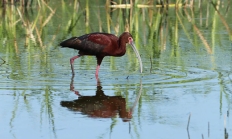
Sporting the form of a curlew, this medium-sized marsh wader is almost always found in flocks, flying in formation and quacking like ducks. Their long, down-curved bill complements their long neck and legs. Although their feathers appear black, a closer look will reveal an iridescence of bronze, purple, maroon, and green. They are named for their "white face" which appears in alternate plumage as a narrow border of white feathers along the edge of their reddish-purple facial skin, delineating a mask around the red eye. The White-faced ibis has extended its breeding grounds in Oregon to wetlands in Harney, Lake…
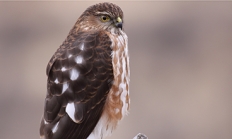
The Sharp-shinned hawk is North America's smallest and most migratory accipiter. As a hunter of songbirds (and sometimes young chickens) it historically endured harsh reproach, and was often depicted as a blood-thirsty villain, even by some ornithologists. Across the U.S., many thousands were shot in the first half of the 20th century. But prevailing attitudes have changed, and today a glimpse of this slender, secretive hawk darting through the treetops is more likely to elicit admiration than malice. Adult plumage, nearly identical to the slightly larger Cooper's hawk, consists of slate gray back and wings, breast and sides barred with…
KLAMATH FALLS, Ore. – ODFW is urging waterfowl hunters and other visitors to use extreme caution after laboratory results revealed exceptionally high levels of microcystin in a water sample collected from the Barnes Unit of the Upper Klamath National Wildlife Refuge. The sample was taken from an area currently open…
SALEM, Ore. – Bowhunters can warm up for the archery season at a free 3D shoot in La Pine on Saturday, Aug. 2 at Three Rivers Archers Park located at the intersection of Coach Rd. and Memorial Lane. This unique course offers hunting scenarios and learning opportunities to help you…


Find the weekly statistics for waterfowl and upland game birds for E.E. Wilson Wildlife Area. More information about E.E. Wilson Wildlife Area
The Wolverine is the largest terrestrial mustelid in Oregon that, to some degree, resembles a small bear. It is powerfully built with a broad, dog-like head; short round ears; small eyes; a slightly humped back; relatively short legs and a bushy, somewhat drooping tale. The pelage consists of a dense, wooly, crimped under fur overlain by course, stiff and somewhat shaggy guard hairs. Fur on the tail is about twice as long as on the body. The base color is blackish brown with a pale brown stripe extending along the sides from the head or shoulders to the base of…

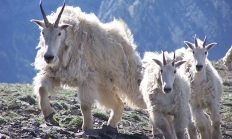
The mountain goat is a stockily built bovid with black scimitar-shaped horns, large black hooves and prominent dew claws, and an entirely white, wooly pelage. Sometimes the pelage contains scattered brown hairs on the dorsum and rump. A long beard, pointed ears, and a squarish muzzle are also characteristic. Males are larger, and have longer, larger-diameter, and more evenly curved horns that females. Mountain goats are denizens of high altitudes, remote, and barren montane regions where they are capable of moving through exceedingly rugged and precipitous terrain with speed and agility. Nevertheless, mountain goats are known to fall occasionally, whereupon…
NW WILDLIFE VIEWING August 27, 2026 Recreating in drought and wildfire season - actions you can take to protect wildlife . For the most current fire closures and restrictions-- KNOW BEFORE YOU GO . Tillamook County Birds At this time of year, herons and egrets can be seen hunting amphibians and small mammals in local farm fields. Bald eagle pairs can be viewed near estuaries and rivers. Clatsop County Birds Coastal storm-watchers may find interesting pelagic species pushed closer to shore by the rough weather. Some species which may be viewed during and just after storms include skuas, jaegers, petrels, storm…
In 1925 the first fish hatchery on the South Santiam River began operations about 5 miles upstream from today’s present site, rearing annually approximately 100,000 spring Chinook in dirt ponds for release into the South Santiam River. The present site came about with the construction of Foster Dam. In 1968 the facility was dedicated for the rearing of spring Chinook and summer steelhead. This facility was built and annually funded in part by the US Army Corps of Engineers to compensate for the loss of spawning and rearing areas above the dams on the South Santiam River.
The tail is brown dorsally with a white fringe, and white ventrally. In males, antlers with tines typically arise from a single main beam. In winter, the pelage is a dark buffy-gray and consists of relatively long, thick, and somewhat brittle hairs; in summer, the pelage is lighter with more tawny tones and is shorter and thinner. The midline of the dorsum is darker and the fade lighter; in males, the patch between the antlers is darker. Pelage markings include white on the venter, throat, muzzle and lower lip, and around the openings of the metatarsal and interdigital glands; a…

SALEM, Ore. – Effective June 1 through Sep. 30, minimum and maximum size limits as well as the daily and possession bag limits for rainbow trout and bass are suspended for Thief Valley Reservoir, Pilcher Creek Reservoir, and Wolf Creek Reservoir which are all located within the Southeast Zone in…