
Search myodfw.com
Showing 1041 - 1060 of 1416 results
One of Oregon's rarest and most local breeders, this vocal but somewhat secretive warbler can be heard and sometimes seen in summer in the south central Cascades. The patient observer may catch a glimpse of a chunky, dark-backed bird feeding low in dense willows, sometimes showing its pale underparts with dark streaks. It is otherwise a rare migrant or vagrant statewide, mostly in Spring. An isolated population of this species has summered and presumably bred in the south central Cascades. No nest has been found in Oregon, owing mainly to the impenetrable habitat. Reports suggest that a small population may…

The Grasshopper sparrow is one of the more enigmatic and erratic birds in Oregon. A small population may appear in an area, persist for a few years, and then disappear, only to return at some later time. It is difficult to detect, because of both its quiet, insect-like song and its reclusive habits. Males sing from elevated perches, such as flower stalks or fence posts before diving back among the grasses. It occurs in scattered "colonies" along the unforested northern slopes of the Blue Mountains. The Grasshopper sparrow is an Oregon Conservation Strategy Species in the Columbia Plateau, Klamath Mountains…
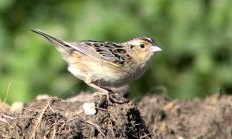
The House finch is the most widespread of Oregon's "red finches." It is a congenial, cheerful singer from urban areas to desert plateaus. The male has a red forehead, throat, eyebrow, rump and varying amounts of red in the breast. It may have small amounts of reddish wash in its otherwise brownish cheek, hindcrown, nape,and streaked back. In some males, red is replaced with red-orange, orange, yellow-orange or yellow. The female is drab grayish-brown, overall, with indistinct streaking above and no red. The House finch is a fairly common resident in lowlands, urban, rural, and agricultural areas throughout Oregon. They…

Although a common breeding bird throughout Oregon's mountains, the Pine siskin retains an air of mystery due to its highly nomadic and unpredictable movements and its fondness for the inaccessible conifer canopy. It is most familiar in winter through early spring when flocks descend to foothills and valleys to feed on alder catkin seeds and many mingle with goldfinches in weed patches and at feeders. It is readily identified by its heavily streaked plumage and by the yellow wing and tail bars that are especially prominent in flight. The Pine siskin is a generally common resident in conifer forests throughout…

The rat-sized American pika is characterized by rounded ears, no external tail, bare planter pads, and hind feed scarcely longer than the front feet. The pika requires talus, creviced rock, and other high elevation microhabitats that provide cool microclimates. Adequate forage close to rocky crevices is needed. In Oregon, the species is limited to suitable habitats in the Cascade Range and the Wallowa, Blue, Strawberry, Steens, Hart, and Warner mountains, and at Newberry Crater in Deschutes County and Grizzly and Cougar peaks in western Lake County. The American pika is an Oregon Conservation Strategy Species and is limited by its…

Townsend's chipmunk is the largest member of the genus in Oregon.The pelage of this chipmunk is dark and dull but as in other Oregon chipmunks, there is a dark brown to blackish middorsal stripe with alternate light and dark stripes, laterally, a total of five dark and four light stripes. Alternate dark (three) and light (two) stripes adorn the sides of the face. The throat, belly, and a patch behind the ear are white. The tail is black on the tip and the margins are frosted above with buff or white-tipped hairs. Townsend's chipmunks have been found on the west…
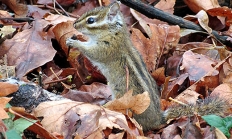
The white-tailed antelope squirrel is the smallest species of ground squirrel in Oregon. Although rather cryptically colored, it is marked distinctively: the grayish-brown dorsum and sides are separated by a white stripe on each side. The stripes are tapered at both ends and extend from behind the ear to near the base of the tail. A white line encircles each eye, the underside of the tail is white grading to grayish near the tip and the venter is white. In Oregon, it occurs south and east of a line connecting Vale, Malheur County; Harney Lake, Harney County and Paisley, Lake…
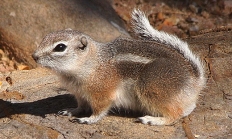
The Washington ground squirrel is the smaller of the two short-tailed, spotted ground squirrels in Oregon. The dorsum has squarish grayish-white spots on a background of pale smoky-gray with a pinkish wash to brownish gray. This squirrel is endemic to the Deschutes-Columbia Plateau Province east and south of the Columbia River and east of the John Day River. A colonial species, it emerges from dormancy in January to early March, males before females. At the approach of a potential threat, the Washington ground squirrel produces a soft, lisping whistle. Other members of the colony respond by standing upright, repeating the…

A research study that began in 2012 confirmed Sierra Nevada red fox presence in the Oregon Cascades, specifically in the Mt. Jefferson, Mt. Washington, and Three Sisters Wilderness Areas. Confirmation was through genetic testing of hair and scat samples. Sierra Nevada red fox is a subspecies of Red fox that live in high elevations. They are slightly darker than Red fox and are highly specialized to montane (mountain) ecosystems. In the red color phase, the upper body is reddish-brown with white chin, cheeks, throat and belly. This fox ranges from silver to black in the black/silver color phase with silver…

CLACKAMAS, Ore.— Fishery managers from Oregon and Washington added recreational fishing days for adult hatchery Chinook and sockeye to the on-going hatchery steelhead and hatchery jack Chinook fishery in the mainstem Columbia River downstream of the Highway 395 Bridge at Pasco, WA during a joint state hearing today. Retention of…

The flight of Pacific loons by the thousands along the coast each spring and fall is one of Oregon's most dramatic bird migrations. Stunning plumage often clothes these fast-flying travelers. The straight bill, distinguishing Pacific from red-throated and yellow-billed, is less robust than that of common loons. The Pacific's head is larger and its neck thicker than those of the red-throated. In flight, Pacific's wing-beats are faster than those of common, loons the feet appear larger, the forecrown is rounder, and the hindcrown more sloped than those of red-throated loons. This is the most abundant loon off the Oregon coast…

Cattle egrets are the smallest of Oregon's three egret species, with short, stout neck and legs, and white body with orange-buff plumes on the head and nape in spring and early summer. They are named for their association with livestock, consuming insects on their backs or stirred up by their hooves. In Oregon, the Cattle egret is a casual transient in spring in the Klamath Basin and rarely in the Malheur National Wildlife Refuge. The least widespread of the state's egrets during the breeding season; a rare breeder in the Great Basin and a few pairs occasionally nesting at Malheur…

Cooper's hawks are smallish "bird hawks" (slightly smaller than American Crows) with rounded wings, a long rounded tail, and long yellow legs. This is the mid-sized accipiter nesting in Oregon and is larger than the Sharp-shinned hawk, but smaller than the Northern goshawk. The usual mode of flight consists of several rapid wing-beats alternating with brief periods of sailing. Juveniles are dark above with underparts streaked vertically while adults tend to have a bluish cast to their gray upperparts. The long tail is barred dark and light with narrow whitish band at the tip. It is an uncommon breeder in…
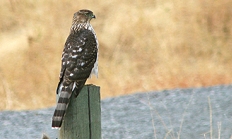
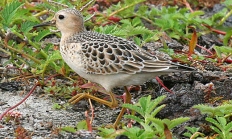
The Buff-breasted sandpiper resembles a plover with a high-stepping, pigeon-like gait. One of the few Oregon shorebirds that frequents dry, sparsely vegetated coastal grasslands. Fall migrants consist of juveniles. It has scaly, buffy-brown underparts, yellow legs, a small head, and a short black bill. Beady black eyes stand out on a plain, pale face. It bobs its head while moving. Gleaming white underwings are displayed in a graceful flight pattern. It is unique among North American shorebirds in having a lek mating system. This is a rare but regular fall migrant on the Oregon coast where it has been recorded…
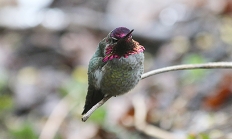
Anna's hummingbird is the largest hummingbird common to our region. It is the only hummingbird regularly found in Oregon in winter, during which time it is exposed to short day lengths, limited sources of food and periods of intense cold. It is more vocal than most hummingbirds with males uttering a dry, scratchy buzz of a song that can be heard throughout the year. It is a rare to locally uncommon summer resident west of the Cascades in interior valleys and along the coast; also along the Columbia River east to The Dalles. It occurs and probably breeds into the…
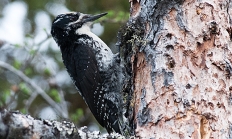
In Oregon, the American three-toed woodpecker tends to use higher-elevation forests; however, forest type may not be as important to this species as the presence of bark beetles. Nests are often fairly low; nest trees are often smaller in diameter than those used by other cavity nesters. Habitat requirements may include trees with heartrot for nesting and high densities of bark or wood-boring beetles. It is rare and local, particularly near and west of the Cascade summit, often near high-elevation lakes or beetle outbreaks. American three-toed woodpeckers are Oregon Conservation Strategy Species in the Blue Mountains and East Cascades ecoregions…
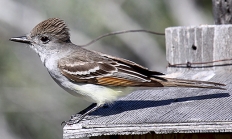
With its erect posture and stately manner, the Ash-throated flycatcher brings a touch of elegance to the oak and juniper woodlands of Oregon. A medium-sized flycatcher, it has a puffy crest and generally pale coloration, sexes are similar. It has gray-brown upperparts and an ashy gray breast; the throat may appear whiter. Belly and undertail coverts are pale yellow. It has two whitish wing bars, and rufous-colored inner webs of the tail and primaries. Juveniles have more extensively reddish tails. It is an uncommon to locally common summer resident in the Rogue and Applegate valleys and a rare vagrant in…
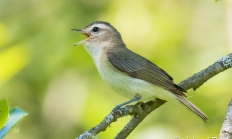
Despite being one of the most common songbirds in deciduous and riparian forests throughout Oregon, the Warbling vireo is frequently overlooked. Its plumage is indistinct. It tends to forage high in the treetops, moving slowly and deliberately among twigs and leaves gleaning insects. Despite its subtle plumage and habits, familiarity with its song makes this vireo easy to find, and a delight to listen to. The Warbling vireo breeds in moderate densities in deciduous habitat throughout Oregon from sea level to montane areas. It is most abundant in the central Coast Range. It is moderately abundant west of the Cascades…
The haunting cries of these wanderers evoke a variety of reactions from curiosity to wonder. Highly social, the Pinyon jay epitomizes the dynamics of flock behavior such as colonial nesting, communal feeding of young and non-territoriality. Although Pinyon jays are nomadic and unpredictable, each flock is a tight-knit, integrated unit occupying a home range that does not overlap with other flocks. Flocks may wander widely outside their home range if sufficient food is not available. The Pinyon jay is a permanent resident in juniper and ponderosa pine woodlands of central Oregon. Oregon's known breeding population is confined to the Metolius…

This moderately small wren maintains the frenetic energy that is so obviously typical of this family of birds. It is a summer inhabitant in many parts of Oregon, generally in open woodlands, thickets, and occasionally in residential gardens. The House wren occurs over the widest latitudinal range of any New World passerine. The House wren nests in a wide variety of native and human-influenced habitats. Nest sites are primarily located within preformed cavities in snags. It is a very uncommon to common transient and summer resident in semi-open woodland habitats throughout the state. In southwest Oregon, it is most common…
