
Search myodfw.com
Showing 1061 - 1080 of 1416 results
This drab, greenish, diminutive species is similar in appearance to the Hutton's vireo, and sometimes confused with that species in western Oregon. Slighter-billed and smaller than the vireo, this little bundle of energy seems always to be moving as it flicks its wings and hops from twig to twig. The male Ruby-crowned kinglet sports a bright red crown spot, typically visible only when the bird is agitated, and in spring pours fourth a delightful melody, surprising for such a small, drab bird. This species breeds in high elevation forests, primarily east of the Cascade crest, where it is common in…

This olive-green warbler is one of the drabbest of Oregon's Warblers., often showing obscure streaking on the underparts and indistinct dark eyeline. The species is named for its telltale orange crown spot but this feature is often hidden, reduced or absent in immature and female birds, and therefore rarely observed in the field. Orange-crowned warblers are one of the earliest and most abundant migrants in Oregon. They glean insects from the undersides of leaves and are often seen probing into dead leaf clusters and flower heads. Perhaps this is why they are able to winter farther north than most other…

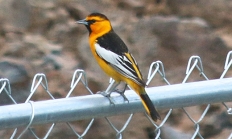
A boldly colored medium-sized bird, the Bullock's oriole builds its characteristic hanging nest in broadleafed trees and tall shrubs, especially when the trees or shrubs are spaced widely and situated along the edges of streams and fields. In Oregon, the Bullock's oriole is a rare to fairly common breeder, especially along major rivers and around farmsteads. It is most widespread in southwest and northeast Oregon. In particular, on the Derby Road in Jackson County. It nests primarily in open spaced cottonwoods, maples, and other tall, forking broadleaf trees. The nest is constructed of plant fibers, hairs, fine grass, and moss…
This bat, found in older forests, has a wingspan of about 10 inches. Its fur is glossy black, tipped with white. It forages over ponds, streams, meadows and roads, often flying very low and roosting behind loose tree bark. Maternity roosts of the silver-haired bat are found in trees. This bat usually bears twins. The silver-haired bat occurs statewide in Oregon except for most of the Columbia Basin and is an Oregon Conservation Strategy Species in all ecoregions except the Nearshore ecoregion. It is primarily associated with coniferous forests, including the juniper woodlands in the southeastern portion of the state…

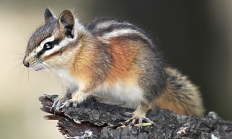
The least chipmunk is the smallest chipmunk in Oregon, but it is only slightly smaller than the yellow-pine chipmunk. As in all chipmunks, the face is marked with a dark stripe through the eye bordered on each side with a light- and a dark-colored stripe. The middorsum is marked with a dark-colored stripe followed on each side by two alternating light- and dark-colored stripes. The least chipmunk has the largest geographic range of any chipmunk. In Oregon, it occurs east of the Cascade Range except in the Columbia Basin and most of the Blue Mountains. In general, it is a…
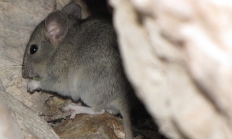
The desert woodrat is the smallest member of the genus that occurs in Oregon. The tail is round, short and bicolored and the ears are long and lightly furred. The pelage is long and soft, a mixture of buff and black dorsally and whitish or light buff ventrally; except for he chest, all body hairs have lead-colored bases. The feet and underside of the tail are white. It occurs in Malheur, Harney, and southern Lake Counties. Throughout its range, it tends to be a habitat generalist, but in Oregon it usually occurs in sagebrush habitats, especially those associated with rimrocks…
NEWPORT, Ore. – ODFW is holding a June 16 public meeting to evaluate the commercial market squid fishery. Oregon commercial squid fishers, producers and interested public are encouraged to attend. The meeting is held from 1 – 3 p.m. at Hatfield Marine Science Center in the Guin Library Seminar Room…

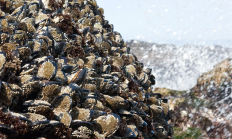
NEWPORT, Ore – Mussel harvesting is now open from Cascade Head to the California border the Oregon Department of Agriculture and Oregon Department of Fish and Wildlife announced today. Marine biotoxin levels in this area tested below the alert level. People should always call the Shellfish Safety Hotline at 1-800-448-2474…

These very abundant seabirds are uncommon off Oregon in winter. Their arrival coincides with some of the Pacific Northwest's stormiest weather. Complicating detection difficulties is their identification; they look very much like the abundant sooty shearwaters - all dark, but slightly smaller with shorter bills and tails. Studied on their Tasmanian breeding grounds continuously for over 45 years, once they leave for the open ocean little is known about them. Popularly know as "muttonbirds," they have been harvested as food for centuries on their southern seas breeding islands. Even today, up to 300,000 chicks are harvested in Tasmania each year…

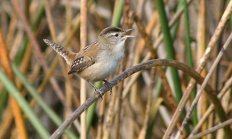
This pugnacious little wren, formerly known as the Long-billed marsh wren, inhabits cattail, bulrush, and other marsh plants. As the only Oregon species of wren that nests over water, it is easy to identify when seen, but sexes are difficult to differentiate in the absence of song due to similar coloration. This species has long been of interest to behavioral and evolutionary ecologists due to its polygyneous mating system, widespread construction of dummy nests, and the male's complex singing behavior. The Marsh wren nests statewide in appropriate wetland habitats. It is particularly common during breeding season around Malheur National Wildlife…
The bubbly warble of this finch is common in western Oregon conifer forests in summer, while its Crossbill-like - but more delicate - pik call is heard in lowland valleys in the winter. Adult males have a distinctly reddish-colored head, face, rump, throat, and breast, broadly but very faintly streaked brownish-pink sides, and a diffused brownish-red nape, back, and wings. Females and immature males have brownish-olive upperparts, wings, and tail, with contrasting streaking. Underparts are buffy-white to off-white with fuzzy, brownish streaking; a dingy pale gray stripe is present above the eye. In Oregon, the Purple finch breeds west of…
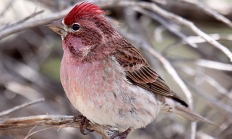
The bubbly warble of this finch is common in western Oregon conifer forests in summer, while its Crossbill-like - but more delicate - pik call is heard in lowland valleys in the winter. Adult males have a distinctly reddish-colored head, face, rump, throat, and breast, broadly but very faintly streaked brownish-pink sides, and a diffused brownish-red nape, back, and wings. Females and immature males have brownish-olive upperparts, wings, and tail, with contrasting streaking. Underparts are buffy-white to off-white with fuzzy, brownish streaking; a dingy pale gray stripe is present above the eye. In Oregon, the Purple finch breeds west of…

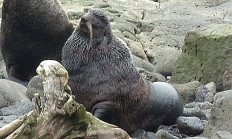
The Northern fur seal is the smallest member of the family in Oregon. The flippers are nearly twice as large as those of a comparably-sized individual of any other species of otariid. The ears are cylindrical and the auditory meatus is covered with wax to prevent entry of water. The pelage consists of coarse guard hairs and an exceedingly thick underfur that serves as waterproof insulation. Adult males are dark gray or brown dorsally and reddish brown ventrally; a grayish cape covers the neck and shoulders. Adult females are grayish brown dorsally and reddish brown ventrally. The Northern fur seal…
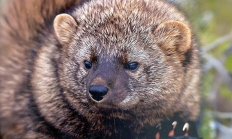
The Fisher is considerably larger than the marten and males are considerably larger than females. It is more stockily built than the weasels, but is similar in that the head is somewhat pointed, the body elongate, and the legs short. The pelage is long except on the face. The fur is dark brown grading to black on the rump and legs; the tail is black. Fishers once occurred throughout the coniferous and mixed forests of Oregon's Coast Range and Cascade Mountains. Currently, there is a native population in the Siskiyou Mountains and an introduced populations in the southern Cascades that…
CLACKAMAS, Ore.—Fishery managers from Oregon and Washington expanded recreational spring Chinook days and retention on the mainstem Columbia River during a joint state hearing yesterday. There is remaining harvest allocation available for increased spring Chinook opportunity while staying within allowed ESA-impact rates and other management limits. The following changes were…
Features: The purple varnish clam is named for the purple hue found inside the clam and the shiny varnish over the brown color outside the shell. It is oval in shape and is relatively flat with a prominent ligament near the hinge. Habitat: These clams can be found in cobble to muddy substrate. Technique: Purple varnish clams are found in very high densities. Limits are 72 a day. Learn more here before getting started clamming. See Oregon Sport Fishing Regulations for information on the daily catch limits for bay clams. How to dig purple varnish clams (video)

The common goldeneye drake is a strikingly handsome black-and-white diver about the size of a greater scaup. Goldeneyes are strong, fast flyers nicknamed "Whistlers" for the sound of their primaries as they zoom past on a still day. Drakes have a black head with a white spot below and in front of the eye, white neck, breast and flanks and a black back and tail. Hens have a brown head, light neck, breast and belly, brown backs and flanks. They are fairly silent and usually alone or in small groups. They tend to remain apart from other ducks. It is…

Canada geese, with their distinctive black neck and head and white cheek patches, need little description because they are one of Oregon's most familiar and conspicuous birds. There are 11 subspecies of the Canada goose. As a whole, the species is widely distributed throughout Oregon, with the exception of mountainous and desert areas lacking reservoirs, lakes, or large rivers. Concentrations of wintering and breeding Canada geese occur wherever agriculture and other human developments provide green forage or small grains and water bodies provide sanctuary. Hear the call of the Canada goose Photo by Leise Wease
