
Search myodfw.com
Showing 121 - 140 of 306 results

Features: While their coloration can be variable, bull trout are generally gray infused with green. The body is covered with small white or pale yellow spots. Some spots along the side may be deep orange to red. The leading edges of the fins along their bellies are white. Bull trout, despite the common name, is not actually a trout but a member of the closely related char group. Habitat: Bull trout require cold, clean water to survive and are typically found in the headwaters of Oregon rivers. Spawning occurs in the fall when water temperatures drop below 50F. Techniques: Anglers…

Features: Blue grouse are large in comparison to most other grouse species. The females are mottled brown, tan, and gray. The males are similar, but with solid blue-gray on the underside and bright orange-yellow combs over the eyes. Habitat: Blue grouse occupy the coniferous forests of western Oregon, the eastern slopes of the Cascades, the Blue Mountains of northeastern Oregon, and the Klamath Basin and south Warner Mountains. Preferred habitat includes timber edges, open timbered slopes, mountain meadows adjacent to springs or other sources of water, and near berry producing areas such as chokecherry thickets. Technique: Effective hunting techniques involve…

The Cascade torrent salamander generally has numerous medium-sized black spots and white-gray flecking along its tan back and sides and a bright yellow belly that has fewer spots. Adults can grow to just over four inches in total length. Cascade torrent salamanders spend their lives in and near permanent, cold, fast-flowing and clear water including headwater streams, waterfall splash zones and seeps in older coniferous forests. Adults need gravel streambeds or other gravel areas with constant and shallow water flow for foraging and cover. The Cascade torrent salamander is an Oregon Conservation Strategy Species in the West Cascades and Willamette…

SALEM, Ore.— The Commission set 2026 groundfish regulations during their meeting in Salem today. The daily catch limit for lingcod will increase from 2 to 3 fish next year, since lingcod populations are healthy and bycatch of yelloweye rockfish (a protected species) is still low. The daily limit for general…

SALEM, Ore. – ODFW staff at the Ashland Boat Inspection Station found golden mussels on a watercraft that was being transported to a new owner from the Sacramento River Delta to Oregon on April 4. The watercraft was decontaminated at the inspection station and all golden mussels attached to the…
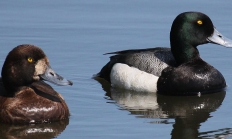
Features: Greater scaup are almost the size of redheads. In hand, they are easily distinguishable from lesser scaup by size and by the white wing stripe extending beyond the secondaries into the primaries. In the field, the two species can be difficult to separate. Drakes are black on both ends and white in the middle. Although not extremely reliable, in good light, generally the black head of drake grater scaup have a green sheen, while the head of a drake lesser scaup have a purple sheen. Hens are dark brown with a white mask around the base of the bill…


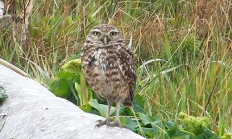
This small owl is unusual in that it nests in earthen burrows in open shrub-steppe regions and grasslands. This habit is even more curious in Oregon since most burrows used for nesting were previously excavated by badgers, a major predator of Burrowing owl eggs and young. These long-legged, short tailed owls are generally brownish buff with spots across the back and barring across the front. Males are usually lighter colored than females, possibly because they spend more time exposed to the elements. Males also average five percent larger than females, a situation rare among owls. The Burrowing owl is a…
The Olive-sided flycatcher is one of the most recognizable breeding birds of Oregon's conifer forests with its resounding, three-syllable whistle song quick, three beers. It is a relatively large, somewhat bulky, large headed, short-necked flycatcher that perches erect and motionless at the top of a tall tree or snag except when singing or darting out to capture flying insects. The overall olive-gray plumage is generally nondescript except for a whitish stripe down the breast and belly which gives the impression of an unbuttoned vest, and white patches between the wings and lower back. This flycatcher breeds in low densities throughout…
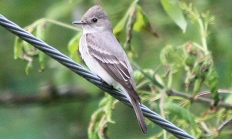
This medium-sized flycatcher has expanded its breeding range from northern California to southwestern Oregon and continues to expand its range in Oregon. First experiences with the species may bring to mind a Slate-colored Junco behaving like a flycatcher. The Black phoebe is dull, sooty black overall, somewhat paler on the back, with a white belly contrasting with the black breast and sides. Bill, legs, and feet are black. The phoebe dips its tail repeatedly. Black phoebes are associated with water. Slow-flowing, idle, or slack water of large rivers, streams, and creeks, ephemeral and permanent ponds, lake shorelines, irrigation ditches, and…

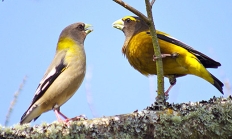
This sturdy-looking bird has a large head, short tail, and massive conical bill adapted for seed eating. The male plumage features bold patches of lemon yellow shading into olive, then brown and black, with white secondaries creating a flashy wing-patch easily seen in flight. The male's bill is chalky white in winter, but changes in early spring to a pale green that matches the new growth at the tips of spruce boughs, where they often nest. Many encounters with this species are of individuals heard flying high overhead, leaving the observer with little else to note. The Evening grosbeak is…
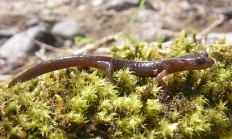
Adult clouded salamanders are generally brown with brassy patches on their backs and gray bellies. As salamanders age, the brassy color fades. The clouded salamander is one of the lungless salamander species; they breathe through their moist skin. Mature adults can grow to just over five inches in total length. Clouded salamanders prefer forest habitats or burned areas that provide large decaying logs or stumps. They are often found in Douglas fir trees where they can find burrows in the wood, or spaces just under the bark to hide. They may also hide deep in rock crevices during dry and…
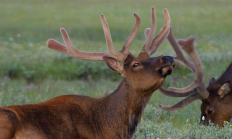
The bright yellow, red, and black plumage of the male Western Tanager, so conspicuous in open situations is very obscure in forested areas where it tends to blend into the shaded foliage. The species perhaps is best known in migration when it visits city parks, orchards, and other open urban and suburban areas. It is attracted to birdbaths but seldom to bird feeders. It breeds in open coniferous forests and mixed coniferous and deciduous woodlands, primarily in mountains. They usually nest in conifers - rarely deciduous trees - at varying heights, usually well out on a branch, often at the…

The gregarious Tricolored blackbird is one of North America's most intensely colonial breeders, forming dense, non-territorial, noisy colonies. A highly synchronized nesting system exploits secure nesting locations and rich food supplies that change from year to year. In Oregon, breeding colonies are scattered and intermittent at specific locations, though sites used during consecutive years may be in the same general area. The Tricolored blackbird breeds most consistently in Klamath and Jackson Counties. Small colonies and summering residents have been found in the Willamette Valley; during fall and winter they are rare. Most retreat south to California in winter, while some…
