Search myodfw.com
Showing 1261 - 1280 of 1415 results
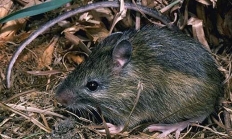
The canyon mouse is a moderate to small-sized mouse-like rodent with a long tail, nearly naked ears and a long, lax, and silky dusty gray pelage. In Oregon, most locations where the canyon mouse has been found are in Harney and Malheur counties, but the distribution includes a group of localities in Crook, Jefferson, Wasco, and Wheeler counties and another group in Lake County. There are also records of the species in extreme southeastern Baker County. Rock, primarily rimrock and talus slopes, seems to be the key component of habitats occupied by the canyon mouse. They are usually active nocturnally…
The Western red-backed vole is among the smaller of the voles in Oregon. The pelage consists of a vaguely demarked reddish-brown or chestnut-brown stripe on the dorsum grading to buffy gray to dark gray on the sides and venter; the tail is indistinctly bi-colored, light grayish-brown above and whitish below. This vole occurs from the Columbia River south through the Coast Range. It does not occur in the Willamette Valley or other interior valleys west of the Cascade Mountains. It is a denizen of forest habitats, but tends to be most abundant in closed canopy old-growth forests containing an abundance…

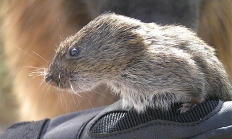
The montane vole is a medium-sized vole. The pelage is ashy gray mixed with brown and black on the dorsum shading to light gray or whitish on the venter. The feet are lead colored and the tail is bi-colored black or dark gray above and light gray to whitish below. Splotches of different shades of yellow on the nose, venter, and dorsal surfaces of the feet and tail occur on some adult Montane voles. This vole is distributed throughout most montane and intermontane areas of the west occurring throughout that portion of Oregon east of the crest of the Cascade…
The Western jumping mouse is a long tailed, sleek-bodied mouse. The pelage is course. They yellowish-gray to ocherous sides are separated sharply from the pale-brown to grayish-brown dorsum; the venter is white, often washed with ochre. The tail is bicolored, but not markedly so. In Oregon, the species occurs throughout most of the area east of the Cascade range except for the Columbia Basin-Deschutes Plateau region. It also occurs in southern Jackson County. Throughout its range, it is a denizen of mountain meadows, particularly those with small streams. Without doubt, the most unique feature of the life cycle of the…
Western painted turtles need marshy ponds, small lakes, slow-moving streams and quiet, off-channel portions of rivers. They prefer waters with muddy bottoms with aquatic vegetation. Open ground for nesting and logs for basking help keep this species healthy. These painted turtles occur in the Blue Mountains and Willamette Valley ecoregions. In the Columbia Plateau, East Cascades and West Cascades ecoregions, they live only along the Columbia River. Western painted turtles are an Oregon Conservation Strategy Species in these: Blue Mountains, Coast Range, Columbia Plateau, East Cascades, West Cascades, Willamette Valley. Photo by Robert Bryce Ott

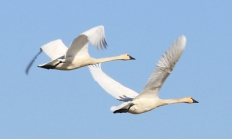
Of several swans found in Oregon, the tundra swan is by far the most common during the non-breeding season. It is most readily distinguished from the similar-appearing trumpeter swan by voice, although subtle differences in physical appearance and behavior can separate the two with difficulty. It is a fairly common transient throughout the state but most abundant at large bodies of water and wetland complexes east of the Cascades including the Malheur National Wildlife Refuge and the surrounding Harney Basin, Summer Lake Wildlife Area and the Klamath Basin. Hear the call of the tundra swan Photo by Kathy Munsel, ODFW
Multnomah County Health Department, Oregon Health Authority, Know Your River, Know Your Food, Get Hooked, ODFW and Portland Harbor Community Coalition are hosting this year's fourth annual carp fishing tournament.
June 27, 2026
Cathedral Park Dock--N Edison St and Pittsburg Ave Portland, OR

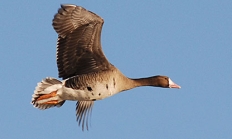
While not as abundant or conspicuous as the more familiar Canada and snow geese, the great white-fronted goose represents one of the first signs of fall. The greater white-fronted goose is gray-brown in body color and has orange feet. Adults have the namesake white forehead, pinkish-orange bill, and black speckled/barred breast and belly. Laugh-like calls from small skeins of these birds are heard high overhead in August through September in the north Willamette Valley and across the Cascades to south central Oregon and northeast California. Hear the call of the greater white-fronted goose Photo by Dave Budeau, ODFW
This large arctic gull visits the Northwest in winter where its pale bulk often stands out in gull flocks. Finding one is a highlight of winter birding. Even at a distance the size and frosty tones of this bird can be spotted in a flock. Most Oregon birds are in the whitish first-or-second-year plumage showing a pinkish bill with sharply delineated black tip, but third-year birds and adults occur now and then, mainly on the north coast and at Sauvie Island. They are rare but regular along the coast and the Columbia River, and rare in the Willamette Valley. It…

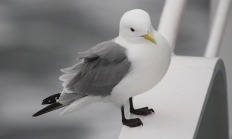
These small agile gulls are predominantly pelagic, but can often be seen from shore and even idling around lower estuaries. It is found primarily on salt water and does not usually forage in dumps and pastures as most gulls do; rather it stays over open ocean, along beaches and in lower estuaries, sometimes resting on the water or on jetties, sand spits and similar bare areas. They are often attracted to feeding swarms of loons, pelicans, tubenoses and other seabirds. The Black-legged kittiwake is a migrant and winter resident in Oregon along the outer coast and offshore. Peak numbers are…
During the breeding season Pigeon guillemots are easily seen flying low over the water along rocky coastlines or in estuaries. They have striking red feet, legs, and mouth linings and their large white wing patches contrast markedly with the rest of their black plumage. When standing on land they have a distinctive upright posture and often emit a high-pitched squeal. In the non breeding season they move offshore and look entirely different when their black plumage becomes mottled with white. The Pigeon guillemot occurs during the breeding season all along the Oregon coast wherever offshore islands or rocky cliffs are…

The White-headed woodpecker is the only woodpecker that relies heavily on the seeds of ponderosa pine for food. It occurs mainly in open ponderosa pine or mixed conifer forests dominated by ponderosa pine. They usually excavate nest cavities in snags but may use stumps, leaning logs and dead tops of live trees. It is an uncommon permanent resident in forests of the Ochoco, Blue, and Wallowa mountains and the east side of the Cascades, but suitable habitat is restricted. The White-headed woodpecker is an Oregon Conservation Strategy Species in the Blue Mountains, East Cascades, and Klamath Mountains ecoregions. Hear the…

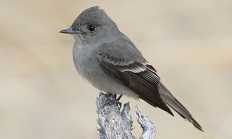
The down-slurred pee-eer call of this flycatcher is one of Oregon's most characteristic summertime bird sounds. Wherever there is a canopy of mature deciduous trees, one is likely to hear the call during warm afternoons when most other birds are silent. Because the call can easily be heard, it can usually be found perched near the tip of a dead branch from which it frequently flies a short distance to capture a flying insect, or to chase an intruder from its territory. The Western wood-pewee is a common migrant and fairly common breeder statewide in open groves of trees or…
A colorful harbinger of spring, the hardy Tree swallow arrives from the south during February each year. It is a highly social species that is usually observed in large flocks often with Violet-green and other swallow species. It is not colonial but several pairs may nest together if available cavities are clustered. The Tree swallow is a bird of open places near water and is seldom seen in residential neighborhoods or built-up urban areas. It is the only swallow that eats berries and small seeds as well as insects. In Oregon, it is a locally abundant summer resident and breeding…

Dashing and darting about, flashing its bright white underparts, the Violet-green Swallow is one of the characteristic birds of summer. Unlike the Tree Swallow it commonly nests in niches and cavities on urban buildings and readily uses nesting boxes in residential areas. Its soft twittery call notes are a familiar pre-dawn sound as they fly about overhead. The Violet-green swallow is a very early spring migrant concentrating about streams and wetlands where emerging insects can be found until warmer weather allows them to move into more upland areas. It is a common to abundant summer resident and breeding species throughout…

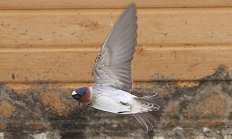
This chunky swallow is readily recognized by its square tail and orangish rump patch. It nests colonially and has taken to human-made structures so well that it has greatly expanded its range into many areas otherwise not suitable for it. It does not do well in urban settings, however, and quickly disappears when areas become densely settled. The unique gourd-shaped mud nest is often usurped by other species for nesting and is often used for protective roosting sites by rosy-finches and other wintering species. It is a locally common to abundant breeding bird near water throughout most of Oregon. Its…
Among the largest of the world's nuthatches, White-breasted nuthatches also are noteworthy for an extensive repertoire of unusual behaviors and habits. Unlike most other North American passerines, White-breasted nuthatches maintain close pair bonds over most of the year. In spring, they cement their pair bond by exhibiting a variety of courtship displays. Elaborate display rituals also are used in antagonistic territorial interactions, and distraction displays are used to deter predators. The White-breasted nuthatch is common in western Oregon lowlands. It is most abundant in southwestern interior valleys, with specimens from Salem to Jackson County. It occurs in oak and mixed…

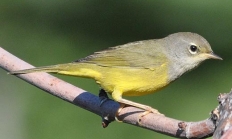
During the breeding season, this gray-hooded warbler is conspicuous, singing boldly from riparian thickets, clear-cuts, and roadside brush. However, when household cares occupy the daylight hours, they become elusive as field mice, slipping about through the thickets like shadows, only the sharp alarm note betraying their presence to an intruder. After many minutes of careful pursuit, an observer is often left with only a brief glimpse of an olive-colored back or a broken white eye-ring. MacGillivray's warbler is one species that appears to thrive in areas that have been disturbed by industrial forest practices. It has been reported from every…
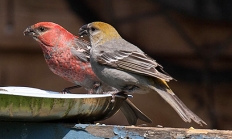
While in Oregon, the Pine grosbeak is tame and not suspicious, usually allowing a close approach as it feeds on buds or dried fruits. The soft-gray females and young males, the latter more or less washed with yellow on the head, far outnumber the rosy males, and observers should look carefully for these duller-colored birds. The song of the Pine grosbeak is often described as similar to the Purple finch, but fuller and with lower pitch. The flight is typically finch-like, but with broad, bounding undulations. The Pine grosbeak breeds in the Wallowas and is suspected to breed in the…
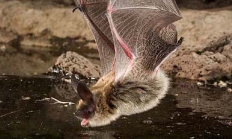
The long-eared myotis is pale brown to strawberry. It is a slow flier and hovers around trees and rocks to catch flies, moths and wasps. It is primarily a bat of coniferous forests in much of Oregon but may occur far from trees in shrub-steppe regions of the state. It forages in openings in dense forest, between the trees beneath the canopy in ponderosa pine, and over willow-bordered creeks. The species is known to enter dwellings and other buildings through open windows and doors, and to forage on moths therein. The long-eared myotis often day roosts in buildings, but may…