
Search myodfw.com
Showing 1341 - 1360 of 1415 results
The Chisel-toothed kangaroo rat is an intermediate-sized kangaroo rat with a narrow face, small ears, and flat-faced, nearly square-edged lower incisors shaped like miniature chisels. Among kangaroo rats, the cheek pouches in relation to the size of the head are exceptionally large. The pelage on the dorsum is composed of hairs with medium-gray bases, a buffy band, and a tiny blackish tip, overall a dirty-sand color. The venter, upper lip, feet, and base and sides of the tail are white and there is a white spot above each eye and behind each ear. A black moustache, eyelids, ears and tail…

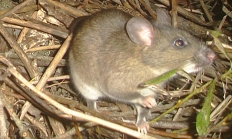
The dusky-footed woodrat is a medium-sized rat-like form with large, nearly naked ears, protruding eyes, and a long tail. The dorsal pelage consists of hairs with steel gray bases, a band of ocherous buff, and a tip of black. Hairs on the throat and belly are white. Although variably in extent, a dusky splotch occurs on the dorsal surface of the white feet. In Oregon, this woodrat occurs from the California border northward along the coast to near Bandon, northward inland through the Willamette Valley and other interior valleys to near Mollala and Monmouth, and northward to Brownsboro, Jackson County…
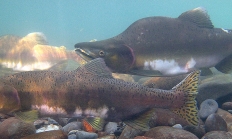
Features: Like all cutthroat trout, this species boasts bright red streaks on either side of its “throat.” You can tell it’s a westslope cutthroat by its spot pattern – the majority of the black spots are found on the back end of the fish with rather few ahead of the dorsal fin. Habitat: While westslope cutthroat trout was once the most widely distributed cutthroat in North America, its home in Oregon has always been limited to the John Day Basin. During the cooler months of summer you can find them in places like Strawberry Creek and upper Canyon Creek. As…

Features: These fish are silver when young, but darken and develop black spots on their tails and backs as they age. In fresh water, the males are red on their sides and develop a hump on their backs earning this species the common name humpback salmon. Females in fresh water are green on the sides with dark bars. Pink salmon are an average of 20- to 25-inches long and rarely weigh over 5 pounds. Habitat: Pink salmon spawn on odd numbered years and do so very close to saltwater, never going very far upriver. In fact, some pink salmon will…
The coloring of adult coastal tailed frogs often matches the color of local rocks ranging from brown or reddish-brown to gray with little flecks of yellow or gray. They have grainy textured skin that further enhances their camouflage. Male coastal tailed frogs have a short tail, the signature for tailed frogs. Adult males grow to one and three-quarter inches long and adult females to two inches long. They live in very shallow and heavily shaded water of fast running, small, permanent mountain streams with cold and clear water, rocky substrates and little silt in older forests. These streams are often…

The Rocky Mountain tailed frog’s coloring often matches the color of local rocks ranging from brown or reddish-brown to gray. They have grainy textured skin that further enhances their camouflage. Males have a short tail, the signature for tailed frogs. Adult males are slightly smaller than adult females that grow to two inches in length. Rocky Mountain tailed frogs are found in the water or close by it. They live in very shallow and heavily shaded water of fast-flowing, small, permanent streams in older mountain forests with cold and clear water, rocky substrates and little silt. These streams are often…

Adult frogs are gray or brown with yellow underbellies and thighs. Their color and grainy textured rough-looking skin helps camouflage them, making them hard to see among rocks. Adults can grow to three inches in length; males are slightly smaller than females. Foothill yellow-legged frogs live in or along edges of permanent streams and rivers with exposed rocky streambeds and off-channel waters that are slow flowing and quiet. In summer, they are likely to hide under rocks in streams or among clumps of vegetation along pools. They use rocks or debris at the bottom of the streams as refuge from…


KLAMATH FALLS, Ore. – ODFW is taking steps to protect native redband trout by requiring catch-and-release fishing for them and flies and artificial lures only (no bait) for all species from June 15 to Oct. 31 on Upper Klamath Lake and spring-fed creeks that feed into it. The waterbodies impacted…
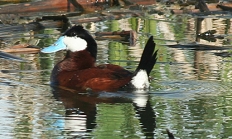
Small in size and displaying a showy, almost comical alternate plumage, the male ruddy duck is an unforgettable sight. Breeding males are unmistakable with their rich chestnut back, black crown, white cheek, sky-blue bill, and proportionately long stiff tail. Female plumage is drab in comparison, being dusky dark brown with a dark facial strip across the mostly white cheek, quite similar to the male's basic plumage. Known for their peculiar courtship display in which the male draws his head down and slaps his bill against his breast repeatedly in increasing tempo, creating a bubbling in the water and a hollow…
ODFW's Living with bears page has tips on living, working, and recreating in bear country and more. Oregon is Black Bear Country Brochure (pdf) Be Wildlife Smart When Working in the Woods (pdf) Electric Fences Keep Bears Out - BearWise Bulletin (pdf) Follow these "bear" essentials on working or recreating in bear country, print this homeowner checklist to keep bears at bay, and more. Essentials for Living with bears (pdf)

Features: Bullheads present in Oregon are distinguished from channel catfish by their square or rounded tails and lack of spotting. They seldom exceed 18 inches in length and a weight of 2 pounds. Yellow bullheads are a more uniform yellow color with white or cream chin barbels and a rounded tail. Habitat: Bullheads are found on the bottom in the shallows of mud-bottomed ponds, lakes, reservoirs and backwaters of rivers. The yellow bullhead is found mainly in the Willamette basin. Technique: Bullheads can be caught any month of the year, but fishing is best from the first warm days of…

Features: California halibut are usually solid brown to black or mottled with light and dark patches on the eyed side and white underneath. They have the ability to change skin color patterns to blend in with the ocean floor. The eyes on a California halibut are most commonly on the left side but may be on the right side as they are on a Pacific halibut. The upper jaw in a California halibut extends to the rear of the lower eye, while on a Pacific halibut the upper jaw only extends to the front of the lower eye. In both…

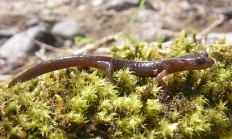
The Larch Mountain salamander is one of the rarest amphibians in the Pacific Northwest. This small woodland salamander has a reddish-brown or yellow black-spotted stripe along its back and has a pink belly. The Larch Mountain salamander is one of the lungless salamanders that has to breathe through its skin. Mature adults can grow to four inches in total length. This salamander like’s steep basalt talus (piles of volcanic rock fragments). Forested areas are also important because trees block out sunlight, allowing moss to grow on rock piles which keeps the ground damp all year. Larch Mountain salamanders prefer slopes…

Adult clouded salamanders are generally brown with brassy patches on their backs and gray bellies. As salamanders age, the brassy color fades. The clouded salamander is one of the lungless salamander species; they breathe through their moist skin. Mature adults can grow to just over five inches in total length. Clouded salamanders prefer forest habitats or burned areas that provide large decaying logs or stumps. They are often found in Douglas fir trees where they can find burrows in the wood, or spaces just under the bark to hide. They may also hide deep in rock crevices during dry and…
Adults have smooth, moist skin that is brown or reddish-brown in color with black flecks on their backs, sides and legs. They may also have a dark colored mask. Adults have red underlegs, hence their name. Females, growing to four inches in length, are almost twice the size of males. Adult red-legged frogs like cool damp coniferous or deciduous forests and forested wetlands. During the non-breeding season, adult frogs spend most of their time on land in woodlands along streams, in moist sedge or brush, along shaded pond edges or under logs and other forest debris. Damp weather permits them…

The bright yellow, red, and black plumage of the male Western Tanager, so conspicuous in open situations is very obscure in forested areas where it tends to blend into the shaded foliage. The species perhaps is best known in migration when it visits city parks, orchards, and other open urban and suburban areas. It is attracted to birdbaths but seldom to bird feeders. It breeds in open coniferous forests and mixed coniferous and deciduous woodlands, primarily in mountains. They usually nest in conifers - rarely deciduous trees - at varying heights, usually well out on a branch, often at the…

The coyote is a typical canid intermediate in size between the foxes and the gray wolf. The pelage of the coyote is grayish, buff, pinkish cinnamon, or brownish, or a combination of those colors, often overlain by blackish tipped hairs on the ears, muzzle feet, and dorsum. The lips and eyelids are black, accentuated by contrasting borders of white fur. The underparts are paler than the remainder of the body. Considerable variation in color and markings of coyotes is evident among individuals and regionally east and west of the Cascade Range. True albinos with pink eyes and pink foot pads…

The Pacific white-sided dolphin is most abundant in the Southern California Bight in winter, but move further north, off Oregon and Washington in summer. These animals can be found from the tip of Baja to the Aleutians and the western Pacific from the Kuril Islands to Japan. They prefer deep, off-shore waters, so sightings are usually limited to recreational and commercial fishers. The Pacific white-sided dolphin is about seven or eight feet long. It has three colors: the chin, throat and belly are creamy white; the beak, flippers, back, and dorsal fin are a dark gray, and there are light…

These large salamanders are marbled brown and tan in color when in their rare terrestrial (land-living) adult form. They are brown with yellowish-tan patches on These large salamanders have an aquatic adult stage that is brown with yellowish-tan patches and short gills. The rare terrestrial adult is marbled brown and tan. Larvae of Cope’s giant salamander are smaller with a more narrow head and shorter legs than the coastal giant salamander. Both terrestrial and aquatic adults can grow up to eight inches in total length. Most adult salamanders live in cold, fast-flowing, clear and permanent streams in coniferous forests. Adult…
