

Search myodfw.com
Showing 221 - 240 of 677 results
Landing page
Find maps, boundary descriptions and hunts available in the new Fox Hunt Area. Download printable PDF map
November 14, 2025
Landing page
Find the weekly statistics for waterfowl and upland game birds at Ladd Marsh Wildlife Area.
September 22, 2017
Zones or Areas
Trout fishing opportunities abound in this zone, known for its high desert climate, sage-covered canyons, glacial peaks and mountain lakes. Anglers will find year-round trout fishing in the Deschutes, Metolius, Fall and Crooked rivers, while several central Oregon lakes and reservoirs are renowned for their trout and kokanee fishing – and their beauty. The Hood and lower Deschutes – both tributaries of the Columbia River – offer high desert fishing for Chinook salmon and summer steelhead.
Article
Creating a purchase group allows you to buy licenses, tags and other documents for family and friends, both online and with agents. After a customer has verified their account, they can be added to a purchase group using their ODFW ID# and the product catalog will reflect the correct products and pricing for each customer in the group. It is important to use customer group purchases as the attestation and acknowledgment is only being made by the customer that is present. Purchase now
November 18, 2025
Educational Moment
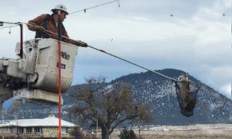
Captain Casey Thomas, Fish & Wildlife Division An Oregon State Police Fish and Wildlife Trooper received multiple complaints about an owl hanging from a power line. The barn owl had become tangled in fishing line, which was hanging from a power line, about 20 yards from a bridge that crosses the Lost River. A local raptor rehabilitator told the Trooper that unlike eagles, Owls can't swim. A local Pacific Power employee had a boom truck and offered to help. Using the Troopers net, he was able to safely cut the owl down. The owl received some treatment at a local…
February 25, 2025
Landing page
Each year ODFW assesses the freshwater escapement of Rogue River coho, fall Chinook, late run summer steelhead, and "half-pounder" steelhead by beach seining the waters near Huntley Park three times a week from Mid July thru October.
October 13, 2017
Zones or Areas
The granite peaks of Oregon’s Blue and Wallowa Mountains form the backdrop for many of this zone’s glacier-carved lakes and crystalline streams. Bull trout thrive in this zone’s cold, clear rivers, which also sustain whitefish and rainbow trout, and welcome returning runs of hatchery-reared steelhead. Chinook salmon travel over 300 miles up the Columbia to spawn in rivers such as the Imnaha and Wallowa. Warmwater fisheries are few, but the John Day River offers world-class fishing for smallmouth bass.
Zones or Areas
Abundant rainfall feeds the massive Willamette River watershed, tamed by a system of reservoirs that are stocked annually with hundreds of thousands of rainbow trout. Some of these reservoirs also grow trophy-size largemouth and smallmouth bass, as well as bluegill, brown bullhead and crappies. Smaller lakes and ponds nearer the valley floor provide springtime trout fishing close to home. Salmon and steelhead navigate the Willamette River and its tributaries, many of which are also home to rainbow and cutthroat trout.
Zones or Areas
Wide open spaces, wild windy places, and extreme temperatures characterize Oregon’s largest, most remote fishing zone. Redband trout are native to its rivers and streams, including the Williamson, Malheur and Chewaucan. Brown and hatchery rainbow trout can grow to trophy-size in many of its lakes and reservoirs, many of which also feature crappie, yellow perch and bass.
Landing page
Located near the Elkhorn Mountain Range, Elkhorn Wildlife Area is best known for Rocky Mountain elk and mule deer herds that use the area during the winter. To keep deer and elk from feeding on agriculture lands when they come down from snow-covered higher elevations, ODFW operates 10 feeding sites on the area to feed 1,400 elk and 800 deer during the winter months.
March 05, 2018
Press Release
LA GRANDE, Ore. – Lookingglass Creek, a tributary to the Grande Ronde River at Palmer Junction, will open for spring Chinook fishing Wednesday, June 18 through Sunday, June 29. The open area is from the mouth upstream to the confluence of Jarboe Creek. After early season projections made it appear…
June 17, 2025
Press Release
NEWPORT, Ore. – The commercial Dungeness crab fishery opens Dec. 31 from Cape Falcon to the Washington border. Fishermen can begin the presoak period – setting baited crab pots in the water – on Dec. 28 in this area. ODFW delayed opening the north coast until crab in Long Beach…
December 19, 2025
Species and Subspecies
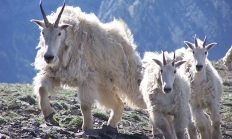
The mountain goat is a stockily built bovid with black scimitar-shaped horns, large black hooves and prominent dew claws, and an entirely white, wooly pelage. Sometimes the pelage contains scattered brown hairs on the dorsum and rump. A long beard, pointed ears, and a squarish muzzle are also characteristic. Males are larger, and have longer, larger-diameter, and more evenly curved horns that females. Mountain goats are denizens of high altitudes, remote, and barren montane regions where they are capable of moving through exceedingly rugged and precipitous terrain with speed and agility. Nevertheless, mountain goats are known to fall occasionally, whereupon…
Zones or Areas
A dozen great rivers pour out of the Coast Range Mountains into tidal bays that welcome runs of salmon and steelhead. Bays are the year-round home to marine perch, rock fish, crabs and clams, while other species come and go with the seasons and tides. A handful of ponds dot the forested slopes, and there are dozens of dune lakes— many stocked with rainbow trout, and some harboring largemouth bass, perch, crappie and brown bullhead.
Landing page
This 141-acre property along both sides of the Yachats River was first purchased in the early 1980s to provide forage for elk and help alleviate elk damage to surrounding agricultural land. It also provides public access to the Siuslaw National Forest along the Yachats River Highway, where there are few public access points.
February 07, 2018
Article
Rabbit hunting is the third most popular type of hunting activity in the U.S., behind wild turkey and deer hunting. Few people take advantage of it in Oregon, but they should—rabbits and hares are abundant and there is no closed season or bag limit. Plus, they taste good!

Article
The Oregon Department of Fish and Wildlife owns or manages nearly 200,000 acres of land set aside for wildlife use and public recreation. The ODFW Wildlife Area Parking Permit helps fund habitat improvements and visitor amenities such as parking, restrooms and interpretive signs at these wildlife refuges. Buy a Parking Permit
November 17, 2025

Article
All funds raised by deer and elk auction and raffle tags go directly to the Access and Habitat Program. Funds raised by bighorn sheep, pronghorn, and Rocky Mountain goat auction and raffle tags go directly to the management of those species.
November 25, 2025

Species and Subspecies
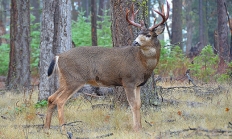
Nearly a dozen subspecies of Odocoileus hemionus are recognized. Of these, two occur in Oregon - the mule deer and Columbian black-tailed deer, often just referred to as "Black-tailed deer." The mule deer is larger, lighter in color, and often associated with more open habitats, whereas the black-tailed deer is smaller and darker, and frequents dense, early seral forest communities. The most distinguishing feature of the black-tailed deer is the tail. Although not as long or wide as that of the white-tail, it is much larger than that of the mule deer. Because of the differences in size, color, marking…
Article
Information gleaned from the teeth of harvested black-tail deer will help ODFW biologists learn more about the deer population.
December 5, 2025