Search myodfw.com
Showing 321 - 340 of 509 results
ODFW Marine Resources Program's Alex Copeland monitors scientific fish finders on board the research vessel. ODFW photo. NEWPORT, Ore. – Oregon Department of Fish and Wildlife's Marine Fisheries Research team is conducting a nearly 10-week at-sea survey to better understand the population status of black, blue, and deacon rockfish—three species…

The Chisel-toothed kangaroo rat is an intermediate-sized kangaroo rat with a narrow face, small ears, and flat-faced, nearly square-edged lower incisors shaped like miniature chisels. Among kangaroo rats, the cheek pouches in relation to the size of the head are exceptionally large. The pelage on the dorsum is composed of hairs with medium-gray bases, a buffy band, and a tiny blackish tip, overall a dirty-sand color. The venter, upper lip, feet, and base and sides of the tail are white and there is a white spot above each eye and behind each ear. A black moustache, eyelids, ears and tail…


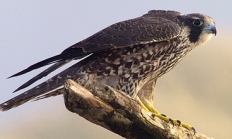
Peregrine falcons are among the most charismatic and noted of the world's birds. They are described as the fastest animal on the planet, and have been recorded reaching speeds in excess of 240 miles an hour in dives after prey. They are one of Oregon's boldest raptors, and have been observed usurping active Golden eagle nest sites, stealing fish from Ospreys and ground squirrels from adult Bald eagles who stray into their territory. It has, for perhaps 4,000 years, been used by falconers because of its skill in capturing game birds in tandem hunts with humans. Peregrines are medium-sized raptors…
This medium-sized flycatcher has expanded its breeding range from northern California to southwestern Oregon and continues to expand its range in Oregon. First experiences with the species may bring to mind a Slate-colored Junco behaving like a flycatcher. The Black phoebe is dull, sooty black overall, somewhat paler on the back, with a white belly contrasting with the black breast and sides. Bill, legs, and feet are black. The phoebe dips its tail repeatedly. Black phoebes are associated with water. Slow-flowing, idle, or slack water of large rivers, streams, and creeks, ephemeral and permanent ponds, lake shorelines, irrigation ditches, and…

The camas pocket gopher is the largest member of the genus, although large size is not a distinctive feature of the species. This gopher is a dark, sooty brown on the dorsum; the ears and nose are blackish. The venter is lead colored except for an irregular and variable-shaped patch of white on the throat. The winter pelage is long and furry; the summer pelage is short and coarse. The camas pocket gopher is one of the most vicious animals known for its size. Nevertheless, these pocket gophers flee from potential predators whenever the opportunity arises. This pocket gopher produces…

The Steller (or Northern) sea lion is the largest member of the family Otariidae. Among adult females and subadult males, the upper body is slim, whereas in adult males it is heavy and muscular. The head is bearlike with a moderate step between muzzle and forehead. The rear flippers are relatively small and can be turned beneath the body for travel on land. The pelage is light buff to reddish brown, slightly darker in the chest and abdomen. Overall the pelage appears darker when wet. However, beneath the water it appears white, whereas the California sea lion appears black. In…

Features: Spruce grouse are gray with white spots on the belly. The back feathers often have dark bars. Females tend to be paler in color than the males. The eyes are outlined by red combs over and white arcs underneath. Habitat: The spruce grouse is native to Oregon and found in coniferous forests across northern North America. However, Oregon is on the periphery of this species' range and they likely were never abundant in the state. Currently, spruce grouse can only be found in the Wallowa Mountains and Snake River divide of northeastern Oregon. Technique: Spruce grouse have been protected…

The North Nehalem Fish Hatchery was originally constructed in 1966. The hatchery replaced the Foley Creek Hatchery which was constructed in 1926. The facility is used for adult collection, spawning, egg incubation and rearing of fall Chinook, coho, winter steelhead and rainbow trout.
Sandy Hatchery began operation in 1951 as a state-funded facility. In 1959, the hatchery became part of the Columbia River Fisheries Development Program (Mitchell Act) – a program to enhance declining fish runs in the Columbia River Basin. The facility is currently used for the adult collection of spring Chinook, winter and summer steelhead, and coho salmon. Coho and winter steelhead eggs are taken, hatched, ponded and reared to release on station.
The major portion of Elk River Hatchery construction was completed in 1968. In 1971 the hatchery completed final construction on an intake and ten new ponds. The purpose of the facility is to supplement natural production of fall Chinook in the Elk and Chetco Rivers and winter steelhead in the Chetco River. The facility is used to collect Elk River fall Chinook, to incubate eggs and rear both natural and hatchery fall Chinook and winter steelhead.
LA GRANDE, Ore. – Effective Aug. 1 through Sep. 30, minimum and maximum size limits as well as the daily and possession bag limits for rainbow trout and bass are suspended for Thief Valley Reservoir (Southeast Zone) located in Union County. Harvest will be allowed by hand, dip net, or…
Salamanders are a group of tailed amphibians with long bodies and short limbs. They often prefer habitats with damp conditions, which allows them to “breathe” better through their skin. Wet and rainy days (typically late fall through spring in Oregon) are the best time to look for salamanders, as the additional moisture from fog and rain allow for increased surface activity. To find salamanders, look in cracks or search under bark, rocks or logs. If you move any debris during your search, remember to put it back where you found it when you’re done—salamanders are sensitive to disturbance and many…

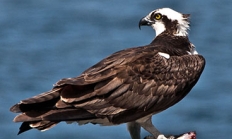
This large bird of prey has dark brown feathers above, white feathers below with a white head and prominent dark eye stripe as well as a visible dark spot at the wrist of the wing when flying. Juveniles have buffy-tipped dark feathers above. In flight, the wings have a noticeable angle or "crook." This highly migratory fish-eating species is frequently found nesting along larger rivers, lakes, and reservoirs. A large bulky nest at the very top of a live, broken top, or dead tree and more recently on utility poles, channel markers, pilings, and cell phone towers near fishable waters…
The gregarious Tricolored blackbird is one of North America's most intensely colonial breeders, forming dense, non-territorial, noisy colonies. A highly synchronized nesting system exploits secure nesting locations and rich food supplies that change from year to year. In Oregon, breeding colonies are scattered and intermittent at specific locations, though sites used during consecutive years may be in the same general area. The Tricolored blackbird breeds most consistently in Klamath and Jackson Counties. Small colonies and summering residents have been found in the Willamette Valley; during fall and winter they are rare. Most retreat south to California in winter, while some…

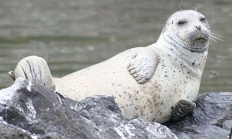
The body of the Pacific harbor seal is plump but tapers to small rear flippers permanently extended posteriorly. The head is large and rounded, the eyes are large, the limbs are short, and the nostrils sit dorsally on the muzzle. The nostrils can be closed when this seal dives. The tongue is notched at the tip. The pelage consists of long overhairs that overlay short underhairs. Markings are extremely variable, but in general the pelage is gray or brownish gray with numerous small spots of black that may coalesce to form splotches. Pacific harbor seals have been observed ashore at…