
Search myodfw.com
Showing 361 - 380 of 509 results
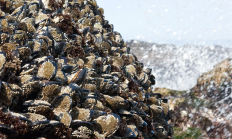
NEWPORT, Ore – Mussel harvesting is now open from Cascade Head to the California border the Oregon Department of Agriculture and Oregon Department of Fish and Wildlife announced today. Marine biotoxin levels in this area tested below the alert level. People should always call the Shellfish Safety Hotline at 1-800-448-2474…
This large arctic gull visits the Northwest in winter where its pale bulk often stands out in gull flocks. Finding one is a highlight of winter birding. Even at a distance the size and frosty tones of this bird can be spotted in a flock. Most Oregon birds are in the whitish first-or-second-year plumage showing a pinkish bill with sharply delineated black tip, but third-year birds and adults occur now and then, mainly on the north coast and at Sauvie Island. They are rare but regular along the coast and the Columbia River, and rare in the Willamette Valley. It…

The House sparrow is an invasive species introduced from Europe. No other North American wild bird is so associated with human settlement as this introduced House sparrow. Its foods are nearly all imports, and its nesting and cover requirements are also human-derived. The House sparrow and European starling are the only introduced passerine birds that are thriving in Oregon. These birds can dominate bird feeders and utilize nest boxes that were intended for native species. The House sparrow can be found statewide around buildings at human developments of adequate size ranging from scattered farmsteads in remote and rural areas to…

SALEM, Ore – Mussel harvesting is now closed from Cape Blanco to the California border the Oregon Department of Agriculture and the Oregon Department of Fish and Wildlife announced today. Recent mussel samples indicate levels of Paralytic Shellfish Toxin – a naturally occurring marine biotoxin that can cause Paralytic Shellfish…
SALEM, Ore – Mussel harvesting is now closed from the Washington border to the north jetty of the Siuslaw River (Florence) the Oregon Department of Agriculture and the Oregon Department of Fish and Wildlife announced today. Recent mussel samples indicate levels of Paralytic Shellfish Toxin – a naturally occurring marine…
The bubbly warble of this finch is common in western Oregon conifer forests in summer, while its Crossbill-like - but more delicate - pik call is heard in lowland valleys in the winter. Adult males have a distinctly reddish-colored head, face, rump, throat, and breast, broadly but very faintly streaked brownish-pink sides, and a diffused brownish-red nape, back, and wings. Females and immature males have brownish-olive upperparts, wings, and tail, with contrasting streaking. Underparts are buffy-white to off-white with fuzzy, brownish streaking; a dingy pale gray stripe is present above the eye. In Oregon, the Purple finch breeds west of…
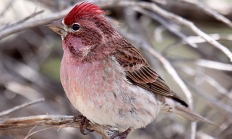
The bubbly warble of this finch is common in western Oregon conifer forests in summer, while its Crossbill-like - but more delicate - pik call is heard in lowland valleys in the winter. Adult males have a distinctly reddish-colored head, face, rump, throat, and breast, broadly but very faintly streaked brownish-pink sides, and a diffused brownish-red nape, back, and wings. Females and immature males have brownish-olive upperparts, wings, and tail, with contrasting streaking. Underparts are buffy-white to off-white with fuzzy, brownish streaking; a dingy pale gray stripe is present above the eye. In Oregon, the Purple finch breeds west of…

Greater scaup are almost the size of redheads. In hand, they are easily distinguishable from lesser scaup by size and by the white wing stripe extending beyond the secondaries into the primaries. In the field the two species are sometimes difficult to separate. Drakes are black on both ends and white in the middle. Hens are dark brown with a white mask around the base of the bill. The common vocalizations are the discordant scaup and purring pbbbrr of the female. Greater scaups form large flocks, sometimes mingling with lesser scaups in fall and winter. They are an abundant migrant…

These small, fast flying seabirds are unique among alcids in North America in their use of coastal coniferous forests, primarily old-growth trees, as nesting habitat. Their solitary nests are usually concealed within the forest canopy, and breeding birds are cryptic and primarily crepuscular at nest sites. Because of their secretive behavior and elusive nests, Marbled murrelets were considered the "enigma of the Pacific" and were one of the last ornithological mysteries in North America, as the first nest was not discovered until 1974. Distribution at inland nesting sites is fragmented, as birds occur only in areas where suitable habitat remains…

The pintail is a large, long-necked duck of open spaces. The long-tailed, full-plumaged drake is striking with a chestnut head, gray back and flanks, bright white breast and front of neck, and iridescent green bronze speculum. The brown hen is nondescript, but shares the long neck and graceful shape of the drake. Common vocalizations are the two-note flute-like whistle of the drake and harsh gaak, either single or in a series, of the hen. In fall and winter, pintails travel in medium to large flocks. In Oregon, flocks seem to fly exceptional distances in daily foraging and can be seen…

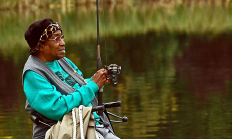
Lower Deschutes Wildlife Area was established in 1983, with the initial donation of land by the Oregon Wildlife Foundation (OWF) of 2,758 acres. In 1986 OWHF donated an additional 5,158 acres of land to the department. The Lower Deschutes Wildlife Area was initially established to provide permanent public angler access. However, especially with the 1986 acquisition, the wildlife area has grown to provide enhanced wildlife and fish habitat (i.e. through removal of livestock, riparian vegetation improvements, etc.) and more wildlife-oriented recreational activities such as hunting, boating, hiking and biking. In 2015, ODFW partnered with the Trust for Public Land to…
The development of the WWA began in 1953 with the acquisition of five parcels of land consisting of 4,400 acres. The Department continued to purchase additional lands, acquiring 1,670 acres in 1954 and another 760 acres in 1955. From 1961 to the present the department has purchased or received another 4,219 acres. The wildlife area currently consists of 12,419 acres owned by the department. In addition, the department, through agreements with the Bureau of Land Management (BLM), manage 1,329 acres within or adjacent to the wildlife area. The WWA was established in response to continuing complaints from landowners concerned with…

NW Fishing July 30, 2026 Trout season is open for Northwest Zone streams. See the regulation booklet for limits, open areas, and bait restrictions. Cutthroat trout are present in most areas open to angling and provide a good fishery in the rivers and streams that will continue to improve from now through the end of the season (October 31). Sea-run cutthroat are in the bays and tidewaters right now and fishing has been good recently. Nehalem Bay has "summer" Chinook coming in. These fish are early returning fall Chinook that start returning to the bay and river in late July…
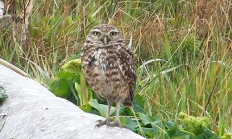
This small owl is unusual in that it nests in earthen burrows in open shrub-steppe regions and grasslands. This habit is even more curious in Oregon since most burrows used for nesting were previously excavated by badgers, a major predator of Burrowing owl eggs and young. These long-legged, short tailed owls are generally brownish buff with spots across the back and barring across the front. Males are usually lighter colored than females, possibly because they spend more time exposed to the elements. Males also average five percent larger than females, a situation rare among owls. The Burrowing owl is a…
SOUTH CENTRAL BIG GAME HUNTING July 30, 2026 Currently open Cougar ( check current harvest numbers), Coyote Season openings beginning in August Bear; Archery & Youth Only Controlled series hunts; Premium, auction and raffle hunts *Check Big Game regulations for hunt details and purchase your tag before hunting. Announcements and resources Summertime is here for youth to get ahead of the game-- Register for Hunter Safety Education before fall. 2026 Point Summary Reports are posted to help you plan this season's big game hunts. It's not too late to purchase Point Savers for each series, available now until November 30…
The bright yellow, red, and black plumage of the male Western Tanager, so conspicuous in open situations is very obscure in forested areas where it tends to blend into the shaded foliage. The species perhaps is best known in migration when it visits city parks, orchards, and other open urban and suburban areas. It is attracted to birdbaths but seldom to bird feeders. It breeds in open coniferous forests and mixed coniferous and deciduous woodlands, primarily in mountains. They usually nest in conifers - rarely deciduous trees - at varying heights, usually well out on a branch, often at the…
