
Search myodfw.com
Showing 521 - 540 of 795 results
Image: The circles show monitoring stations in the basin and the green shows detection of a tagged salmon. KLAMATH FALLS, Ore. — Salmon are making exciting progress in their return to the upper Klamath Basin, with fisheries biologists from ODFW and The Klamath Tribes celebrating a series of firsts as…
The FRWA was created by a licensing agreement signed in 1957 and modified in 1982 and 2008, between the US Army Corps of Engineers and the Oregon Game Commission. This agreement authorized the state to develop, conserve, and manage all wildlife resources on 5,261 acres of land and water within the Fern Ridge Project. ODFW also acquired the 309 acre Coyote Creek South and 224 acre Coyote Creek Northeast units in 2013 and 2015, respectively. The wildlife area now totals 5,794 acres.


Duck season has begun, plan your Sauvie Island hunt using the reservation summaries and daily harvest reports to increase your odds of success.
A white form on the distant water may be the sides and breast of an adult male, whose deep green head and dark back are less visable when far away. The pearl gray bodies and white breasts of females, subadults, and eclipse males are starkly delineated from their full-crested chestnut heads. Long, slender, saw-tooth bills are held horizontally during surface swimming and grip squirming prey after an underwater chase. From coastal bays to the high Cascades, in all corners of Oregon and far beyond, common mergansers ply the rivers and peer into still waters in their efficient pursuit of fish…

Of Oregon's breeding seabirds, Leach's storm-petrel is the smallest, most pelagic, and flies the farthest offshore of any of Oregon's breeding seabirds to feed. It spends the non-breeding season in the subtropical and equatorial Pacific. It is the second most abundant breeding seabird in Oregon, and is rarely seen from land or close to shore. It comes to its breeding islands, where it nests in burrows, only under the cover of darkness. Its plumage is black and Oregon populations have a distinct white rump. Leach's storm-petrels are long lived birds characterized by long-term pair bonds and may breed yearly for…

The Turkey vulture, known locally as a "buzzard," is a common sight spring through fall throughout the state, except in the highest mountains and featureless desert expanses in summer where they are uncommon. Seeing Turkey vultures returning is a welcome sign of spring. Turkey vultures are large-winged soaring birds with overall dark plumage except for a silvery sheen on the undersides of the flight feathers. Adults have small, featherless, red heads, while juveniles have gray heads. The Turkey vulture is a common to abundant transient throughout the state and an uncommon to common summer resident except in high mountains. It…

Cryptically colored, usually solitary and somewhat secretive, the Wilson snipe is often flushed before being seen, sometimes exploding from practically underfoot and rocketing off in a corkscrew flight. This plump-bodied, long-billed bird of open marshland is primarily crepuscular, peaking in feeding activity at dusk and dawn, and often sleeping during the day. In breeding season they become more flamboyant, appearing atop fence posts and displaying their unique winnowing flights from high in the air, their outer tail feathers vibrating with an eerie whistling sound. They are uncommon and local west of the Cascades in the summer and uncommon and local…

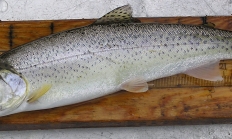
Features: Coastal cutthroat trout are typically are blue/green on top, red along the lateral line, and white on the belly. They are lightly or heavily spotted and adults have a red slash mark on the throat. Habitat: The most common variety of trout in Oregon is the coastal cutthroat, found in the streams and beaver ponds in coastal drainages. They also are stocked in high mountain hike-in lakes where the water stays cool throughout the summer. Techniques: Cutthroats that are year-round residents of small streams may not get any bigger than 8- or 9-inches, but can reward the angler with…
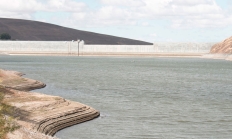

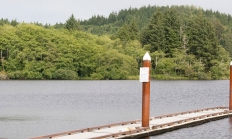
More information about Denman Wildlife Area
This stocky, medium-sized shorebird is a denizen of Oregon's rocky shoreline, foraging as close to the crashing waves as possible, hence its name. It uses the rocky intertidal zone which includes jetties, offshore rocks and rocky shorelines, sea stacks, and tidal pools and is occasionally found on sandy beaches interspersed with groups of rocks, and on mudflats near the mouth of the Coquille River. It sometimes uses freshwater outfalls for bathing. Birds wintering in Oregon have the upperparts, head, neck, and breast slate gray with a whitish eye-ring. Indistinct supercilium and chin are white, wheres the belly and abdomen are…

These small, fast flying seabirds are unique among alcids in North America in their use of coastal coniferous forests, primarily old-growth trees, as nesting habitat. Their solitary nests are usually concealed within the forest canopy, and breeding birds are cryptic and primarily crepuscular at nest sites. Because of their secretive behavior and elusive nests, Marbled murrelets were considered the "enigma of the Pacific" and were one of the last ornithological mysteries in North America, as the first nest was not discovered until 1974. Distribution at inland nesting sites is fragmented, as birds occur only in areas where suitable habitat remains…

The European starling is considered an invasive species in Oregon. It was introduced from Europe. They most closely resemble blackbirds, with which they often flock in fall and winter. While both have iridescent plumage, starlings can be told from blackbirds by their two-toned wing pattern - dark upperwing, pale underwing - and during the breeding season by the bright yellow bill. Starlings adapt readily and quickly to human habitation and are highly efficient and successful breeders. However, the abundance of the bird, the rapidity with which it has spread across North America, and its propensity to cause damage to crops…
