Search myodfw.com
Showing 581 - 600 of 849 results
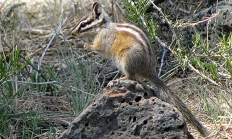
The yellow-pine chipmunk is one of the smallest in Oregon, only slightly larger than the least chipmunk. Its face is marked with a dark stripe, followed laterally by two alternate light and dark stripes. The outermost light strip is nearly white. It occurs on the east slope of the Western Cascades and eastward through most of the remainder of Oregon, except it is absent from most of the Columbia Basin and much of southern Harney, eastern Malheur, and southern Baker counties. Its range also extends westward in the Siskiyou Mountains in southern Jackson and Josephine counties. Ponderosa pine seems to…
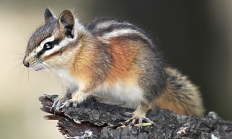
The least chipmunk is the smallest chipmunk in Oregon, but it is only slightly smaller than the yellow-pine chipmunk. As in all chipmunks, the face is marked with a dark stripe through the eye bordered on each side with a light- and a dark-colored stripe. The middorsum is marked with a dark-colored stripe followed on each side by two alternating light- and dark-colored stripes. The least chipmunk has the largest geographic range of any chipmunk. In Oregon, it occurs east of the Cascade Range except in the Columbia Basin and most of the Blue Mountains. In general, it is a…
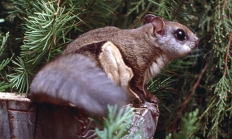
The Northern flying squirrel is the smallest arboreal squirrel in Oregon. It is typically squirrel-like except that the fore- and hind legs are connected by a furred patagium that extends from the ankle to the wrist. It is lead colored with buffy brown to brown tips. It occurs in forested areas west of the Cascade Range and eastward to near Lakeview, Lake County and Paulina Lake, Deschutes County. The species also occurs in the Blue, Ochoco, and Wallowa mountains. Northern flying squirrels are mostly nocturnal although individuals may be observed abroad during light hours on rare occasions. They are usually…
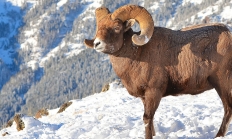
Features: Rocky Mountain bighorn sheep are the largest-bodied bighorn in North America and one of two subspecies of wild sheep in Oregon. Bighorn sheep were extirpated from the state in the 1800s so current populations are the result of a reintroduction effort by ODFW and sportsman groups. Habitat: Oregon’s estimated 800 Rocky Mountain bighorn sheep are found in the northeast corner of the state, in canyons of the Snake River and its tributaries and in alpine areas of the Wallowa Mountains. Techniques: Bighorn sheep are one of the rarest game species hunted in Oregon today, with about 100 tags available…
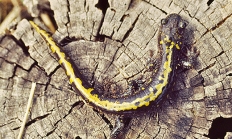
Appropriately named, adult long-toed salamanders have extremely long toes on their hind feet. Adults have black or brown skin that is smooth and moist with a yellow ragged-edged stripe running from its head to the tip of its tail. It is speckled with white or silver dots along its sides and underside. Adults may grow up to more than six inches in total length. Adult long-toed salamanders are seen infrequently, as they spend most of the year in the ground. They find cover in a variety of habitats including grasslands, dry shrub-steppe, pastures, lowland forests, high elevation lakes and ponds…
The drake gadwall is a large mostly gray dabbling duck. Adult drakes have a black bill, buff head, gray body, and black upper and lower tail coverts. Hens are nondescript brown ducks with a spotted, yellowish-orange bill with black edges. Gadwalls are unique among dabbling ducks in having a partly white speculum which can be observed in flight. Common vocalizations include the deep, reed-like sounds of the male and the female's quacking, similar to but more nasal and higher pitched than the mallard hen. It is an abundant breeder locally in eastern Oregon and an uncommon breeder in western Oregon…

SALEM, Ore – Mussel harvesting is now closed from Cape Blanco to the California border the Oregon Department of Agriculture and the Oregon Department of Fish and Wildlife announced today. Recent mussel samples indicate levels of Paralytic Shellfish Toxin – a naturally occurring marine biotoxin that can cause Paralytic Shellfish…
SALEM, Ore – Mussel harvesting is now closed from the Washington border to the north jetty of the Siuslaw River (Florence) the Oregon Department of Agriculture and the Oregon Department of Fish and Wildlife announced today. Recent mussel samples indicate levels of Paralytic Shellfish Toxin – a naturally occurring marine…
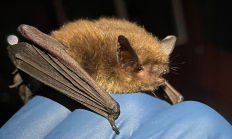
SALEM, Ore.— The fungus that causes white-nose syndrome in bats has been detected in Clatsop County. White-nose syndrome is an infection in bats caused by the fungus Pseudogymnoascus destructans that disrupts hibernation, causing dehydration and starvation. Samples analyzed by U.S. Geological Survey (USGS) confirmed the presence of the fungus in…
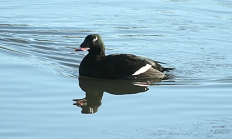
The white secondaries of the white-winged scoter in all plumages form a conspicuous square wing patch during flight but are often hidden during rest. Other than the secondaries, males' plumage is entirely black except for a small white teardrop around each eye. Females and immatures are dark brown above and pale below with diffuse white patches in front of and behind the eyes. A black knob graces the males' swollen, white-ridged, orange bills, while females' and immatures' bills are dark; the feathering of all extends almost to the nostril. Abundant along the coast from fall through spring, white-winged scoters are…
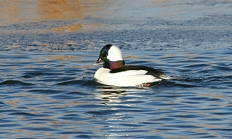
The bufflehead is North America's smallest diving duck, giving it the advantage of being able to nest in abandoned holes of northern flickers, a plentiful resource off limits to larger cavity-nesting ducks. It is a swift flyer and takes wing from water more easily and neatly than other diving ducks. Widely distributed throughout the state in winter, males attract attention with their striking white body, black back, and iridescent black head with a large notch of white; females and juveniles are dark charcoal-gray with a conspicuous white patch behind and below the eye. It is a local, uncommon breeder in…
The Turkey vulture, known locally as a "buzzard," is a common sight spring through fall throughout the state, except in the highest mountains and featureless desert expanses in summer where they are uncommon. Seeing Turkey vultures returning is a welcome sign of spring. Turkey vultures are large-winged soaring birds with overall dark plumage except for a silvery sheen on the undersides of the flight feathers. Adults have small, featherless, red heads, while juveniles have gray heads. The Turkey vulture is a common to abundant transient throughout the state and an uncommon to common summer resident except in high mountains. It…

With short pointed wings and long narrow tails, these small falcons are well built for fast pursuit and mid-air attacks. Sexes differ in color and size, with adult males about 25 percent smaller by weight than females. Males range from blackish gray to pale blue-gray on the back with a reddish wash along sides of the breast and a banded tail; females have brownish backs. In winter, it can be found throughout the state in open or semi-open habitats, but it is most regular near major estuaries, lakes, reservoirs, and occasionally in cities where food supplies are reliable. For nesting…

With its long, decurved bill, the black and cinnamon Virginia rail probes the mud for much of its food. Its narrow body is specially designed for slipping through a densely vegetated marsh, so it rarely has to move away from cover. Known for its staccato kidik, kidik call, this rail also contributes grunts, clicks, churs, squeaks, skeeuws, and quack-like noises to the marsh chorus. In Oregon, this is a rare to locally abundant breeder. In western Oregon it breeds in freshwater and brackish marshes. In eastern Oregon, large marshes in Klamath, Lake, and Harney counties host numerous breeders each year…

This small shorebird moves along the sand by foot rather than flight. It has a distinct black cap behind a white forehead, a dark line though the eye, and an incomplete black breast band. Males have darker and more distinct breeding plumage than females; both sexes loose coloration during late summer. It is the only shorebird that regularly breeds on Oregon's beaches. East of the Cascades, the Western Snowy plover is a summer resident breeding on alkaline flats and salt pans. On the Oregon coast, this species is found year-round between Heceta Head and Cape Blanco. Western snowy plovers are…

This is the world's smallest "peep" and can usually be picked out by its brownish coloration, dull yellowish legs, and hunched, creeping foraging style. Least can be found in small flocks in Oregon almost year-round. The Least sandpiper feeds on open mud with Western sandpipers but often feeds where some grass, salicornia or other cover is present, avoiding walking in the water as Western often do. It is uncommon to locally abundant statewide in migration, with most birds along the coast and at larger lakes and marshes inland. It is locally common on the coast in winter; smaller numbers winter…

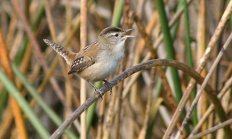
This pugnacious little wren, formerly known as the Long-billed marsh wren, inhabits cattail, bulrush, and other marsh plants. As the only Oregon species of wren that nests over water, it is easy to identify when seen, but sexes are difficult to differentiate in the absence of song due to similar coloration. This species has long been of interest to behavioral and evolutionary ecologists due to its polygyneous mating system, widespread construction of dummy nests, and the male's complex singing behavior. The Marsh wren nests statewide in appropriate wetland habitats. It is particularly common during breeding season around Malheur National Wildlife…
The bubbly warble of this finch is common in western Oregon conifer forests in summer, while its Crossbill-like - but more delicate - pik call is heard in lowland valleys in the winter. Adult males have a distinctly reddish-colored head, face, rump, throat, and breast, broadly but very faintly streaked brownish-pink sides, and a diffused brownish-red nape, back, and wings. Females and immature males have brownish-olive upperparts, wings, and tail, with contrasting streaking. Underparts are buffy-white to off-white with fuzzy, brownish streaking; a dingy pale gray stripe is present above the eye. In Oregon, the Purple finch breeds west of…

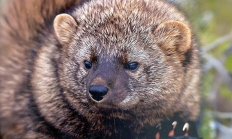
The Fisher is considerably larger than the marten and males are considerably larger than females. It is more stockily built than the weasels, but is similar in that the head is somewhat pointed, the body elongate, and the legs short. The pelage is long except on the face. The fur is dark brown grading to black on the rump and legs; the tail is black. Fishers once occurred throughout the coniferous and mixed forests of Oregon's Coast Range and Cascade Mountains. Currently, there is a native population in the Siskiyou Mountains and an introduced populations in the southern Cascades that…