
Search myodfw.com
Showing 621 - 640 of 849 results
Adult frogs have moist bumpy skin that is tan or olive-green colored on their topsides. On their heads, backs, sides and legs, they have dark spots with light centers that darken with age. They also have red bellies and orange-red underlegs. Adult females grow to four inches in length and males to three inches in length. Columbia spotted frogs live in wet areas that provide abundant aquatic vegetation such as marshes, permanent ponds, lake edges and slow streams. When frightened, they hide in dense vegetation or under debris at the bottom of shallow wetlands. Adult frogs overwinter in springs, spring-fed…

The goal of the Oregon Hatchery Research Center (OHRC) is to answer scientific questions related to fish recovery and hatchery programs. Information gained at the Research Center will help answer questions vital to the success of the Oregon Plan for Salmon and Watersheds and implementation of the Native Fish Conservation Policy. The Oregon Hatchery Research Center is a cooperative research project between the Oregon Department of Fish and Wildlife and the Oregon State University Department of Fisheries and Wildlife.
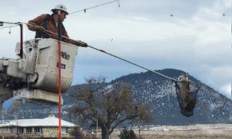
Additional events coming soon
Multiple locations

Central Point, Ore. – The Oregon Department of Forestry (ODF) declared fire season in southwestern Oregon on May 15 this year due to drought conditions, and Industrial Fire Precaution Level 2 (IFPL 2) went into effect on June 17, 2026. The ODF Southwest Oregon District is increasing the public use…

NW WILDLIFE VIEWING September 17, 2026 Recreating in drought and wildfire season - actions you can take to protect wildlife . For the most current fire closures and restrictions-- KNOW BEFORE YOU GO . Tillamook County Birds At this time of year, herons and egrets can be seen hunting amphibians and small mammals in local farm fields. Bald eagle pairs can be viewed near estuaries and rivers. Clatsop County Birds Coastal storm-watchers may find interesting pelagic species pushed closer to shore by the rough weather. Some species which may be viewed during and just after storms include skuas, jaegers, petrels, storm…
The ring-necked duck, which would have been better named "ring-billed duck" and is called "blackjack" in the southeastern United States, frequents different habits than the scaups with which is is often confused. The black back, white crescent on the side just in front of the wing, and white-ringed bill separate the drake ring-neck from the scaups. The brownish neck ring of the male in alternate plumage is not prominent. The hen is a small dark brown duck with a buff face. Drakes in courtship give a head-throw accompanied by a wow note while hens utter a growling purr. Ring-necks are…

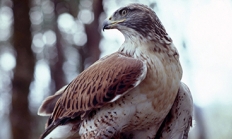
This largest of Oregon's hawks inhabits the most open country of the state's buteos, and watches over its home range on long, motionless wings for extended periods in search of prey. Ferruginous hawks are sensitive to human disturbance and tend to reside in remote areas. They occur in two color morphs, but dark-morph birds are rare in Oregon. Light-morph birds are white below with few markings except for the ruddy-colored leg feathers. The back and wing coverts are rust colored and the tips of the primaries and end of the tail tend toward dark smoky gray. It is an uncommon…
The Long-billed curlew is the largest North American shorebird. Its most striking morphological characteristic, the long decurved bill, is an adaptation for foraging on earthworms or burrow-dwelling organisms like shrimp and crab. Body plumage is a rich buff with a tinge of cinnamon or pink. Sexes have similar plumage, but females are larger with a longer bill. It can be distinguished from other curlews in flight by its bright cinnamon underwings. When observed on the ground, the Long-billed curlew's head lacks the strongly streaked pattern of other cerlews or Whimbrel. It is a locally common breeder in open grassland areas…

At certain estuaries and interior alkali lakes, flocks of many thousands of these migrants can be observed swirling around over shallow water, landing to frantically feed, before resuming migration. Falcons often attack Westerns, and their acrobatic, tightly coordinated escape flights are breathtaking to observe. In winter, these small sandpipers are gray above with white underparts. In breeding plumage they have a rich rufous-chestnut back, cheeks and cap, dark-centered scapulars with rufous-chestnut edges, grayish throats streaked with dark chevrons through the flank, and whitish underparts. Longer-billed females generally are larger than males but are otherwise similar in appearance. Along the coast…

All have cause to marvel at the sight of a gorgeous male Purple martin. Adult males are entirely glossy bluish-purple, although they may look black in poor light. Females and yearling males are grayish below and darker above with a paler forehead and nape. The world's largest swallow, martins are uncommon in Oregon. They nest both solitarily and colonially in nest boxes specially put up for them, in crevices in human-made structures, and in cavities in snags and pilings. They are an uncommon local summer resident, principally inhabiting the Coast Range and Willamette Valley. They are also locally common at…
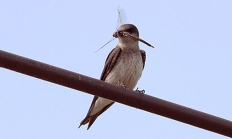
The song of the Yellow-headed blackbird, if it can be called a song as it lacks any musical quality, is a familiar sound in the marshes particularly of central and southeastern Oregon. The male, with its yellow head, neck, and breast, black body and wings, and white wig patches, is unmistakable. The female is more subtle with its dusky or sooty brown body plumage and yellow cheeks, chin, throat and chest, but is also distinctive. It is an abundant spring and summer resident in marshes of large alkaline lakes and wetlands in southeast Oregon, most notably the Klamath, Summer, Malheur…

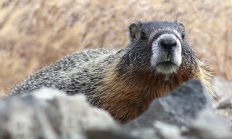
The yellow-bellied marmot is the largest squirrel in Oregon. It has short legs, a short and bushy tail, and ears short and covered with fur. The pelage consists of a dense, wooly underfur covered by long, course guard hairs and is distinctively colored and marked. In Oregon, it occurs in suitable habitats east of a line connecting Mt. Hood, Hood River County, and Mt. Mazama, Klamath County, except for the Columbia Basin. The primary requisites of suitable habitats for the yellow-bellied marmot are boulders or piles of rocks and an abundance of succulent vegetation in close proximity thereto. Occasionally, an…
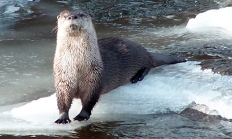
The River otter is adapted for both terrestrial and aquatic environments. The heavily muscled, somewhat cylindrical body is thickest at the thorax and tapers posteriorly to a thick, flattened tail. The body tapers to a blunt and slightly flattened head. The legs are short and powerful; and the toes are webbed. The eyes are small, forwardly directed and set high on the head. The underfur is grayish, short, and dense, and overlain by longer, stiff and shiny guard hairs. The dorsum is brown and the venter a lighter brown or tan; the lower jaw and throat are whitish. In Oregon…
Eastern Oregon mule deer are managed by Deer Hunt Areas, while all other big game, including Western Oregon deer hunts are managed by wildlife management units. Plan ahead by checking the boundaries of where you want to hunt. Hunters in Oregon can access millions of acres of public land open to hunting ( national forests, BLM land, state forests, wildlife areas) plus many private lands open through Oregon’s Access and Habitat program. See www.oregonhuntingmap.com to find a place to hunt.

The Rocky Mountain tailed frog’s coloring often matches the color of local rocks ranging from brown or reddish-brown to gray. They have grainy textured skin that further enhances their camouflage. Males have a short tail, the signature for tailed frogs. Adult males are slightly smaller than adult females that grow to two inches in length. Rocky Mountain tailed frogs are found in the water or close by it. They live in very shallow and heavily shaded water of fast-flowing, small, permanent streams in older mountain forests with cold and clear water, rocky substrates and little silt. These streams are often…

Adult frogs are gray or brown with yellow underbellies and thighs. Their color and grainy textured rough-looking skin helps camouflage them, making them hard to see among rocks. Adults can grow to three inches in length; males are slightly smaller than females. Foothill yellow-legged frogs live in or along edges of permanent streams and rivers with exposed rocky streambeds and off-channel waters that are slow flowing and quiet. In summer, they are likely to hide under rocks in streams or among clumps of vegetation along pools. They use rocks or debris at the bottom of the streams as refuge from…
