
Search myodfw.com
Showing 621 - 640 of 875 results
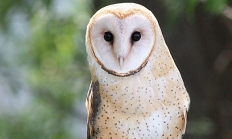
One of the most startling sounds in the black of night is the loud, harsh call of the Barn owl as it flies over field or marsh in search of small rodents. They are white to tan beneath with fine spotting ranging from almost none to fairly extensive. The face has a well-defined facial disc that acts as a parabolic dish collecting the faint sounds of its prey, allowing it to hunt successfully in total darkness. Male and female Barn owls are similar in appearance though the female is somewhat larger. The Barn owl is a fairly common permanent resident…
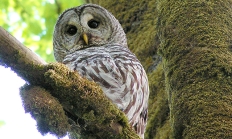
The Barred owl expanded its range from the eastern United States. It was first reported in Oregon in the early 1970s and has since spread to forested areas throughout most of the state. Sometimes confused with the closely related Northern spotted owl, the Barred owl is large with grayish-brown and white feathers and stripes on its chest and throat. It is easily distinguished from the Northern spotted owl by the pronounced horizontal barring across the throat and upper breast, and vertical brown streaks on the lower breast and abdomen. The Barred owl is now a permanent resident in forests of…
The White-headed woodpecker is the only woodpecker that relies heavily on the seeds of ponderosa pine for food. It occurs mainly in open ponderosa pine or mixed conifer forests dominated by ponderosa pine. They usually excavate nest cavities in snags but may use stumps, leaning logs and dead tops of live trees. It is an uncommon permanent resident in forests of the Ochoco, Blue, and Wallowa mountains and the east side of the Cascades, but suitable habitat is restricted. The White-headed woodpecker is an Oregon Conservation Strategy Species in the Blue Mountains, East Cascades, and Klamath Mountains ecoregions. Hear the…

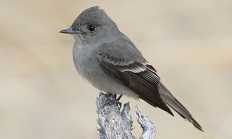
The down-slurred pee-eer call of this flycatcher is one of Oregon's most characteristic summertime bird sounds. Wherever there is a canopy of mature deciduous trees, one is likely to hear the call during warm afternoons when most other birds are silent. Because the call can easily be heard, it can usually be found perched near the tip of a dead branch from which it frequently flies a short distance to capture a flying insect, or to chase an intruder from its territory. The Western wood-pewee is a common migrant and fairly common breeder statewide in open groves of trees or…
This colonial-nesting swallow places its nest at the end of a burrow dug into a soft cliff or bank. The nesting cliff often appears riddled with holes, but not all burrows are used for nesting. A highly social species, the Bank swallow is usually observed in flocks of its own or with other swallow species. It has dark wings and tail that contrast with the paler brown back. The underparts are whitish except for a distinct brown breastband. It is a generally uncommon, but locally common to abundant summer resident at mid- to low elevations east of the Cascades. Numerous…

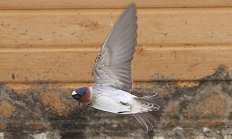
This chunky swallow is readily recognized by its square tail and orangish rump patch. It nests colonially and has taken to human-made structures so well that it has greatly expanded its range into many areas otherwise not suitable for it. It does not do well in urban settings, however, and quickly disappears when areas become densely settled. The unique gourd-shaped mud nest is often usurped by other species for nesting and is often used for protective roosting sites by rosy-finches and other wintering species. It is a locally common to abundant breeding bird near water throughout most of Oregon. Its…
Among the largest of the world's nuthatches, White-breasted nuthatches also are noteworthy for an extensive repertoire of unusual behaviors and habits. Unlike most other North American passerines, White-breasted nuthatches maintain close pair bonds over most of the year. In spring, they cement their pair bond by exhibiting a variety of courtship displays. Elaborate display rituals also are used in antagonistic territorial interactions, and distraction displays are used to deter predators. The White-breasted nuthatch is common in western Oregon lowlands. It is most abundant in southwestern interior valleys, with specimens from Salem to Jackson County. It occurs in oak and mixed…

Brown creepers are the only North American birds that rely on both the trunk and bark of trees for both nesting and foraging. They are small birds, about five inches in length, and have a long, slender, down-curved bill used to probe for insects hidden in the furrows of tree bark. Their brown back, streaked with white, makes creepers on of the best-camouflaged girds of the forest. They most often forage upward from the base of a tree, using their long, stiff tail for support. The Brown creeper breeds and winters throughout forested areas of Oregon, from the coast to…

Arguably the most widely recognized of Oregon's birds, the American robin is the largest, most abundant, and most widespread thrush in the state. Ranging from sea level to treeline, the robin's loud, musical voice and conspicuous brick-red chest make it unmistakable to even the most casual of observers. The robin thrives in both human-dominated and natural landscapes and is considered to be a habitat generalist throughout its range. Considering the robin's natural history, we know most about its diet, which comprises primarily of soft invertebrates in the spring and summer and fruit in the fall and winter. It is most…

The House finch is the most widespread of Oregon's "red finches." It is a congenial, cheerful singer from urban areas to desert plateaus. The male has a red forehead, throat, eyebrow, rump and varying amounts of red in the breast. It may have small amounts of reddish wash in its otherwise brownish cheek, hindcrown, nape,and streaked back. In some males, red is replaced with red-orange, orange, yellow-orange or yellow. The female is drab grayish-brown, overall, with indistinct streaking above and no red. The House finch is a fairly common resident in lowlands, urban, rural, and agricultural areas throughout Oregon. They…

The rat-sized American pika is characterized by rounded ears, no external tail, bare planter pads, and hind feed scarcely longer than the front feet. The pika requires talus, creviced rock, and other high elevation microhabitats that provide cool microclimates. Adequate forage close to rocky crevices is needed. In Oregon, the species is limited to suitable habitats in the Cascade Range and the Wallowa, Blue, Strawberry, Steens, Hart, and Warner mountains, and at Newberry Crater in Deschutes County and Grizzly and Cougar peaks in western Lake County. The American pika is an Oregon Conservation Strategy Species and is limited by its…

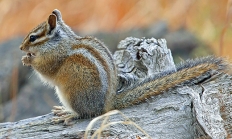
The pelage of this chipmunk is marked with five dark and four light stripes on the dorsum; the middorsal stripe is usually black and nearly always darker than the other four dark stripes. The sides of the face are marked with three brown and two light gray stripes, a patch behind the ear is light gray. The tail is blackish frosted with ochre dorsally and rusty brown ventrally. Allen's chipmunk produces a call of a rapid series of three or four to as many as 10 syllables. In Oregon, it occurs in forested areas along the eastern part of the…
Belding's ground squirrel is a medium-sized ground squirrel without spots, stripes, or splotches. The pelage is smoky gray with some pinkish on the face, feet, and venter, and with a more or less well-defined reddish or brownish band in the middorsal region. The tail is cinnamon on the ventral surface. This squirrel occurs south and east of a line connecting Enterprise, Heppner, Maupin, Wasco Sisters, Diamond Lake, and south to Fish Lake. It may occur in steppe and shrub-steppe area, particularly in meadows; sagebrush flats; and small-grain pasture , and hay-crop fields, and sometimes in openings in woodlands. The Belding's…
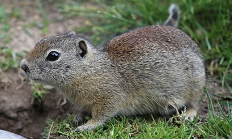
The Washington ground squirrel is the smaller of the two short-tailed, spotted ground squirrels in Oregon. The dorsum has squarish grayish-white spots on a background of pale smoky-gray with a pinkish wash to brownish gray. This squirrel is endemic to the Deschutes-Columbia Plateau Province east and south of the Columbia River and east of the John Day River. A colonial species, it emerges from dormancy in January to early March, males before females. At the approach of a potential threat, the Washington ground squirrel produces a soft, lisping whistle. Other members of the colony respond by standing upright, repeating the…

The moose is the largest member of the family Cervidae. The pelage is blackish or dark brownish grading to dark gray or grayish brown on the venter and leg. The muzzle is broad and overhanging, the palmate antlers of adult males are massive, and a "bell" (waddlelike flap of skin on the throat) is present. The first moose to come to Oregon wandered south from Washington or west from Idaho across the Palouse Prairie. They stayed to establish a herd in the Blue Mountains north of Elgin, and today there are an estimated 50 adults and calves in the area…

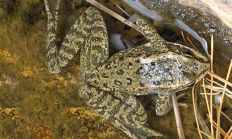
Adult Cascades frogs have tan, copper or green backs with black spots and yellow bellies. Their skin has small bumps on the back and sides. Females, which grow to three inches in length, are slightly larger than males. Cascades frogs live in a variety of moist habitats including mountain meadows, bogs, seasonally flooded forested swamps and shallow ponds, marshes and lakes. They use woody debris, mud or dense vegetation for cover from predators and spend their winters hibernating in mud. They emerge during the summer and live in wet meadows and bogs or along forested streams and pond edges. The…
Canvasbacks are large; adults in good condition are as heavy as mallards and second in size only to the white-winged scoter among common Oregon ducks. Drakes have a reddish head and neck; black breast, lower back and tail coverts; nearly white back, flank, and belly, and dark gray tail. The hen is grayish brown with a darker brown head, neck, breast and tailcoverts. It is an occasional summer resident in northeast Oregon, nesting locally only at Ladd Marsh in Union County. It is an uncommon spring and fall migrant in northeastern Oregon and regular in winter and spring on the…

Although not as imposing as the Canvasback, the redhead is a large, handsome, fast-flying diver. The drake has a red head, black breast and tail coverts, and steel gray back, flanks and tail. Hens are a medium brown. During courtship, the drake utters a very un-duck-like meow. Known for nest parasitism - laying eggs in the nests of other birds, usually other diving ducks - redhead eggs have also been found in the nests of a variety of species. It is an uncommon summer resident in northeast Oregon, but commonly breeds at Batch and Bogus lakes and locally elsewhere in…

Known as "bluebill" to most hunters, this species is one of the most abundant and widespread of North American ducks. The lesser scaup is similar to the greater scaup in appearance and habits, but is smaller and lacks the white on the primaries. In the field, however, the black-and-white drakes and brown hens are very similar to greater scaups. The common vocalization is the purr call of the female; drakes are usually silent, but utter a low single-note whistle in courtship. In general, the lesser scaup is more apt to be found in interior or freshwater habitats while the greater…

The pied-billed grebe is an aquatic species that breeds at the edge of open water in freshwater lakes, ponds, sluggish rivers, and marshes. When disturbed, it sinks like a submarine, rather than diving, and re-emerges with only its head above water. This is a brownish grebe with a black vertical bar in the middle of the rather stubby, whitish bill, and jet-black throat patch on both sexes in alternate plumage. It has a surprisingly loud "yelping" call within a marsh. Young have striking stripes on the head. This bird is widespread and common in Oregon. It winters locally in open…
