
Search myodfw.com
Showing 641 - 660 of 1416 results
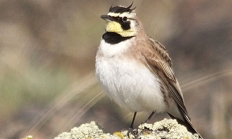
Wide open spaces generally surround these sparrow-sized, ground dwelling birds. The upperparts are mostly brownish and the underparts are generally buffy with varying amounts of yellow on the throat. There is black on the breast and side of the head, but the most unique features are small black "horns." Females and immature birds are duller. Interesting behavior includes aerial displays and "flight songs" during courtship, and the propensity to forage and loaf along dirt and gravel roads. In western Oregon, it breeds in small, scattered populations throughout the Willamette Valley, with concentrations in the central valley on and near Basket…
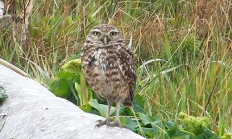
This small owl is unusual in that it nests in earthen burrows in open shrub-steppe regions and grasslands. This habit is even more curious in Oregon since most burrows used for nesting were previously excavated by badgers, a major predator of Burrowing owl eggs and young. These long-legged, short tailed owls are generally brownish buff with spots across the back and barring across the front. Males are usually lighter colored than females, possibly because they spend more time exposed to the elements. Males also average five percent larger than females, a situation rare among owls. The Burrowing owl is a…
The largest of Oregon's grebes, these have a long white neck, black cap, bright red iris, long strait bill, dark back, bright white breast, and they appear tailless. While excellent divers, they are unable to walk on land because their body weight is forward of their legs. Differences in appearance between western and Clark's grebes are subtle. In the western grebe, the black cap typically extends down to the eye whereas white facial plumage extends slightly above the eye on the Clark's grebe, but this is not always diagnostic in winter. The western grebe is a common breeder in eastern…

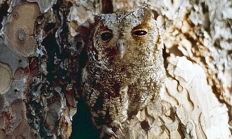
This diminutive owl is one of the smallest in North America, with a body mass of about 1.9 ounces. It has dark eyes, brown plumage with darker and reddish variegations, and small ear tufts. The Flammulated owl is unique among owls in the Pacific Northwest in that it preys almost exclusively on insects and is a neotropical migrant. Additionally, the pitch of its rather ventriloquial hoot is among the lowest of all North American owls. The Flammulated owl breeds on the eastern slope of the Cascades, in the Blue and Wallowa mountains, and in small numbers in the mountains of…
Because of its association with old forests, this inconspicuous, dark brown owl has become one of the most controversial birds in the Pacific Northwest. The dark eyes and creamy white mottling on the breast and abdomen are distinctive, as is the lack of fear of humans. Both adults and young will typically allow humans to approach within a few feet, and it is not unusual for curious juveniles to follow hikers through the woods. The Northern spotted owl is a permanent resident in forested regions of western Oregon, from the coastal mountains to the eastern foothills of the Cascade Range…

The Least flycatcher closely resembles the Hammond's flycatcher, but its distinctive voice and choice of habitat help to identify calling birds. It was formerly an unexpected vagrant west of the Rocky Mountains, but since 1981 it has become recognized as a regular migrant and local summer resident in the state. It is found in deciduous groves along streams and in wet lowlands. It desires a deciduous overstory with at least some low brushy undergrowth. It is regular migrant and local summer resident in the state of Oregon with the spring migration from May to mid-June. The majority of sightings are…

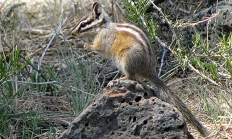
The yellow-pine chipmunk is one of the smallest in Oregon, only slightly larger than the least chipmunk. Its face is marked with a dark stripe, followed laterally by two alternate light and dark stripes. The outermost light strip is nearly white. It occurs on the east slope of the Western Cascades and eastward through most of the remainder of Oregon, except it is absent from most of the Columbia Basin and much of southern Harney, eastern Malheur, and southern Baker counties. Its range also extends westward in the Siskiyou Mountains in southern Jackson and Josephine counties. Ponderosa pine seems to…
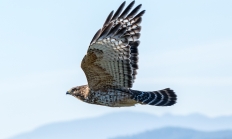
A medium-sized hawk, the Red-shouldered hawk has bold black-and-white flight feathers and rusty shoulder patches. Seen in flight from underneath, especially when lit from the sun, its wings show a translucent 'window' near the tips. It relies on perches for hunting and is closely affiliated with wooded wetlands and riparian bottomlands. In the breeding season this hawk is found in moist woodlands with at least a few deciduous trees. It prefers riparian bottoms, especially those near shallow wetlands or open meadows. In winter, it may use more open lands such as found in the Rogue and Willamette valleys, depending on…
Look here to find out how waterfowl counts this week compare to years past.
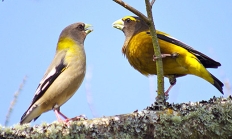
This sturdy-looking bird has a large head, short tail, and massive conical bill adapted for seed eating. The male plumage features bold patches of lemon yellow shading into olive, then brown and black, with white secondaries creating a flashy wing-patch easily seen in flight. The male's bill is chalky white in winter, but changes in early spring to a pale green that matches the new growth at the tips of spruce boughs, where they often nest. Many encounters with this species are of individuals heard flying high overhead, leaving the observer with little else to note. The Evening grosbeak is…
The Canada lynx is only slightly larger than the bobcat. Nevertheless, long legs and long fur produce the illusion that the lynx is considerably larger than it actually is. Documented accounts of wild lynx are rare and lynx are not expected to currently reside in Oregon. However, if lynx were to be observed, it is likely to occur at higher elevations such as in the Cascade Range, Blue Mountains or Wallowa Mountains. Habitats used by lynx often are defined in terms of habitats used by their primary prey species, thus good snowshoe hare habitat usually is considered to be good…

Features: Their eyed-side is greenish-brown to dark brown or black with lighter blotches. Their blind side is white to milky-white. They have a large, stout but flat body, shaped like an elongated diamond . Pacific halibut have been known to reach 500 pounds, but on average are 40 pounds. Habitat: Halibut are a large flatfish and so they spend much time near the bottom of the ocean looking above for food. They prefer chilly water and are primarily found in the Gulf of Alaska. Technique: Boat anglers use heavy rods to fish on or near gravel bottoms in water 150-500…

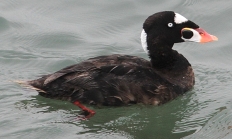
Although the least numerous scoter on the continent, it is the most common scoter along the Pacific coast south of Alaska and winters by the thousands off Oregon. Adult males' plumage, black except for white patches on the forehead and nape, yields attention to the bill, a swollen white, red-orange, yellow, and black wedge feathered squarely along its base. The highly visible standard advertises male's presence for up to a mile. Dark-billed adult females and subadults are dark brown above and paler brown below, with two indistinct light patches on the cheeks and sometimes on the nape. A flattened head…
This cavity-nesting thrush is one of three bluebird species found only in North America. Previously abundant in western Oregon, the Western bluebird suffered a precipitous decline through degradation of habitat and avian competition. The male has a cobalt blue head and throat, blue wings and tail edged with dusky brown, russet breast and flanks, gray-blue belly and undertail coverts. Female colorations are subdued: head and throat gray, back gray-brown, wings and tail pale blue, breast and flanks pale russet. The amount and brightness of blue and russet are brighter on older birds. The Western bluebird breeds in open habitats with…

This small, rich-brown wren is only slightly larger than a quarter, and has a tail quite short for a wren. A quiet observer in the forest will see these birds hop in and out and all over logs, snags, shrubs, twigs, and limbs on the forest floor. It has been said that the song of this bird is larger than the bird itself. The Winter wren breed from Coos County southward and in eastern Oregon in the Blue and Steens mountains. It retreats from high altitudes in winter where snow pack is heavy. Migration probably occurs throughout the state, but…

This is a bird of riparian thickets, farmlands, and towns. Since 1980, it has been observed almost annually in Harney County, usually in numbers less than five. A pair successfully fledged young near the Malheur National Wildlife Refuge headquarters in 1994. Most Harney County records occur from early April to late October. Away from Harney county individuals have also been seen in the various eastern and southeastern counties of Oregon. Hear the song of the Great-tailed grackle Photo by Kathy Munsel, ODFW

When walking through riparian areas in certain parts of Oregon in summer, one can often hear a song which suggests the Robin's but with less volume and energy, and with a greater variety of phrase. Yet, when one looks up, the bird is often hidden within the canopy foliage. The Red-eyed vireo is a fairly common summer breeder in Wallowa County and an uncommon to rare breeder in Union County, Baker County, and eastern Grant and Umatilla counties, and northern Malheur County. Hear the song of the Red-eyed vireo Photo by John Sutton, Flickr

Gray jays are common visitors at mountainous campsites and parks and are commonly known as "camp robbers" for their habit of taking food from humans. Gray jays in the Blue Mountains have the top of their heads white, while birds in the Cascades and Coast ranges have white restricted to the forehead. Coast Range birds are decidedly browner vs grayish overall. In Oregon, the Gray jay resides in conifer forests of the Coast and Cascade ranges, the eastern slope of the Cascades at Ft. Klamath and in the southwestern part of the state. Hear the call of the Gray jay…
