
Search myodfw.com
Showing 661 - 680 of 849 results
The Tufted Puffin is extremely charismatic and the most recognized seabird in Oregon. It is easily identified in the breeding season by the colorful laterally compressed bill, a distinct white face with long cream-colored facial plumes, black body, and reddish-orange feet. In winter it moves offshore and loses most of its colorful plumage and bill plates. Tufted Puffins are burrow-nesters and feed at sea. Along the Oregon coast, they primarily nest on soil-covered islands free of mammalian predators. They also occasionally nest on headlands such as Cape Mears, Cape Lookout, Cape Foulweather, and Yaquina Head. Tufted Puffin populations have…

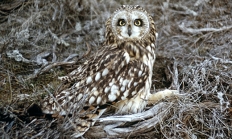
The Short-eared owl is one of our most conspicuous owls owing to its use of open country and crepuscular habits. It is often seen hunting low over the ground across marshes, fields, and other open areas on its buoyant, long wings, flying slowly and irregularly like a giant moth. This owl also differs from most other owls as it seldom vocalizes and is more often seen than heard. It was named for its inconspicuous "ear" tufts arising from the center of the forehead, though field observers rarely see these tufts. Distinguishing characteristics include a pale buff facial disk and a…
This long-distance, relatively late-arriving migrant to Oregon is associated with shrub-dominated habitats, especially riparian willow thickets. The plumage has subtle tones of olive-green and gray; the species is without a visible eye-ring but the characteristic sneezy, abrupt song reveals its presence. The Willow flycatcher breeds in western Oregon from sea level along the coast and interior to above 5,000 feet west of the Cascades summit. In eastern Oregon it breeds mostly above 1,000 feet from Klamath to Burns and also Lake County and Union County. The habitat of breeding Willow flycatchers is characterized by dense shrubs and/or tall herbaceous plants…

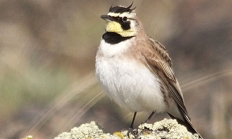
Wide open spaces generally surround these sparrow-sized, ground dwelling birds. The upperparts are mostly brownish and the underparts are generally buffy with varying amounts of yellow on the throat. There is black on the breast and side of the head, but the most unique features are small black "horns." Females and immature birds are duller. Interesting behavior includes aerial displays and "flight songs" during courtship, and the propensity to forage and loaf along dirt and gravel roads. In western Oregon, it breeds in small, scattered populations throughout the Willamette Valley, with concentrations in the central valley on and near Basket…
The bright yellow, red, and black plumage of the male Western Tanager, so conspicuous in open situations is very obscure in forested areas where it tends to blend into the shaded foliage. The species perhaps is best known in migration when it visits city parks, orchards, and other open urban and suburban areas. It is attracted to birdbaths but seldom to bird feeders. It breeds in open coniferous forests and mixed coniferous and deciduous woodlands, primarily in mountains. They usually nest in conifers - rarely deciduous trees - at varying heights, usually well out on a branch, often at the…

The Red crossbill is aptly named for its unusual bill configuration of crossed upper and lower tips of the mandibles which it uses to pry seeds primarily from native conifer cones. Degree of bill crossing is variable depending on wear, and it can have a right or left cross. Adaption to varied conifer cone structures and sizes has resulted in a diversity in body size, bill size and shape, and palate configurations in Red crossbills. Juveniles are brown with heavy streaked undersides and faint buff wing bars. Mature males are red with dark brown flight feathers and tail; first-year males…

The common muskrat is the largest arvicoline rodent on Oregon. The body is heavy and rounded, and except for the tail and feet, heavily furred. The eyes are beady; the ears are rounded and almost covered with fur; the tail is flattened laterally, scaly, keeled, and naked except for a few hairs on the keel. The forefeet are relatively small, but the hind feet are large and partly webbed. The pelage consists of an exceedingly dense underfur usually overlain by glossy dark-brown guard hairs; the underfur is waterproof. Reddish, blackish, silvery, and white individuals have been recorded. In Oregon, muskrats…

The coyote is a typical canid intermediate in size between the foxes and the gray wolf. The pelage of the coyote is grayish, buff, pinkish cinnamon, or brownish, or a combination of those colors, often overlain by blackish tipped hairs on the ears, muzzle feet, and dorsum. The lips and eyelids are black, accentuated by contrasting borders of white fur. The underparts are paler than the remainder of the body. Considerable variation in color and markings of coyotes is evident among individuals and regionally east and west of the Cascade Range. True albinos with pink eyes and pink foot pads…

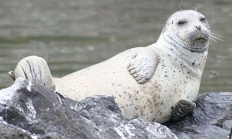
The body of the Pacific harbor seal is plump but tapers to small rear flippers permanently extended posteriorly. The head is large and rounded, the eyes are large, the limbs are short, and the nostrils sit dorsally on the muzzle. The nostrils can be closed when this seal dives. The tongue is notched at the tip. The pelage consists of long overhairs that overlay short underhairs. Markings are extremely variable, but in general the pelage is gray or brownish gray with numerous small spots of black that may coalesce to form splotches. Pacific harbor seals have been observed ashore at…
The majestic trumpeter swan is the largest of our native waterfowl and one of the heaviest flying birds in the world with males sometimes exceeding 30 pounds. Historically hunted to the brink of extinction, it was recognized as an endangered species long before there was an Endangered Species Act, and its recovery is a conservation success story. The adult's snow-white plumage with contrasting black bill and feet and 8-foot wingspan define this magnificent bird. Their neck is as long as their body and is used to reach food at the marsh bottom. In spring, the trumpeter swan is a locally…

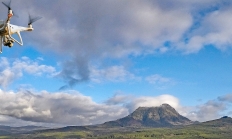
The Columbia Basin Wildlife Areas are a composition of four Oregon Department of Fish and Wildlife (department) managed wildlife areas located along the Columbia River, in the Columbia Basin. The four wildlife areas (Power City, Irrigon, Coyote Springs and Willow Creek) are within the Columbia Plateau ecoregion. Management agreements for these areas were initially established between 1971 and 1977 between the department and Federal agencies which own the lands. The Columbia Basin Wildlife Areas, which total approximately 1,885 acres, provide an important landbase for the conservation and recreation of fish and wildlife within a highly privatized and altered landscape and…
SW Fishing September 17, 2026 Best bets for weekend fishing: Cooler weather has improved trout fishing conditions at most lakes and reservoirs. Some of the more popular spots to fish for red-tailed surfperch are along beaches like Horsefall Beach and Whiskey Run. Anglers have the best success fishing with sand shrimp weighted gear on the bottom although power grubs can also work. Try warmwater fishing for bass at Ben Irving, Howard Prairie and Hyatt Reservoirs. Fish Lake may show promise with freshly stocked trophy trout. Hemlock and Lake of the Woods are accessible, and people are catching good numbers of…
CENTRAL WILDLIFE VIEWING September 17, 2026 Recreating in drought and wildfire season - actions you can take to protect wildlife . For the most current fire restrictions-- KNOW BEFORE YOU GO . Crook County All public land fire closures within Crook County have been lifted which broadens wildlife viewing access. Remember to use caution when traveling through and recreating in burned areas. Waterfowl should be visible along the crooked river and on most lakes/reservoirs. Herons, osprey, and kingfishers are frequently seen along the crooked river while searching for prey. Raptors, including bald eagles, redtail hawks, and kestrels can be seen…
The skies near favored stopover locations are filled twice annually with the sights and sounds of these geese as they migrate between Arctic breeding grounds and wintering areas farther south. Snow geese share very similar all-white plumage and black wing tips with the less common Ross's goose. These are Oregon's only wild white geese. It is predominantly a spring and fall migrant, especially abundant in large wetland and agricultural complexes such as Malheur National Wildlife Refuge, Silvies River floodplain in Harney County, Lower Klamath National Wildlife Refuge and Klamath Wildlife Area. Wintering snow geese in Oregon are found primarily along…
