Search myodfw.com
Showing 661 - 680 of 1410 results
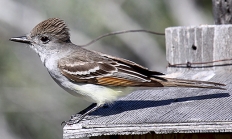
With its erect posture and stately manner, the Ash-throated flycatcher brings a touch of elegance to the oak and juniper woodlands of Oregon. A medium-sized flycatcher, it has a puffy crest and generally pale coloration, sexes are similar. It has gray-brown upperparts and an ashy gray breast; the throat may appear whiter. Belly and undertail coverts are pale yellow. It has two whitish wing bars, and rufous-colored inner webs of the tail and primaries. Juveniles have more extensively reddish tails. It is an uncommon to locally common summer resident in the Rogue and Applegate valleys and a rare vagrant in…
This moderately small wren maintains the frenetic energy that is so obviously typical of this family of birds. It is a summer inhabitant in many parts of Oregon, generally in open woodlands, thickets, and occasionally in residential gardens. The House wren occurs over the widest latitudinal range of any New World passerine. The House wren nests in a wide variety of native and human-influenced habitats. Nest sites are primarily located within preformed cavities in snags. It is a very uncommon to common transient and summer resident in semi-open woodland habitats throughout the state. In southwest Oregon, it is most common…

This bat, found in older forests, has a wingspan of about 10 inches. Its fur is glossy black, tipped with white. It forages over ponds, streams, meadows and roads, often flying very low and roosting behind loose tree bark. Maternity roosts of the silver-haired bat are found in trees. This bat usually bears twins. The silver-haired bat occurs statewide in Oregon except for most of the Columbia Basin and is an Oregon Conservation Strategy Species in all ecoregions except the Nearshore ecoregion. It is primarily associated with coniferous forests, including the juniper woodlands in the southeastern portion of the state…

The Western spotted skunk is smaller and more weasel-like than the Striped skunk. The pelage is black with a somewhat pentagonal white patch between the eyes, a round white patch on each side of the head and four or six segmented white body stripes. This skunk is endowed with a muscle-encapsulated musk gland similar to those of the Striped skunk and so similarly, can eject musk from two papillae located under the tail. The odor of the musk is considered somewhat more pungent or acrid but is less spreading than that of the Striped skunk. In Oregon, this skunk occurs…


With short pointed wings and long narrow tails, these small falcons are well built for fast pursuit and mid-air attacks. Sexes differ in color and size, with adult males about 25 percent smaller by weight than females. Males range from blackish gray to pale blue-gray on the back with a reddish wash along sides of the breast and a banded tail; females have brownish backs. In winter, it can be found throughout the state in open or semi-open habitats, but it is most regular near major estuaries, lakes, reservoirs, and occasionally in cities where food supplies are reliable. For nesting…

With a widespread distribution and affinity for open habitats, the Killdeer is one of the most common and recognized birds through much of North America. Killdeer are large for a plover and easily distinguished from other North American plovers by their characteristic two black or brownish-black breast bands. Killdeer are well known for their loud and persistent call of "kill-dee, kill-dee," heard at all times of day or night on both the breeding and wintering grounds. Killdeer often nest close to human activities. Adults perform an elaborate and exaggerated broken-wing display to lure humans and potential predators away from their…

One of the most familiar sights along the roads of Oregon is a Red-tailed hawk soaring high on the sky over a field, or perched on a utility pole, waiting patiently for prey. Red-tailed hawks are large-bodied raptors with relatively broad wings. The back is mottled brown, and the tail of mature birds is orangish red with a thin, dark subterminal band. Perched birds can be identified from behind even when the tail is concealed by the white mottling on the scapulars forming a faint 'V'. Most individuals can be assigned to one of two color morphs, light or dark…

The European starling is considered an invasive species in Oregon. It was introduced from Europe. They most closely resemble blackbirds, with which they often flock in fall and winter. While both have iridescent plumage, starlings can be told from blackbirds by their two-toned wing pattern - dark upperwing, pale underwing - and during the breeding season by the bright yellow bill. Starlings adapt readily and quickly to human habitation and are highly efficient and successful breeders. However, the abundance of the bird, the rapidity with which it has spread across North America, and its propensity to cause damage to crops…

One of the "winter" finches that appear unpredictably in the state, the White-winged Crossbill wanders in flocks year-round searching for food, and may actually be seen in parts of Oregon in any month of the year. Its peculiar twisted bill, specialized for prying seeds out of conifer cones, is smaller than that of the Red Crossbill, and it prefers smaller, softer cones, mainly spruce. Males are a dull pinkish red, with distinctive broad with bars on black wings. Females are dusty brown and dull yellow with blurry streaks. The White-winged crossbill is a very rare and erratic visitor in Oregon…

The ring-necked duck, which would have been better named "ring-billed duck" and is called "blackjack" in the southeastern United States, frequents different habits than the scaups with which is is often confused. The black back, white crescent on the side just in front of the wing, and white-ringed bill separate the drake ring-neck from the scaups. The brownish neck ring of the male in alternate plumage is not prominent. The hen is a small dark brown duck with a buff face. Drakes in courtship give a head-throw accompanied by a wow note while hens utter a growling purr. Ring-necks are…

This restless diver of cold oceans and bays is one of the prize waterfowl to see on a coastal winter day. Although the loud, musical call of males is seldom heard in Oregon, we can still be cheered on a chilly day by this energetic visitor from the north. The winter males' body is mostly white except for a black breast and central back; the wings are dark, scapulars long and gray, and the dark central tail feathers elongate. Winter females are darker above with a light head; scapulars and tail feathers are short and dark. Dark areas mark females'…

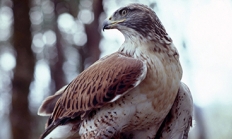
This largest of Oregon's hawks inhabits the most open country of the state's buteos, and watches over its home range on long, motionless wings for extended periods in search of prey. Ferruginous hawks are sensitive to human disturbance and tend to reside in remote areas. They occur in two color morphs, but dark-morph birds are rare in Oregon. Light-morph birds are white below with few markings except for the ruddy-colored leg feathers. The back and wing coverts are rust colored and the tips of the primaries and end of the tail tend toward dark smoky gray. It is an uncommon…

The thick, dense feathering on its underparts allows this dainty shorebird to float high on the water. Its lobbed toes give it considerable maneuverability while swimming. It is equally at home on the roughest seas and the smallest farm pond. A highly sociable bird and extremely trusting. Smaller size and slender bill separate this species from the Wilson's and Red phalaropes. Offshore it concentrates along tide rips and over upwellings. In shallow waters it stirs the bottom with its feet or spins rapidly to expose the tiny organisms that it picks up with its needlelike bill. An opportunistic forager of…

When mention is made of ducks, many people first think of the mallard. Its ability to tolerate human disturbance and adapt to urban as well as rural habitats make it the Northern Hemisphere's most abundant and widespread waterfowl. Females are mottled-brown, with dark brown stripe through the eye, orange bill with black splotching and have yellowish-orange legs. Immatures resemble adult females until males acquire nuptial plumage usually by mid-November. Males enter the eclipse molt in June and resemble hens until mid-September. Wings of both sexes have a violet-blue speculum bordered in front and behind by a pronounced white stripe. They…

SALEM, Ore.–The Fish and Wildlife Commission will meet virtually on Friday, Oct. 10 from 8:30 a.m.-noon for a training related to cultural resources, tribal sovereignty, and tribal treaty rights. The meeting will be livestreamed from the Commission page and via ODFW's YouTube channel. Invited speakers will share information with the…

This is one of the most widespread and familiar waterbirds in Oregon. It is the largest heron in North America, standing approximately four feet tall. It is slate gray with a white crown, cheeks, and throat, rusty thighs and a uniformly yellow bill. Adults develop long gray-white plumes on chest, neck, and back during breeding. Juveniles have similar plumage but may be distinguished by absence of breeding plumes, a dark crown, and dark upper bill. Great blue herons frequent many habitats from shallow areas of marshes, lakes, streams, and oceans, where they feed on fish, amphibians, and aquatic invertebrates; to…

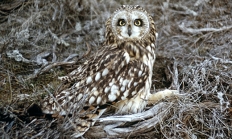
The Short-eared owl is one of our most conspicuous owls owing to its use of open country and crepuscular habits. It is often seen hunting low over the ground across marshes, fields, and other open areas on its buoyant, long wings, flying slowly and irregularly like a giant moth. This owl also differs from most other owls as it seldom vocalizes and is more often seen than heard. It was named for its inconspicuous "ear" tufts arising from the center of the forehead, though field observers rarely see these tufts. Distinguishing characteristics include a pale buff facial disk and a…