Search myodfw.com
Showing 681 - 700 of 847 results
Eastern Oregon mule deer are managed by Deer Hunt Areas, while all other big game, including Western Oregon deer hunts are managed by wildlife management units. Plan ahead by checking the boundaries of where you want to hunt. Hunters in Oregon can access millions of acres of public land open to hunting ( national forests, BLM land, state forests, wildlife areas) plus many private lands open through Oregon’s Access and Habitat program. See www.oregonhuntingmap.com to find a place to hunt.

The Rocky Mountain tailed frog’s coloring often matches the color of local rocks ranging from brown or reddish-brown to gray. They have grainy textured skin that further enhances their camouflage. Males have a short tail, the signature for tailed frogs. Adult males are slightly smaller than adult females that grow to two inches in length. Rocky Mountain tailed frogs are found in the water or close by it. They live in very shallow and heavily shaded water of fast-flowing, small, permanent streams in older mountain forests with cold and clear water, rocky substrates and little silt. These streams are often…

Adult frogs are gray or brown with yellow underbellies and thighs. Their color and grainy textured rough-looking skin helps camouflage them, making them hard to see among rocks. Adults can grow to three inches in length; males are slightly smaller than females. Foothill yellow-legged frogs live in or along edges of permanent streams and rivers with exposed rocky streambeds and off-channel waters that are slow flowing and quiet. In summer, they are likely to hide under rocks in streams or among clumps of vegetation along pools. They use rocks or debris at the bottom of the streams as refuge from…

This small, boldly-patterned duck can be found in Oregon throughout the year, either around rocky headlands on the coast or inland on mountain streams. No other breeding duck in Oregon feeds almost exclusively on benthic invertebrates, often swimming underwater and upstream against swift current in search of prey. Though males are striking in appearance, these and the drab brown females can be difficult to see when at rest on a mid-stream rock or dodging behind rocks as they evade observers. Broods have been observed or nests located on tributaries in the river basins of the west Cascades. They are found…

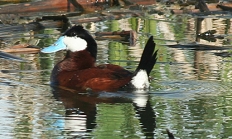
Small in size and displaying a showy, almost comical alternate plumage, the male ruddy duck is an unforgettable sight. Breeding males are unmistakable with their rich chestnut back, black crown, white cheek, sky-blue bill, and proportionately long stiff tail. Female plumage is drab in comparison, being dusky dark brown with a dark facial strip across the mostly white cheek, quite similar to the male's basic plumage. Known for their peculiar courtship display in which the male draws his head down and slaps his bill against his breast repeatedly in increasing tempo, creating a bubbling in the water and a hollow…
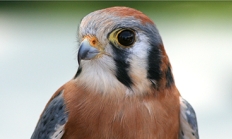
Formerly known in American literature as the Sparrow hawk, this is the smallest (dove-sized) and most familiar and abundant member of the family Falconidae in North America and one of the easiest raptors to observe. It has two considerably different plumages: adult male and female and juvenile males differ somewhat from adult males until post-juvenile mold in fall. Adult males have rufous backs and tails with blue-grey upper wing coverts. The tail has a wide black subterminal band. Juvenile males are similar to adult males but have heavily streaked breasts. Females are slightly larger than males and have reddish-brown backs…
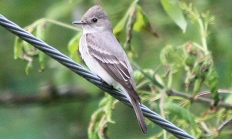
The Olive-sided flycatcher is one of the most recognizable breeding birds of Oregon's conifer forests with its resounding, three-syllable whistle song quick, three beers. It is a relatively large, somewhat bulky, large headed, short-necked flycatcher that perches erect and motionless at the top of a tall tree or snag except when singing or darting out to capture flying insects. The overall olive-gray plumage is generally nondescript except for a whitish stripe down the breast and belly which gives the impression of an unbuttoned vest, and white patches between the wings and lower back. This flycatcher breeds in low densities throughout…
This medium-sized flycatcher has expanded its breeding range from northern California to southwestern Oregon and continues to expand its range in Oregon. First experiences with the species may bring to mind a Slate-colored Junco behaving like a flycatcher. The Black phoebe is dull, sooty black overall, somewhat paler on the back, with a white belly contrasting with the black breast and sides. Bill, legs, and feet are black. The phoebe dips its tail repeatedly. Black phoebes are associated with water. Slow-flowing, idle, or slack water of large rivers, streams, and creeks, ephemeral and permanent ponds, lake shorelines, irrigation ditches, and…

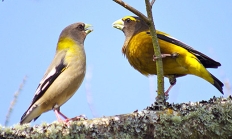
This sturdy-looking bird has a large head, short tail, and massive conical bill adapted for seed eating. The male plumage features bold patches of lemon yellow shading into olive, then brown and black, with white secondaries creating a flashy wing-patch easily seen in flight. The male's bill is chalky white in winter, but changes in early spring to a pale green that matches the new growth at the tips of spruce boughs, where they often nest. Many encounters with this species are of individuals heard flying high overhead, leaving the observer with little else to note. The Evening grosbeak is…
The Steller (or Northern) sea lion is the largest member of the family Otariidae. Among adult females and subadult males, the upper body is slim, whereas in adult males it is heavy and muscular. The head is bearlike with a moderate step between muzzle and forehead. The rear flippers are relatively small and can be turned beneath the body for travel on land. The pelage is light buff to reddish brown, slightly darker in the chest and abdomen. Overall the pelage appears darker when wet. However, beneath the water it appears white, whereas the California sea lion appears black. In…

Adult clouded salamanders are generally brown with brassy patches on their backs and gray bellies. As salamanders age, the brassy color fades. The clouded salamander is one of the lungless salamander species; they breathe through their moist skin. Mature adults can grow to just over five inches in total length. Clouded salamanders prefer forest habitats or burned areas that provide large decaying logs or stumps. They are often found in Douglas fir trees where they can find burrows in the wood, or spaces just under the bark to hide. They may also hide deep in rock crevices during dry and…
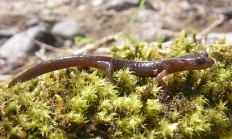
Adults have smooth, moist skin that is brown or reddish-brown in color with black flecks on their backs, sides and legs. They may also have a dark colored mask. Adults have red underlegs, hence their name. Females, growing to four inches in length, are almost twice the size of males. Adult red-legged frogs like cool damp coniferous or deciduous forests and forested wetlands. During the non-breeding season, adult frogs spend most of their time on land in woodlands along streams, in moist sedge or brush, along shaded pond edges or under logs and other forest debris. Damp weather permits them…

If this is a new activity for you, our friends at the Audubon Society have tips on how to start birding and how to connect with other birders. This is a great resource that also includes tips on choosing binoculars, reviews and recommendations on the best birding apps and field guides, and an easy seven-point guide on how to identify birds. The Cornell Lab of Ornithology has an extensive website that includes the world's largest archive of wildlife sounds and videos, bird cams, eBird citizen science opportunities, scientific publications, bird guides, bird nesting box plans and more. ODFW's Living with…
When mention is made of ducks, many people first think of the mallard. Its ability to tolerate human disturbance and adapt to urban as well as rural habitats make it the Northern Hemisphere's most abundant and widespread waterfowl. Females are mottled-brown, with dark brown stripe through the eye, orange bill with black splotching and have yellowish-orange legs. Immatures resemble adult females until males acquire nuptial plumage usually by mid-November. Males enter the eclipse molt in June and resemble hens until mid-September. Wings of both sexes have a violet-blue speculum bordered in front and behind by a pronounced white stripe. They…

Luck may determine when a deer crosses your path, but skill determines whether you're ready for that moment. Aim for a more successful hunt this season by attending one of the many skills events! ODFW connects people to Oregon's great outdoors by offering a multitude of workshops and events throughout the year. Education programs cover required Hunter Safety certification courses, ability level and age specific workshops, and events for the entire family. Let us help you prepare for your next step outdoors. Receive Workshops & Events Updates by E-mail

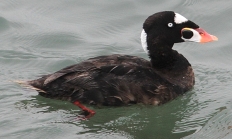
Although the least numerous scoter on the continent, it is the most common scoter along the Pacific coast south of Alaska and winters by the thousands off Oregon. Adult males' plumage, black except for white patches on the forehead and nape, yields attention to the bill, a swollen white, red-orange, yellow, and black wedge feathered squarely along its base. The highly visible standard advertises male's presence for up to a mile. Dark-billed adult females and subadults are dark brown above and paler brown below, with two indistinct light patches on the cheeks and sometimes on the nape. A flattened head…
With four wing-beats each second pushing them to 62 miles per hour, brant are the fastest and strongest geese in flight and among the swiftest of all large birds. Black brant comprise the vast majority of brant occurring in Oregon. These small geese have smoky black backs and bellies, and dissected white collars and white around the tails provide striking contrast. The black brant can live up to 20 years and are resilient enough to ride out storms on the open ocean. In Oregon, wintering numbers along the coast have seen a 50 percent reduction from previous years due to…

This is one of the most widespread and familiar waterbirds in Oregon. It is the largest heron in North America, standing approximately four feet tall. It is slate gray with a white crown, cheeks, and throat, rusty thighs and a uniformly yellow bill. Adults develop long gray-white plumes on chest, neck, and back during breeding. Juveniles have similar plumage but may be distinguished by absence of breeding plumes, a dark crown, and dark upper bill. Great blue herons frequent many habitats from shallow areas of marshes, lakes, streams, and oceans, where they feed on fish, amphibians, and aquatic invertebrates; to…

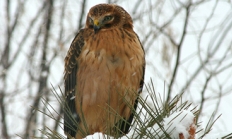
The Northern harrier is a slender, medium-sized hawk characterized by a noticeably long tail, bold white rump patch, and owl-like face. Commonly encountered in large expanses of open country, its main hunting technique is through use of a distinctive buoyant, gliding flight low over the ground that relies heavily on visual as well as auditory cues to detect prey. The larger females have rich brown upperparts while adult males are mostly light to medium gray, sometimes appearing almost ghostly silvery-white. Males are noted for their high-spirited and acrobatic courtship displays, in particular a series of dives and barrel rolls in…