
Search myodfw.com
Showing 681 - 700 of 1410 results
The bright yellow, red, and black plumage of the male Western Tanager, so conspicuous in open situations is very obscure in forested areas where it tends to blend into the shaded foliage. The species perhaps is best known in migration when it visits city parks, orchards, and other open urban and suburban areas. It is attracted to birdbaths but seldom to bird feeders. It breeds in open coniferous forests and mixed coniferous and deciduous woodlands, primarily in mountains. They usually nest in conifers - rarely deciduous trees - at varying heights, usually well out on a branch, often at the…

This dark colored salamander has a reddish-brown ragged edged stripe that runs along the top of the head to the tip of the tail with black or dark brown sides. It has a long body and tail and the belly is black with large white flecks. The Oregon slender salamander is a lungless salamander species, relying on its skin to breathe. Mature adults can grow to just under four inches in total length, with females about 12 percent larger than males. Oregon slender salamanders are most common in stable, moist old-growth (late successional and second-growth) forests where there are abundant…


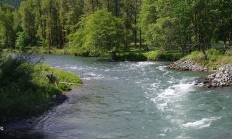
A dozen great rivers pour out of the Coast Range Mountains into tidal bays that welcome runs of salmon and steelhead. Bays are the year-round home to marine perch, rock fish, crabs and clams, while other species come and go with the seasons and tides. A handful of ponds dot the forested slopes, and there are dozens of dune lakes— many stocked with rainbow trout, and some harboring largemouth bass, perch, crappie and brown bullhead.
The Umatilla Hatchery began operation in 1991. The hatchery is used for egg incubation and rearing of spring Chinook, fall Chinook and summer steelhead.
The common porcupine is a large, short-legged rodent with up to 30,000 bare-tipped quills (modified hairs) covering the upper parts of the body and the dorsal and lateral surfaces of the tail. The quills are scattered among much longer, course guard hairs; the underfur is woolly. The quills are arranged in rows across the body, the longest quills are on the rump, the shortest on the face. Quills used in defense are replaced commencing about 10-42 days after loss. The overall color of the porcupine is dark brown or blackish. The front feet have four toes, the rear feet five…

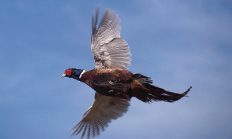
SALEM, Ore.— If you are considering registering for a youth pheasant hunt, it is not too late. More slots have opened for many youth pheasant hunts being held statewide this month after duplicate registrations were removed from the system. "We've heard some parents have been unable to sign up their…

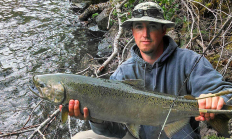
Need to figure out controlled hunts, find a place to clam, learn how to fish or get directions to a wildlife area? We've got information on all that and more, straight from ODFW biologists and other accomplished hunters, anglers and wildlife watchers. Header image by Dave Budeau


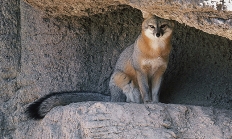
The gray fox is among the smaller canids in Oregon. The basic color of the gray fox is grizzled gray, but the stiff middorsal hairs have long black tips that extend onto the tail as a black mane. Guard hairs are banded white, gray, and black. The throat, venter, and inside of the legs are white; a cinnamon-rufous border to the white throat extends on the flanks and underside of the tail A blackish patch on the side of the face extends onto the lower jaw and a grayish black "exclamation point" extends upward from the interior margin of each…
While there is a general, statewide season for cougars, there are quotas set by zone. Once a quota in a certain zone is met, that zone will close for cougar hunting. Below are the most recent numbers on cougar harvest by zone.
The southwest zone includes Umpqua River, Coos Bay, Coquille River, Port Orford, Rogue River and Chetco River - all of which offer shellfishing.