
Search myodfw.com
Showing 801 - 820 of 903 results
The gregarious Tricolored blackbird is one of North America's most intensely colonial breeders, forming dense, non-territorial, noisy colonies. A highly synchronized nesting system exploits secure nesting locations and rich food supplies that change from year to year. In Oregon, breeding colonies are scattered and intermittent at specific locations, though sites used during consecutive years may be in the same general area. The Tricolored blackbird breeds most consistently in Klamath and Jackson Counties. Small colonies and summering residents have been found in the Willamette Valley; during fall and winter they are rare. Most retreat south to California in winter, while some…

The skies near favored stopover locations are filled twice annually with the sights and sounds of these geese as they migrate between Arctic breeding grounds and wintering areas farther south. Snow geese share very similar all-white plumage and black wing tips with the less common Ross's goose. These are Oregon's only wild white geese. It is predominantly a spring and fall migrant, especially abundant in large wetland and agricultural complexes such as Malheur National Wildlife Refuge, Silvies River floodplain in Harney County, Lower Klamath National Wildlife Refuge and Klamath Wildlife Area. Wintering snow geese in Oregon are found primarily along…

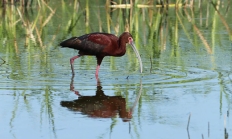
Sporting the form of a curlew, this medium-sized marsh wader is almost always found in flocks, flying in formation and quacking like ducks. Their long, down-curved bill complements their long neck and legs. Although their feathers appear black, a closer look will reveal an iridescence of bronze, purple, maroon, and green. They are named for their "white face" which appears in alternate plumage as a narrow border of white feathers along the edge of their reddish-purple facial skin, delineating a mask around the red eye. The White-faced ibis has extended its breeding grounds in Oregon to wetlands in Harney, Lake…
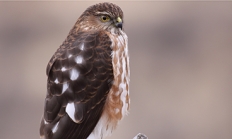
The Sharp-shinned hawk is North America's smallest and most migratory accipiter. As a hunter of songbirds (and sometimes young chickens) it historically endured harsh reproach, and was often depicted as a blood-thirsty villain, even by some ornithologists. Across the U.S., many thousands were shot in the first half of the 20th century. But prevailing attitudes have changed, and today a glimpse of this slender, secretive hawk darting through the treetops is more likely to elicit admiration than malice. Adult plumage, nearly identical to the slightly larger Cooper's hawk, consists of slate gray back and wings, breast and sides barred with…
This cavity-nesting thrush is one of three bluebird species found only in North America. Previously abundant in western Oregon, the Western bluebird suffered a precipitous decline through degradation of habitat and avian competition. The male has a cobalt blue head and throat, blue wings and tail edged with dusky brown, russet breast and flanks, gray-blue belly and undertail coverts. Female colorations are subdued: head and throat gray, back gray-brown, wings and tail pale blue, breast and flanks pale russet. The amount and brightness of blue and russet are brighter on older birds. The Western bluebird breeds in open habitats with…

Crabbing and Clamming May 21, 2026 Regulation updates as of Nov. 21, 2025 These are in-season regulation changes adopted on a temporary or emergency basis. Please see e-regulations for permanent regulations. Before clamming or crabbing, call ODA's shellfish safety information hotline at (800) 448-2474 or visit the ODA shellfish safety closures web page at: http://ODA.direct/ShellfishClosures Mussels: OPEN coastwide. Razor clams: OPEN from the WA border to Cape Blanco. CLOSED from Cape Blanco to the CA border. Bay clams: OPEN coastwide. Crabs: OPEN coastwide. Sport crab harvest: Status map Sport seasons and licensing rules: Visit the Oregon Department of Fish and…
Image: The circles show monitoring stations in the basin and the green shows detection of a tagged salmon. KLAMATH FALLS, Ore. — Salmon are making exciting progress in their return to the upper Klamath Basin, with fisheries biologists from ODFW and The Klamath Tribes celebrating a series of firsts as…

The Oregon Fish and Wildlife Commission conducts hybrid public meetings, allowing for testimony either in person or virtually. Meetings are also livestreamed from the Commission page and the ODFW YouTube channel. Per statute ORS 496.108(5), the Commission must hold one meeting per year in each Congressional District. Meeting dates and locations are scheduled a year in advance and can't always align with the local community impacted by regulation changes, another reason why they are hybrid. Meetings begin at 8:00 a.m. and proceed chronologically through the published agenda. The Commission will take a lunch recess as close to noon as the agenda…
The Bald eagle is one of eight species of sea-eagle worldwide, and the only sea-eagle found throughout North America. It is one of the most studied North American birds. Large size, wingspan of six-and-a-half to eight feet, and the contrast of white head and tail, and yellow eyes, beak, and leg, to dark brown body and wings make the adult Bald eagle one of our most distinctive raptors. Six age-related plumages have been recognized; adult plumage is acquired at four-and-a-half to five years of age. Sexes have similar plumages, but females are larger than males, and the sex of individuals…

Bonneville Hatchery was constructed in 1909. In 1957, the facility was remodeled and expanded as part of the Columbia River Fisheries Development Program (Mitchell Act)—a program to enhance declining fish runs in the Columbia River Basin. The hatchery underwent another renovation in 1974 as part of the U.S. Army Corps of Engineers' (USACE) mitigation of fish losses from the construction of the John Day Dam. In 1998, construction was completed on the Captive Broodstock Facility for the Grande Ronde Basin spring Chinook supplementation program.
Updated April 29, 2026 Subscribe for updates Starting Jan. 1, 2026, an Ocean Endorsement is needed for most recreational anglers fishing in the ocean. Check the Ocean Endorsement page for more information. Ocean Endorsement
SALEM, Ore.— White-nose syndrome (WNS) in bats has been detected for the first time in Oregon in Columbia and Benton counties. White-nose syndrome is caused by an infection with the fungus Pseudogymnoascus destructans that disrupts hibernation, causing early winter emergence, dehydration and starvation. This finding follows the 2025 detection of…
The American marten is weasel-like with a long body and pointy face. The legs are short; the toes, including the pads, are completely furred; and the nails are semiretractile. The tail is bushy and long. The pelage in winter is luxuriant, with a dense underfur and sparse covering of guard hairs. The color varies, but usually is a golden brown shading to dark brown on the feet and tail; the head is lighter. The throat and chest are splotched with orange or yellow. A small dark stripe extends upward from the medial corner of each eye, giving the appearance of…

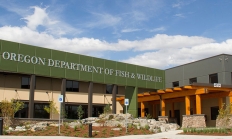

OTIS, Ore.—ODFW's recent legislatively adopted budget did not include funding to continue the operation of Salmon River Hatchery, one of more than 30 hatcheries that ODFW maintains in the State. The cost of operating and maintaining the hatchery exceeded available revenue, but funding is just one of the issues facing…
Establishment of the Bridge Creek Wildlife Area initially started in 1961 when a parcel of land was purchased from the Frank Hilbert estate. After the initial purchase, several private holdings were acquired to consolidate the land under department ownership. The last parcel was purchased from the Colvin Cattle Company in 1975. The primary purpose of the wildlife area is to maintain and protect a key historic winter range for Rocky Mountain elk ( Cervus elaphus nelsoni).