
Search myodfw.com
Showing 901 - 920 of 1128 results
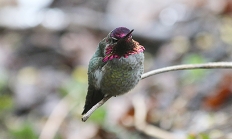
Anna's hummingbird is the largest hummingbird common to our region. It is the only hummingbird regularly found in Oregon in winter, during which time it is exposed to short day lengths, limited sources of food and periods of intense cold. It is more vocal than most hummingbirds with males uttering a dry, scratchy buzz of a song that can be heard throughout the year. It is a rare to locally uncommon summer resident west of the Cascades in interior valleys and along the coast; also along the Columbia River east to The Dalles. It occurs and probably breeds into the…
Even in the most barren and desolate reaches of the Great Basin, the cheerful song of the hardy Rock wren will contradict any notion that the desert is devoid of life. This specialist of cracks and crevices can be found almost anywhere there is exposed rock. One of its most unique features is the mysterious pebble path is constructs from its stone-cave nest to the outside entrance. Drab and pale overall, the gray head and back, white to tawny underparts, and gray tail with buff-tipped corners distinguish this species from other wrens. The Rock wren is a common breeder in…

This moderately small wren maintains the frenetic energy that is so obviously typical of this family of birds. It is a summer inhabitant in many parts of Oregon, generally in open woodlands, thickets, and occasionally in residential gardens. The House wren occurs over the widest latitudinal range of any New World passerine. The House wren nests in a wide variety of native and human-influenced habitats. Nest sites are primarily located within preformed cavities in snags. It is a very uncommon to common transient and summer resident in semi-open woodland habitats throughout the state. In southwest Oregon, it is most common…

The Veery is known less for its appearance than for its ethereal song, a series of spiraling, reverberating flutelike notes, each lower in pitch, suggesting the name: vee-ur, vee-ur, vee-ur. A patient observer may get a fleeting glimpse of a small thrush with reddish brown upperparts, pale undersides, and a buffy upper breast with a few darker spots. It is an uncommon breeder in lower to middle elevations in the Blue Mountains where sufficient riparian thickets exist for cover and forage needs. It is locally common along watercourses in Union, Wallowa, and east Umatilla counties, and less common in north…

This bat, found in older forests, has a wingspan of about 10 inches. Its fur is glossy black, tipped with white. It forages over ponds, streams, meadows and roads, often flying very low and roosting behind loose tree bark. Maternity roosts of the silver-haired bat are found in trees. This bat usually bears twins. The silver-haired bat occurs statewide in Oregon except for most of the Columbia Basin and is an Oregon Conservation Strategy Species in all ecoregions except the Nearshore ecoregion. It is primarily associated with coniferous forests, including the juniper woodlands in the southeastern portion of the state…

Duck season has begun, plan your Sauvie Island hunt using the reservation summaries and daily harvest reports to increase your odds of success.
Of Oregon's breeding seabirds, Leach's storm-petrel is the smallest, most pelagic, and flies the farthest offshore of any of Oregon's breeding seabirds to feed. It spends the non-breeding season in the subtropical and equatorial Pacific. It is the second most abundant breeding seabird in Oregon, and is rarely seen from land or close to shore. It comes to its breeding islands, where it nests in burrows, only under the cover of darkness. Its plumage is black and Oregon populations have a distinct white rump. Leach's storm-petrels are long lived birds characterized by long-term pair bonds and may breed yearly for…

The Turkey vulture, known locally as a "buzzard," is a common sight spring through fall throughout the state, except in the highest mountains and featureless desert expanses in summer where they are uncommon. Seeing Turkey vultures returning is a welcome sign of spring. Turkey vultures are large-winged soaring birds with overall dark plumage except for a silvery sheen on the undersides of the flight feathers. Adults have small, featherless, red heads, while juveniles have gray heads. The Turkey vulture is a common to abundant transient throughout the state and an uncommon to common summer resident except in high mountains. It…

Cryptically colored, usually solitary and somewhat secretive, the Wilson snipe is often flushed before being seen, sometimes exploding from practically underfoot and rocketing off in a corkscrew flight. This plump-bodied, long-billed bird of open marshland is primarily crepuscular, peaking in feeding activity at dusk and dawn, and often sleeping during the day. In breeding season they become more flamboyant, appearing atop fence posts and displaying their unique winnowing flights from high in the air, their outer tail feathers vibrating with an eerie whistling sound. They are uncommon and local west of the Cascades in the summer and uncommon and local…

Look here to find out how waterfowl counts this week compare to years past.
This stocky, medium-sized shorebird is a denizen of Oregon's rocky shoreline, foraging as close to the crashing waves as possible, hence its name. It uses the rocky intertidal zone which includes jetties, offshore rocks and rocky shorelines, sea stacks, and tidal pools and is occasionally found on sandy beaches interspersed with groups of rocks, and on mudflats near the mouth of the Coquille River. It sometimes uses freshwater outfalls for bathing. Birds wintering in Oregon have the upperparts, head, neck, and breast slate gray with a whitish eye-ring. Indistinct supercilium and chin are white, wheres the belly and abdomen are…

The European starling is considered an invasive species in Oregon. It was introduced from Europe. They most closely resemble blackbirds, with which they often flock in fall and winter. While both have iridescent plumage, starlings can be told from blackbirds by their two-toned wing pattern - dark upperwing, pale underwing - and during the breeding season by the bright yellow bill. Starlings adapt readily and quickly to human habitation and are highly efficient and successful breeders. However, the abundance of the bird, the rapidity with which it has spread across North America, and its propensity to cause damage to crops…

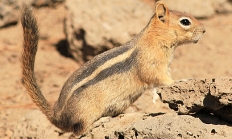
The golden-mantled ground squirrel doubtlessly is the most distinctively marked ground squirrel in Oregon; a white stripe bordered on both sides by a black stripe extends from the shoulder to the hip. From nose to nape above the eye, the head is russet. The back between the stripes is grizzled dark grayish-brown becoming less grizzled on the rump; lateral to the stripes the color grades to a light buffy-gold on the venter. The face, shoulders, front legs, and feet are a bright orangish-gold. This ground squirrel occupies the east slope of the Cascade Range and most of central Oregon, and…
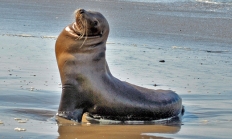
The California sea lion is the mid-sized Oregon otriid. The body is slender and tapering, the flippers are relatively small, and the rear flippers can be rotated beneath the body for moving on land. The short, course pelage lacks dense underfur; when dry, it usually is chocolate brown, but individuals with light-tan pelage are known to occur. The pelage appears black when wet. In older males, the pate is tan. The occurrence of the California sea lion along the Oregon coast is seasonal. The primary areas where it comes ashore are Cascade Head, Tillamook County; Cape Argo, Coos County; and…
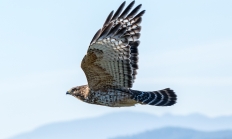
A medium-sized hawk, the Red-shouldered hawk has bold black-and-white flight feathers and rusty shoulder patches. Seen in flight from underneath, especially when lit from the sun, its wings show a translucent 'window' near the tips. It relies on perches for hunting and is closely affiliated with wooded wetlands and riparian bottomlands. In the breeding season this hawk is found in moist woodlands with at least a few deciduous trees. It prefers riparian bottoms, especially those near shallow wetlands or open meadows. In winter, it may use more open lands such as found in the Rogue and Willamette valleys, depending on…
The song of the Yellow-headed blackbird, if it can be called a song as it lacks any musical quality, is a familiar sound in the marshes particularly of central and southeastern Oregon. The male, with its yellow head, neck, and breast, black body and wings, and white wig patches, is unmistakable. The female is more subtle with its dusky or sooty brown body plumage and yellow cheeks, chin, throat and chest, but is also distinctive. It is an abundant spring and summer resident in marshes of large alkaline lakes and wetlands in southeast Oregon, most notably the Klamath, Summer, Malheur…


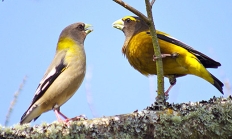
This sturdy-looking bird has a large head, short tail, and massive conical bill adapted for seed eating. The male plumage features bold patches of lemon yellow shading into olive, then brown and black, with white secondaries creating a flashy wing-patch easily seen in flight. The male's bill is chalky white in winter, but changes in early spring to a pale green that matches the new growth at the tips of spruce boughs, where they often nest. Many encounters with this species are of individuals heard flying high overhead, leaving the observer with little else to note. The Evening grosbeak is…
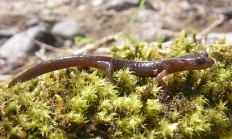
Adult clouded salamanders are generally brown with brassy patches on their backs and gray bellies. As salamanders age, the brassy color fades. The clouded salamander is one of the lungless salamander species; they breathe through their moist skin. Mature adults can grow to just over five inches in total length. Clouded salamanders prefer forest habitats or burned areas that provide large decaying logs or stumps. They are often found in Douglas fir trees where they can find burrows in the wood, or spaces just under the bark to hide. They may also hide deep in rock crevices during dry and…
The bright yellow, red, and black plumage of the male Western Tanager, so conspicuous in open situations is very obscure in forested areas where it tends to blend into the shaded foliage. The species perhaps is best known in migration when it visits city parks, orchards, and other open urban and suburban areas. It is attracted to birdbaths but seldom to bird feeders. It breeds in open coniferous forests and mixed coniferous and deciduous woodlands, primarily in mountains. They usually nest in conifers - rarely deciduous trees - at varying heights, usually well out on a branch, often at the…
