Search myodfw.com
Showing 121 - 140 of 897 results
ODFW's Living with bears page has tips on living, working, and recreating in bear country and more. Oregon is Black Bear Country Brochure (pdf) Be Wildlife Smart When Working in the Woods (pdf) Electric Fences Keep Bears Out - BearWise Bulletin (pdf) Follow these "bear" essentials on working or recreating in bear country, print this homeowner checklist to keep bears at bay, and more. Essentials for Living with bears (pdf)


The eastern cottontail is the largest member of the genus in Oregon. Overall, the dorsal pelage is brownish, becoming darker (almost black) on the rump and lighter buffy brown on the flanks; the nape patch is orangy brown without black hairs, and the head is the same color as the dorsum. The hairs on the dorsum have steel gray bases followed by bands of brownish black, buff, and black. The venter hairs are white with gray bases, giving a splotched appearance when the hairs are spread, and the tail hairs are white to the base. This rabbit was introduced into…

Oregon has many different species of shorebirds, and they live near waterbodies from the ocean to the desert. Shorebirds are easily identified by their small to medium-sized bodies with long legs and thin bills. Location and habitat use, bill shape and body proportions help identify individual species.


Oxbow Hatchery was originally constructed in 1913 to provide additional rearing facilities for Bonneville Hatchery. It was relocated to this present site in 1937 following the construction of Bonneville Dam. Oxbow operated as a state-funded hatchery until 1952 when it was remodeled and expanded as part of the Columbia River Fisheries Development Program (Mitchell Act) – a program to enhance declining fish runs in the Columbia River Basin. The hatchery is presently used for interim egg incubation and early rearing of coho and spring Chinook salmon. No adult fish are collected or spawned at Oxbow and there are no fish…
The Western ground snake is found in arid desert scrub vegetation with sandy soil, usually under surface objects or in areas with some surface moisture, such as the edges of washes. This snake feeds on small arthropods such as spiders, scorpions, centipedes, crickets, and grasshoppers. It also takes insect larvae. Photo by Peter Paplanus, Flickr

The Western whiptail is found in eastern Oregon deserts and semi-arid shrublands. It is most common in flat, sandy areas and along dry washes. These lizards are primarily insectivorous. In a food habits study in southeastern Oregon, they ate caterpillars, crickets, grasshoppers, and beetles. They also eat spiders, scorpions, and other lizards. Photo by Keith Kohl, ODFW

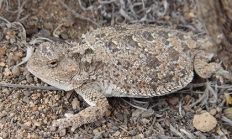
The pygmy short-horned lizard occurs in sagebrush deserts, juniper woodlands, and open coniferous forests. It prefers open areas with sandy soils, but is also found on rocky soil. Ants make up a large part of the diet, but beetles, caterpillars, spiders, and sowbugs are also eaten. This lizard burrows into the soil when inactive. Photo by Dave Budeau, ODFW
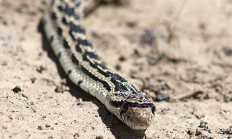
The gopher snake occurs in a wide variety of habitats, from deserts and grasslands to woodlands and open forests. It frequents agricultural regions, especially where there is brushy cover such as fence rows. Diet varies according to size, with young eating insects, lizards, rodents, and birds and their eggs. Adults can take larger prey, occasionally as large as rabbits. Photo by Simon Wray, ODFW
Features: Chukars are brown-gray with a black stripe running across the head, through the eye, and down onto the chest. Their bills and feet are red, and their sides have white and black barring. Habitat: Extensive areas in eastern Oregon provide ideal habitat for chukars. Cheatgrass, an introduced plant species, was already well established through much of eastern Oregon prior to the 1950s, and provides one of the most important year-around food resources for the chukar. Their habitat is generally steep, rocky, dry, and largely unsuitable for development, agriculture or other commercial uses except grazing. Important chukar areas in Oregon…

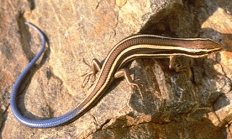
The Western skink is found in moist places such as under rocks or logs in a variety of habitats from grassland and chaparral to desert scrub, juniper woodlands, and coniferous woodlands and forests. Rocky areas with some moisture, such as riparian zones, are favored. This skink feeds on a wide variety of invertebrates, including beetles, grasshoppers, moths, flies, spiders, and earthworms. Photo by Simon Wray, ODFW
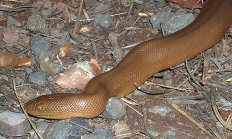
The rubber boa occurs in a variety of habitats, from desert scrub, foothill woodlands, and grasslands through deciduous and coniferous forests. In the Coast Range, it is found commonly in forest clearings that contain rotting stumps and logs. It is absent from the immediate vicinity of the coast north of Coos Bay. Rubber boas are constrictors and eat small mammals, especially young mice and shrews. Photo by Simon Wray, ODFW