
Search myodfw.com
Showing 141 - 160 of 383 results
Bandon Hatchery was constructed in 1925. Various renovations have taken place since original construction and more are planned for the future. The facility is used for adult collection, egg incubation and rearing of both natural and hatchery fall Chinook, winter steelhead, and trophy-sized rainbow trout.
Alsea Hatchery was constructed in 1936 and is operated with state funds. Many improvements have been made to the hatchery since original construction. The hatchery produces both winter steelhead and rainbow trout. The facility is used for adult collection, spawning, egg incubation and rearing of winter steelhead, and egg incubation and rearing of rainbow trout.
Prineville Reservoir Wildlife Area came under the shared management of the Oregon Department of Fish and Wildlife & United States Bureau of Reclamation in 1962. It is managed for the protection and enhancement of wildlife habitat, big game winter range, improving riparian wetlands, and to promote wildlife stewardship. Goals of the PRWA include creating recreational opportunities for viewing and enjoying wildlife, including mule deer, bald eagles, and a variety of waterfowl. Boating, hiking, and camping are a few popular activities permitted in the wildlife management area. Hunting and fishing opportunities are also available within Prineville Reservoir Wildlife Area, as regulated…
The present facility was constructed in 1925, across the North Umpqua River from an earlier trout hatchery built in 1920. The hatchery was closed in 1975 due to low stream flows and high water temperatures, and was reopening in 1979 after extensive reconstruction. In 2012 a state of the art fish passage ladder was completed. It included a fish viewing window for Rock Creek basin fish inventory and a fish trap facility. The hatchery produces fall and spring Chinook, coho, summer and winter steelhead, and rainbow trout. The facility is used for adult collection, spawning, incubation, and rearing of Chinook…
Cole Rivers Hatchery was constructed by the US Army Corps of Engineers (USACE) in 1973 to mitigate for spawning and rearing areas blocked by the construction of Lost Creek, Applegate, and Elk Creek Dams. The hatchery was named in honor of Cole M. Rivers, a biologist on the Rogue River for 20 years. The facility is used for adult collection, spawning, egg incubation and rearing of spring Chinook, coho, summer steelhead, and winter steelhead, and egg incubation and rearing of fall Chinook and rainbow trout. Infrastructure Repair and Renovation Updates
Construction of this facility began in 1924 and production started in 1925 by the state of Oregon. Various renovations have taken place with the most recent being the addition of 4 new fish rearing raceways and improvements to the pollution abatement system which was completed in 2016. Other renovations made throughout the hatchery have utilized the Restoration and Enhancement Program.. The purpose of this facility is to enhance spring Chinook, winter steelhead, summer steelhead, and coho populations for various coastal streams. The facility is used for adult collection, egg incubation and rearing of spring Chinook, fall Chinook, winter steelhead, summer…
The Umatilla Hatchery began operation in 1991. The hatchery is used for egg incubation and rearing of spring Chinook, fall Chinook and summer steelhead.
The northwest zone provides many opportunities for crabbing and clamming. This zone encompasses Clatsop beaches, Nehalem Bay, Tillamook Bay, Netarts Bay, Nestucca Bay, Siletz Bay, Yaquina Bay, Alsea Bay and Siuslaw River.
The mottled petrel breeds in New Zealand and nearby islands, and ranges throughout much of the Pacific Ocean, mostly far from land. It is a common May to October visitant in the northern and eastern North Pacific, with non-breeding birds occurring during the winter months. Photo by Dominique, Flickr

Trask River Hatchery was constructed in 1916 to replace an earlier hatchery that was located three miles upstream from the present site. Many improvements have been made to the hatchery since original construction including a new alarm system, early rearing building, and a 40’ x 60’ pole building. Trask Pond was constructed in 1970 and Tuffy Creek was constructed in 1988. The hatchery is used for adult collection, incubation, and rearing of fall and spring Chinook, coho, wild winter steelhead and hatchery winter steelhead.
The Columbia Basin Wildlife Areas are a composition of four Oregon Department of Fish and Wildlife (department) managed wildlife areas located along the Columbia River, in the Columbia Basin. The four wildlife areas (Power City, Irrigon, Coyote Springs and Willow Creek) are within the Columbia Plateau ecoregion. Management agreements for these areas were initially established between 1971 and 1977 between the department and Federal agencies which own the lands. The Columbia Basin Wildlife Areas, which total approximately 1,885 acres, provide an important landbase for the conservation and recreation of fish and wildlife within a highly privatized and altered landscape and…
The Columbia Basin Wildlife Areas are a composition of four Oregon Dept. of Fish & Wildlife managed wildlife areas located along the Columbia River in the Columbia Basin. The four wildlife areas (Power City, Irrigon, Coyote Springs, and Willow Creek) are within the Columbia Plateau ecoregion. Management agreements for these areas were initially established between 1971 and 1977 between the department and Federal agencies which own the lands. The Columbia Basin Wildlife Areas, which total approximately 1,885 acres, provides an important landbase for the conservation and recreation of fish and wildlife within a highly privatized and altered landscape and play…
Willamette Trout Hatchery and the adjacent Oakridge Salmon Hatchery were combined in 1983 and operate today as Willamette Hatchery. The trout hatchery was constructed in 1922 and the salmon hatchery in 1911. The U.S. Army Corps of Engineers (USACE) rebuilt the salmon hatchery in 1952 to mitigate for fishery losses caused by Hills Creek, Lookout Point and the Dexter hydroelectric/flood control projects. The trout side was rebuilt between 1950 and ‘56. Today, Willamette Hatchery is used for adult holding/spawning, egg incubation and rearing of spring Chinook and rainbow trout. In addition, both summer and winter steelhead are reared at this…
Oak Springs Hatchery was constructed in several phases beginning in 1922 with the last major construction in 1996. The facility is currently used for egg production, incubation and rearing of rainbow trout, incubation and rearing of summer and winter steelhead, and maintains one resident rainbow trout and one resident cutthroat broodstock.
The McKenzie River originates in the Cascade Range and empties into the Willamette River near Eugene, which then flows northward into the Columbia River. McKenzie Hatchery was first constructed in 1938 and rebuilt in 1975. Today, 30 rearing ponds, a visitor's center, spawning room, egg incubation facility, office, feed storage, shop area, fish ladder and picnic area are the main components of the facility layout. McKenzie Hatchery is temporarily closed to comply with Oregon Department of Environmental Quality permit conditions. Visitors should be aware that no fish are present in the facilities' production raceways and show ponds. Fish have been…
Wallowa began operation in 1920 as a resident trout hatchery. In 1985, the hatchery was renovated as part of the Lower Snake River Compensation Program (LSRCP) – a program to mitigate for spring Chinook and summer steelhead losses caused by the four federal dams constructed on the lower Snake River. Wallowa Hatchery is used for adult collection, spawning, acclimation and release of summer steelhead.
Piloted in 2014, the Tag Team program helps ODFW fish biologists better evaluate resident gamefish, bass, and stocked rainbow trout fisheries. It's also a chance for anglers to participate in fishery management and, perhaps, come away with up to $50.
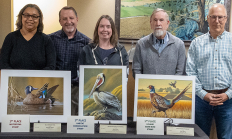
SALEM, Ore. – The winning artwork has been selected for the 2026 Oregon Waterfowl, Upland Game Bird, and Habitat Conservation Stamp Art Contests. In the Waterfowl Stamp category, first place went to Richard Clifton of Milford, Del., for his artwork featuring a blue-winged teal. For the Upland Game Bird category…
Features: Drakes are easily distinguished from American wigeon drakes by a reddish brown head, gray flank, and lack of green eye stripe. Hens are similar to American wigeon hens and difficult to distinguish. The call of the male is a shrill whistling, whe'e you; the female's voice a low purr or croak. It is a rare to uncommon visitant east of the Cascades.
