Search myodfw.com
Showing 161 - 180 of 396 results
Find maps, boundary descriptions and hunts available in the new Northeast Hunt Area. Download printable PDF map

The Canada lynx is only slightly larger than the bobcat. Nevertheless, long legs and long fur produce the illusion that the lynx is considerably larger than it actually is. Documented accounts of wild lynx are rare and lynx are not expected to currently reside in Oregon. However, if lynx were to be observed, it is likely to occur at higher elevations such as in the Cascade Range, Blue Mountains or Wallowa Mountains. Habitats used by lynx often are defined in terms of habitats used by their primary prey species, thus good snowshoe hare habitat usually is considered to be good…

Month of May
Various locations
June - Various dates
EE Wilson Wildlife Area - 29555 Camp Adair Rd Monmouth, OR 97361
CORVALLIS, Ore. — The Oregon Hatchery Research Center Board will meet in Corvallis on Tuesday, December 2 from 11:00 a.m. to 1:00 p.m. at the Oregon Department of Fish and Wildlife South Willamette Watershed District Office (7118 NE Vandenberg Avenue, Corvallis, OR 97330). In addition to the regularly scheduled items…
Find maps, boundary descriptions and hunts available in the new Fox Hunt Area. Download printable PDF map

Lower Deschutes Wildlife Area was established in 1983, with the initial donation of land by the Oregon Wildlife Foundation (OWF) of 2,758 acres. In 1986 OWHF donated an additional 5,158 acres of land to the department. The Lower Deschutes Wildlife Area was initially established to provide permanent public angler access. However, especially with the 1986 acquisition, the wildlife area has grown to provide enhanced wildlife and fish habitat (i.e. through removal of livestock, riparian vegetation improvements, etc.) and more wildlife-oriented recreational activities such as hunting, boating, hiking and biking. In 2015, ODFW partnered with the Trust for Public Land to…
Canis lupus is the largest canid, not only in Oregon, but in the rest of the world as well. The wolf has relatively long legs, a narrow and deep chest, elbows that turn inward and foot pads that turn outward. These, combined with the digitigrade feet possessed by all canids, make the wolf highly adapted for running. The pelage of gray wolves is long over the body and tail, but relatively short on the legs and face. The predominant color is gray, but the legs, flanks, and venter sometimes are yellowish or light brownish. These colors are overlain by long…

SAUVIE ISLAND WILDIFE AREA, Ore.— To manage ongoing traffic and parking problems at Sauvie Island Wildlife Area's beaches, ODFW is introducing a new limited-entry parking pilot program. Starting July 4, vehicles will need a free Sauvie Island Beaches Pass in addition to the Wildlife Area Parking Permit ($10 daily) to…
Find maps, boundary descriptions and hunts available in the new Devils Garden Hunt Area. Download printable PDF map
Find maps, boundary descriptions and hunts available in the new Keno Hunt Area. Download printable PDF map
Find maps, boundary descriptions and hunts available in the new Southeast Hunt Area. Download printable PDF map
Oregon's recreational fisheries for Pacific halibut and bottomfish are constrained by bycatch of yelloweye rockfish, an overfished species. Many of the regulations on these fisheries exist to keep bycatch of yelloweye rockfish within sustainable limits, in order to help the stock recover (for example, depth restrictions in the bottomfish fishery, and no lingcod during offshore long-leader trips). ODFW encourages anglers to reduce impacts by using descending devices to release yelloweye rockfish, and better yet, to avoid areas where they might be caught.
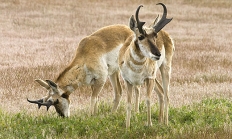
The pronghorn, often called "antelope," is deer-sized with relatively long and thin legs and feet with just two digits on each foot, a relatively small tail, and unique horns consisting of deciduous keratin sheaths set on bony cores arising from the fontal bones. Among males, the laterally flattened sheaths are long, branched and recurved, but in those females that possess horns they are short and simple. The horns and hooves are black. The front feet are larger and carry most of the weight when the pronghorn runs. The pelage is course. The dorsum is a light buff and is separated…