
Search myodfw.com
Showing 181 - 200 of 897 results

PRINEVILLE, Ore. – A single dead adult quagga mussel was found out of water on the shoreline at Prineville Reservoir on June 6 during a routine survey for aquatic invasive species. This marks the first time that this highly invasive freshwater mussel species has been found in or near an…
Willamette Fishing June 25, 2026 Best bets for weekend fishing: Shad fishing is good in the Oregon City area. Several waterbodies will continue to be stocked with trout this week, however the upcoming hot weather will most certainly impact trout stockings. Many of the valley ponds are already too warm to receive their usual spring stockings. Check the stocking schedule for changes or try warmwater fishing. Spring Chinook continue to be caught in the Willamette below St Johns Bridge. Catch is increasing around Kelley Point Park. Target these fish early in the morning nad on incoming to high tides with…
This cavity-nesting thrush is one of three bluebird species found only in North America. Previously abundant in western Oregon, the Western bluebird suffered a precipitous decline through degradation of habitat and avian competition. The male has a cobalt blue head and throat, blue wings and tail edged with dusky brown, russet breast and flanks, gray-blue belly and undertail coverts. Female colorations are subdued: head and throat gray, back gray-brown, wings and tail pale blue, breast and flanks pale russet. The amount and brightness of blue and russet are brighter on older birds. The Western bluebird breeds in open habitats with…

Klaskanine Hatchery was first operated in 1911 by the state of Oregon. In 1959 the hatchery was enlarged and renovated under the Columbia River Fisheries Development Program (Mitchell Act)—a program to enhance declining fish runs in the Columbia River Basin. The hatchery is now closely tied to the Select Area Fisheries Enhancement (SAFE) program and works closely with Clatsop County Fisheries (CCF). The facility is currently used primarily for rearing coho for SAFE commercial fisheries, as well as for adult collection and spawning of fall Chinook and as a rearing facility for fall Chinook and winter steelhead.
ODFW's legislatively adopted 2025-27 budget did not include funding to continue the operation of Salmon River Hatchery. The hatchery is shifting fish production to other facilities but will remain open for public/fishing access with a volunteer host and occasional staff on site. Learn more.
Irrigon Hatchery began operation in 1984 as part of the Lower Snake River Compensation Program (LSRCP)—a program to mitigate for spring Chinook and summer steelhead losses caused by the four federal dams constructed on the lower Snake River. This facility serves as an egg incubation and rearing facility for summer steelhead destined for the Grande Ronde and Imnaha river systems and egg incubation for 575,000 Umatilla coho eggs for transfer to Cascade Hatchery. Irrigon Hatchery also rears 1.4 million fall Chinook for the Grande Ronde and Snake Rivers and is used as a rearing site for legal-sized and trophy rainbow…
Features: Redear sunfish are often confused with bluegill, but differ by having a red or orange border around the black ear flap and by lacking the spot on the dorsal fin and the vertical bars on the side. Habitat: In Oregon, redear sunfish are found only in a few ponds in the Willamette Valley and the central part of the state. In their native range, redear sunfish prefer warm, large lakes and reservoirs and bayous with vegetated shallow areas and clear water. They feed primarily on the bottom and seldom take surface insects. The diet consists mostly of zooplankton, insect…

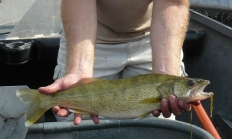
Features: Color varies, but walleye are generally dark olive-brown on top grading to almost white below. Walleye have two well-separated dorsal fins; the first fin has a large black spot at its rear base. The opaque eyes, giving the fish its common name, and canine teeth are other prominent features. Habitat: Walleye are found in the Columbia, Willamette and Snake rivers. In the Willamette River, the walleye fishery is generally limited to the section downstream from Willamette Falls at Oregon City, although a few have been documented as far upstream as Dexter Dam. Walleye prefer large, clean and cold or…

The goal of the Oregon Hatchery Research Center (OHRC) is to answer scientific questions related to fish recovery and hatchery programs. Information gained at the Research Center will help answer questions vital to the success of the Oregon Plan for Salmon and Watersheds and implementation of the Native Fish Conservation Policy. The Oregon Hatchery Research Center is a cooperative research project between the Oregon Department of Fish and Wildlife and the Oregon State University Department of Fisheries and Wildlife.
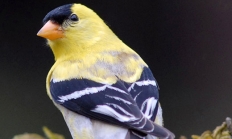
The exuberant bounding flight, musical calls, and flashy yellow and black plumage of the American goldfinch in breeding-season make them one of the most recognized and welcome of Oregon birds. Found in flocks nearly year-round, these goldfinches are a familiar site in riparian woodlands, orchards, weedy fields, and agricultural land. They are among the last of Oregon's songbirds to nest and are highly nomadic in the nonbreeding season. They may form mixed flocks with Lesser goldfinches and Pine siskins at bird feeders and weed patches throughout Oregon, as well as with Common redpolls some years in northeast Oregon. Their diet…
The Columbia Basin Wildlife Areas are a composition of four Oregon Department of Fish and Wildlife (department) managed wildlife areas located along the Columbia River, in the Columbia Basin. The four wildlife areas (Power City, Irrigon, Coyote Springs and Willow Creek) are within the Columbia Plateau ecoregion. Management agreements for these areas were initially established between 1971 and 1977 between the department and Federal agencies which own the lands. The Columbia Basin Wildlife Areas, which total approximately 1,885 acres, provide an important landbase for the conservation and recreation of fish and wildlife within a highly privatized and altered landscape and…

Construction of this facility began in 1924 and production started in 1925 by the state of Oregon. Various renovations have taken place with the most recent being the addition of 4 new fish rearing raceways and improvements to the pollution abatement system which was completed in 2016. Other renovations made throughout the hatchery have utilized the Restoration and Enhancement Program.. The purpose of this facility is to enhance spring Chinook, winter steelhead, summer steelhead, and coho populations for various coastal streams. The facility is used for adult collection, egg incubation and rearing of spring Chinook, fall Chinook, winter steelhead, summer…
The Chisel-toothed kangaroo rat is an intermediate-sized kangaroo rat with a narrow face, small ears, and flat-faced, nearly square-edged lower incisors shaped like miniature chisels. Among kangaroo rats, the cheek pouches in relation to the size of the head are exceptionally large. The pelage on the dorsum is composed of hairs with medium-gray bases, a buffy band, and a tiny blackish tip, overall a dirty-sand color. The venter, upper lip, feet, and base and sides of the tail are white and there is a white spot above each eye and behind each ear. A black moustache, eyelids, ears and tail…

The Steller (or Northern) sea lion is the largest member of the family Otariidae. Among adult females and subadult males, the upper body is slim, whereas in adult males it is heavy and muscular. The head is bearlike with a moderate step between muzzle and forehead. The rear flippers are relatively small and can be turned beneath the body for travel on land. The pelage is light buff to reddish brown, slightly darker in the chest and abdomen. Overall the pelage appears darker when wet. However, beneath the water it appears white, whereas the California sea lion appears black. In…
