Search myodfw.com
Showing 201 - 220 of 897 results


The gregarious Tricolored blackbird is one of North America's most intensely colonial breeders, forming dense, non-territorial, noisy colonies. A highly synchronized nesting system exploits secure nesting locations and rich food supplies that change from year to year. In Oregon, breeding colonies are scattered and intermittent at specific locations, though sites used during consecutive years may be in the same general area. The Tricolored blackbird breeds most consistently in Klamath and Jackson Counties. Small colonies and summering residents have been found in the Willamette Valley; during fall and winter they are rare. Most retreat south to California in winter, while some…

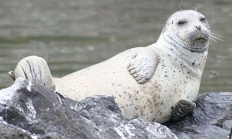
The body of the Pacific harbor seal is plump but tapers to small rear flippers permanently extended posteriorly. The head is large and rounded, the eyes are large, the limbs are short, and the nostrils sit dorsally on the muzzle. The nostrils can be closed when this seal dives. The tongue is notched at the tip. The pelage consists of long overhairs that overlay short underhairs. Markings are extremely variable, but in general the pelage is gray or brownish gray with numerous small spots of black that may coalesce to form splotches. Pacific harbor seals have been observed ashore at…
Following droughts in the 1930s that affected most of North America, major conservation efforts, by both private and governmental entities, were enacted to reverse trends of degrading and disappearing wetlands. During this time period there was a major creation and expansion of federal wildlife refuges and state wildlife areas. As the concept of waterfowl flyway management was endorsed and developed, wildlife areas were acquired and managed as part of a larger plan focused on migratory waterfowl needs. LMWA was one of several wetland-focused wildlife areas established in Oregon. Ladd Marsh Wildlife Area was established in 1949, with primary objectives of…
The American marten is weasel-like with a long body and pointy face. The legs are short; the toes, including the pads, are completely furred; and the nails are semiretractile. The tail is bushy and long. The pelage in winter is luxuriant, with a dense underfur and sparse covering of guard hairs. The color varies, but usually is a golden brown shading to dark brown on the feet and tail; the head is lighter. The throat and chest are splotched with orange or yellow. A small dark stripe extends upward from the medial corner of each eye, giving the appearance of…

Trask River Hatchery was constructed in 1916 to replace an earlier hatchery that was located three miles upstream from the present site. Many improvements have been made to the hatchery since original construction including a new alarm system, early rearing building, and a 40’ x 60’ pole building. Trask Pond was constructed in 1970 and Tuffy Creek was constructed in 1988. The hatchery is used for adult collection, incubation, and rearing of fall and spring Chinook, coho, wild winter steelhead and hatchery winter steelhead.
Willamette Trout Hatchery and the adjacent Oakridge Salmon Hatchery were combined in 1983 and operate today as Willamette Hatchery. The trout hatchery was constructed in 1922 and the salmon hatchery in 1911. The U.S. Army Corps of Engineers (USACE) rebuilt the salmon hatchery in 1952 to mitigate for fishery losses caused by Hills Creek, Lookout Point and the Dexter hydroelectric/flood control projects. The trout side was rebuilt between 1950 and ‘56. Today, Willamette Hatchery is used for adult holding/spawning, egg incubation and rearing of spring Chinook and rainbow trout. In addition, both summer and winter steelhead are reared at this…
The McKenzie River originates in the Cascade Range and empties into the Willamette River near Eugene, which then flows northward into the Columbia River. McKenzie Hatchery was first constructed in 1938 and rebuilt in 1975. Today, 30 rearing ponds, a visitor's center, spawning room, egg incubation facility, office, feed storage, shop area, fish ladder and picnic area are the main components of the facility layout. McKenzie Hatchery is temporarily closed to comply with Oregon Department of Environmental Quality permit conditions. Visitors should be aware that no fish are present in the facilities' production raceways and show ponds. Fish have been…
SNAKE FISHING June 25, 2026 Best bets for weekend fishing Bass and trout can be caught downstream of Hells Canyon Dam. As the weather warms, fishing for bass, perch, and crappie will get good in Hells Canyon Reservoirs Some large crappie are being caught in Brownlee Reservoir Announcements: If your favorite fishing spot is no longer listed It's probably because that river, lake or reservoir is closed for the season, inaccessible due to snow and bad roads, or offers limited fishing opportunities during the winter months. These waterbodies will re-appear in the Recreation Report when they re-open next spring, or…
Find maps, boundary descriptions and the percent public land for the Melrose Unit.
Central Fishing June 25 8, 2026 Best bets for weekend fishing: Still spring Chinook throughout the Hood River. The last day of the season is June 30. Stonefly season is winding down but good reports of nymph fishing on the lower Deschutes Anglers report excellent trout fishing opportunities at Lava and Little Lava Lakes North and South Twin Lakes were stocked this week with trophy rainbow trout. Shevlin Park and Metolius youth and disabled fishing ponds were recently stocked to provide excellent angling opportunities. Anglers report smaller than average (12-16-in) but abundant rainbow trout and 15-in kokanee and good fishing…
Following droughts in the 1930s that affected most of North America, major conservation efforts, both private and governmental, were enacted to reverse trends of degrading and disappearing wetlands. During this time period there was a major creation and expansion of Federal refuges and State wildlife areas. As the concept of waterfowl flyway management was endorsed and developed, wildlife areas were acquired and managed as part of a larger plan focused on migratory waterfowl needs. Klamath Wildlife Area was one of several wetland-focused wildlife areas established in Oregon. KWA was established in 1958, with primary objectives of protecting and improving waterfowl…
The development of the WWA began in 1953 with the acquisition of five parcels of land consisting of 4,400 acres. The Department continued to purchase additional lands, acquiring 1,670 acres in 1954 and another 760 acres in 1955. From 1961 to the present the department has purchased or received another 4,219 acres. The wildlife area currently consists of 12,419 acres owned by the department. In addition, the department, through agreements with the Bureau of Land Management (BLM), manage 1,329 acres within or adjacent to the wildlife area. The WWA was established in response to continuing complaints from landowners concerned with…
Willamette Trout Hatchery and the adjacent Oakridge Salmon Hatchery were combined in 1983 and operate today as Willamette Hatchery. The trout hatchery was constructed in 1922 and the salmon hatchery in 1911. The U.S. Army Corps of Engineers (USACE) rebuilt the salmon hatchery in 1952 to mitigate for fishery losses caused by Hills Creek, Lookout Point and the Dexter hydroelectric/flood control projects. The trout side was rebuilt between 1950 and ‘56. Today, Willamette Hatchery is used for adult holding/spawning, egg incubation and rearing of spring chinook and rainbow trout. In addition, both summer and winter steelhead are reared at this…