
Search myodfw.com
Showing 1161 - 1180 of 1204 results
The Larch Mountain salamander is one of the rarest amphibians in the Pacific Northwest. This small woodland salamander has a reddish-brown or yellow black-spotted stripe along its back and has a pink belly. The Larch Mountain salamander is one of the lungless salamanders that has to breathe through its skin. Mature adults can grow to four inches in total length. This salamander like’s steep basalt talus (piles of volcanic rock fragments). Forested areas are also important because trees block out sunlight, allowing moss to grow on rock piles which keeps the ground damp all year. Larch Mountain salamanders prefer slopes…

Siskiyou Mountains salamanders are similar to Del Norte salamanders, except they are a little shorter, growing to about five-and-a-half inches in total length. An adult salamander is brown with a light brown stripe along the back and a grayish-purple belly. It has light scattered flecks along the body. The Siskiyou Mountains salamander is a lungless salamander and breathes through its skin. Siskiyou Mountains salamanders require talus (rock fragment piles) or rock outcrops in older forests. This salamander retreats deep within rocky crevices that remain cool and moist during the dry summer. Even during the rainy season, Siskiyou Mountains salamanders typically…

Adult clouded salamanders are generally brown with brassy patches on their backs and gray bellies. As salamanders age, the brassy color fades. The clouded salamander is one of the lungless salamander species; they breathe through their moist skin. Mature adults can grow to just over five inches in total length. Clouded salamanders prefer forest habitats or burned areas that provide large decaying logs or stumps. They are often found in Douglas fir trees where they can find burrows in the wood, or spaces just under the bark to hide. They may also hide deep in rock crevices during dry and…
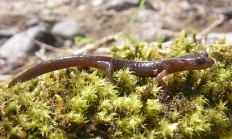
This dark colored salamander has a reddish-brown ragged edged stripe that runs along the top of the head to the tip of the tail with black or dark brown sides. It has a long body and tail and the belly is black with large white flecks. The Oregon slender salamander is a lungless salamander species, relying on its skin to breathe. Mature adults can grow to just under four inches in total length, with females about 12 percent larger than males. Oregon slender salamanders are most common in stable, moist old-growth (late successional and second-growth) forests where there are abundant…

Worldwide, frogs and toads are in trouble because of habitat loss, pollution, pesticides, climate change, diseases, the pet trade and competition from invasive species. Many of Oregon's 12 native species of frogs and toads are listed as Oregon Conservation Strategy Species of concern. Frogs and toads belong to the same animal group but are very different. Toads have dry, rough and bumpy skin covering a wide body while frogs are slender with smooth, moist skin. Frog eyes are higher on the head than toads and are rounder and bulging. And there's a reason we play "leap frog" - frogs take…

Adults have smooth, moist skin that is brown or reddish-brown in color with black flecks on their backs, sides and legs. They may also have a dark colored mask. Adults have red underlegs, hence their name. Females, growing to four inches in length, are almost twice the size of males. Adult red-legged frogs like cool damp coniferous or deciduous forests and forested wetlands. During the non-breeding season, adult frogs spend most of their time on land in woodlands along streams, in moist sedge or brush, along shaded pond edges or under logs and other forest debris. Damp weather permits them…

The drake wood duck is the most colorful of North American ducks. The brown hen has similar features including a crest, distinctive white eye-ring, white belly and purplish-blue iridescence on wing coverts and speculum. Both sexes have a prominent tail that can be a field mark in flight. As their name implies, they are associated with timbered wetlands, nesting in cavities and sometimes even feeding in trees. Hens utter a fairly wide range of un-duck like sounds, but most common is a loud wee-e-e-e-k, wee-e-e-e-k. It is a regular breeder in the Willamette Valley, along slow reaches and backwaters of…

The drake gadwall is a large mostly gray dabbling duck. Adult drakes have a black bill, buff head, gray body, and black upper and lower tail coverts. Hens are nondescript brown ducks with a spotted, yellowish-orange bill with black edges. Gadwalls are unique among dabbling ducks in having a partly white speculum which can be observed in flight. Common vocalizations include the deep, reed-like sounds of the male and the female's quacking, similar to but more nasal and higher pitched than the mallard hen. It is an abundant breeder locally in eastern Oregon and an uncommon breeder in western Oregon…

This foreign visitor is regularly found in Oregon among wintering flocks of American widgeon. Drakes are easily distinguished from American wigeon drakes by reddish brown head, gray flank, and lack of green eye stripe. Hens are similar to American Wigeon hens and difficult to distinguish. The call of the male is a shrill whistling, whe'e you; the female's voice a low purr or croak. It is a rare to uncommon visitant east of the Cascades. Hear the call of the eurasian wigeon Photo by ©Greg Gilson

When mention is made of ducks, many people first think of the mallard. Its ability to tolerate human disturbance and adapt to urban as well as rural habitats make it the Northern Hemisphere's most abundant and widespread waterfowl. Females are mottled-brown, with dark brown stripe through the eye, orange bill with black splotching and have yellowish-orange legs. Immatures resemble adult females until males acquire nuptial plumage usually by mid-November. Males enter the eclipse molt in June and resemble hens until mid-September. Wings of both sexes have a violet-blue speculum bordered in front and behind by a pronounced white stripe. They…

The blue-winged teal is one of Oregon's least common ducks. It is a small, warm-weather duck usually found in Oregon only from late spring until the weather cools in early fall. Except for adult drakes in alternate plumage, blue-wings are difficult to distinguish from cinnamon teal. For that reason its status in Oregon is less clear than that of other ducks. Adult blue-wing drakes have a gray head with white crescent between the eye and bill. Hens and young of both species are nondescript small brown ducks, but show the prominent blue wing-covert patch in flight. It is an uncommon…
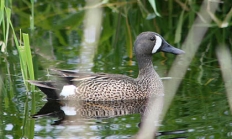
The bright rusty plumage of the male cinnamon teal, a bird of western North America, is a visual delight. In flight, both males and females show powder blue in the wings as they fly fast and low, timed at nearly 60 miles per hour. They weigh only about one pound. They are a common breeder throughout the state except in western Oregon and the high Cascades. They are most common east of the Cascades. Hear the call of the cinnamon teal Photo by Maxine Wyatt
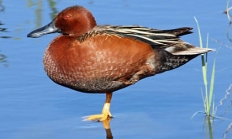
The Northern shoveler's specialized bill earned it in the nickname "spoonbill" among waterfowl hunters. The drake is strikingly handsome with a dark head, white breast, reddish belly, blue wing coverts and an iridescent green speculum. Brown hens also have blue wing patches similar to that of the cinnamon and blue-wing teal. This duck is locally common in summer in eastern Oregon and uncommon in western Oregon. It is a common spring and fall migrant statewide. Hear the call of the Northern shoveler Photo by Kathy Munsel, ODFW

The pintail is a large, long-necked duck of open spaces. The long-tailed, full-plumaged drake is striking with a chestnut head, gray back and flanks, bright white breast and front of neck, and iridescent green bronze speculum. The brown hen is nondescript, but shares the long neck and graceful shape of the drake. Common vocalizations are the two-note flute-like whistle of the drake and harsh gaak, either single or in a series, of the hen. In fall and winter, pintails travel in medium to large flocks. In Oregon, flocks seem to fly exceptional distances in daily foraging and can be seen…

The green-winged teal is the smallest North American dabbling duck. In alternate plumage, green-wing drakes have a cinnamon-colored head with a green eye-stripe, gray back, flanks, and wing with a iridescent green speculum. Hens are brown with a green speculum. This duck is mainly a migrant and winter visitor. It is an uncommon summer resident and breeder in northeastern Oregon and a rare summer resident west of the Cascades. Hear the call of the green-winged teal Photo by Kathy Munsel, ODFW

Although not as imposing as the Canvasback, the redhead is a large, handsome, fast-flying diver. The drake has a red head, black breast and tail coverts, and steel gray back, flanks and tail. Hens are a medium brown. During courtship, the drake utters a very un-duck-like meow. Known for nest parasitism - laying eggs in the nests of other birds, usually other diving ducks - redhead eggs have also been found in the nests of a variety of species. It is an uncommon summer resident in northeast Oregon, but commonly breeds at Batch and Bogus lakes and locally elsewhere in…

Salamanders are a group of tailed amphibians with long bodies and short limbs. They often prefer habitats with damp conditions, which allows them to “breathe” better through their skin. Wet and rainy days (typically late fall through spring in Oregon) are the best time to look for salamanders, as the additional moisture from fog and rain allow for increased surface activity. To find salamanders, look in cracks or search under bark, rocks or logs. If you move any debris during your search, remember to put it back where you found it when you’re done—salamanders are sensitive to disturbance and many…

The Forest Sharp-tailed Snake was recognized as a separate species from the Common Sharp-tailed Snake ( Contia tenuis) in 2010. While these two species closely resemble one another, Forest Sharp-tailed Snakes can be identified by their long tails which have 43-58 subcaudal scales. This secretive species limits most of their activity to the rainy season, preferring to stay underground during dry conditions. Forest Sharp-tailed Snakes occur in southwest portion of the Oregon, where they select mesic environments and can be found in shaded forest habitats and mixed woodlands. Photo by russnamitz, iNaturalist
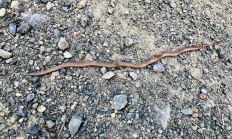
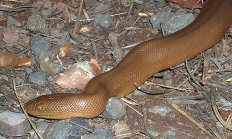
The rubber boa occurs in a variety of habitats, from desert scrub, foothill woodlands, and grasslands through deciduous and coniferous forests. In the Coast Range, it is found commonly in forest clearings that contain rotting stumps and logs. It is absent from the immediate vicinity of the coast north of Coos Bay. Rubber boas are constrictors and eat small mammals, especially young mice and shrews. Photo by Simon Wray, ODFW
Three Mile Falls Dam is located at river mile three on the Umatilla River. The dam was constructed in the early 1900s and serves as an irrigation dam that is a complete barrier to fish migrating upstream. In order to successfully migrate past the dam, all adult salmon and steelhead must use the fish passage facility located on the east side of the dam. The fish facility consists of a fish ladder, viewing window, fish trap and holding pond. Every adult salmon and steelhead heading upstream is counted at this facility using a combination of trapping and video tape enumeration…